
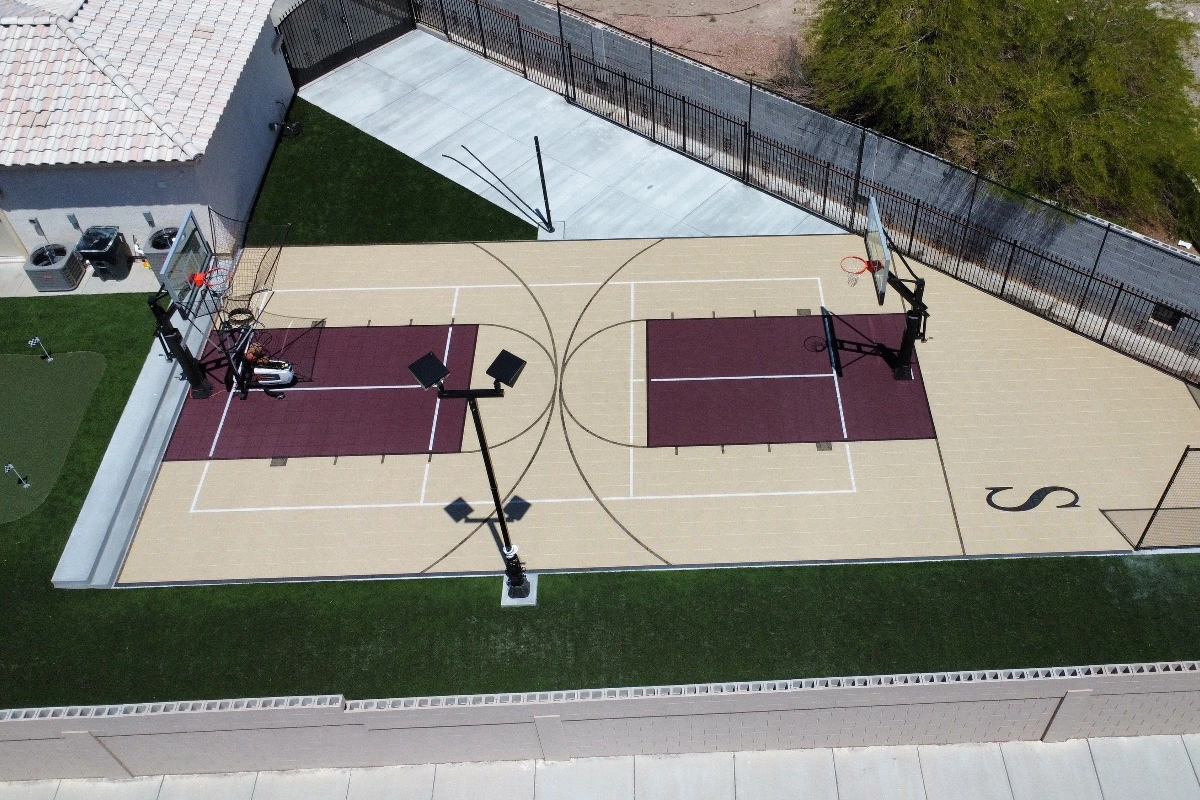
A multi-game court is one of the most practical and popular solutions for homeowners, schools, HOAs, and recreational facilities that want to maximize space while offering multiple sports options in a single area.
Instead of building separate courts for basketball, pickleball, volleyball, or tennis, a multi game court allows all these sports to share one professionally designed athletic surface. This creates a versatile recreational space that supports year-round activity while reducing construction costs and maintenance demands.
A professionally designed multi-game court can become the centerpiece of a backyard entertainment area, school athletic space, or community recreation facility. These courts combine performance, durability, and flexibility while creating an attractive outdoor feature for players of all ages.
A multi-game court is a single athletic surface designed to support multiple sports such as basketball, pickleball, volleyball, and modified tennis layouts.
Instead of dedicating an entire space to one activity, the court uses multiple line markings, flexible equipment systems, and carefully planned layouts to accommodate several recreational options at once.
This design allows families and facilities to maximize functionality without needing separate courts for every sport.
Multi-purpose athletic courts continue to grow in popularity because they save space, reduce construction costs compared to multiple standalone courts, offer year-round recreational use, and improve property value.
For homeowners, a backyard game court creates a family-friendly recreation area that encourages outdoor activity. For schools and HOAs, it creates a flexible shared-use environment that supports multiple programs and activities.
One of the biggest advantages of a multi-purpose game court is flexibility. The court can be customized around the sports and activities most important to the property owner.
Basketball is one of the most common features included in a multi-game court design. Layouts may include full courts, half courts, adjustable hoops, and training-focused recreational spaces.
Basketball integrates especially well with pickleball and volleyball layouts because these sports can share similar court dimensions and open movement areas.
Pickleball is ideal for multi-use courts because it requires less space than tennis and works well alongside basketball layouts.
A basketball and pickleball court combination is one of the most popular residential court designs today because it supports both competitive play and casual family recreation.
Volleyball setups may use portable or fixed net systems depending on the property and intended usage. Many recreational courts include center-court volleyball markings that can be used when needed without interfering heavily with other sports.
Some multi-game courts include modified tennis layouts designed for training, recreational play, or compact residential use.
Because full tennis courts require more space, multi-use courts often use smaller or adjusted layouts rather than regulation-sized tennis dimensions.
Choosing the right surface is one of the most important decisions during the design process. The ideal surface depends on the intended sports, climate conditions, comfort preferences, and maintenance goals.
Acrylic athletic surfacing is one of the most common options for outdoor courts. These systems provide UV resistance, strong traction, custom color flexibility, and long-term durability.
Professional acrylic coatings are specifically designed for outdoor sports performance and work well for basketball, pickleball, volleyball, and other hardcourt activities.
For outdoor courts in Arizona and Nevada, UV-resistant acrylic systems are especially valuable because they help reduce fading and heat-related surface wear.
A modular game court system uses interlocking athletic tiles designed for outdoor recreational use.
These systems provide shock absorption, easy installation, multi-sport flexibility, and relatively low maintenance. Modular tiles are especially popular for backyard courts because they provide comfort while supporting multiple sports.
They also offer excellent drainage and customizable color combinations.
Cushioned athletic surfaces prioritize player comfort and reduced joint impact. These systems are commonly selected for family-focused recreational spaces where comfort and long-term usability are priorities.
Cushioned systems can also help reduce fatigue during extended play sessions.
|
Surface Type |
Best For |
Main Benefits |
Considerations |
|
Acrylic Sports Surfacing |
Outdoor athletic courts |
Traction, UV resistance, durability |
Requires proper base preparation |
|
Modular Tile Systems |
Backyard recreation |
Cushioning, drainage, flexibility |
Different ball bounce feel |
|
Cushioned Athletic Systems |
Family-focused recreation |
Comfort, reduced joint stress |
Higher installation cost |
|
Concrete with Acrylic Coating |
Multi-sport hardcourts |
Long-lasting structure |
Needs resurfacing over time |
|
Asphalt Base Systems |
Recreational courts |
Cost-effective outdoor foundation |
Requires surface coatings |
Professional outdoor recreational court design follows a step-by-step process to ensure durability, performance, and long-term functionality.
Contractors first evaluate available yard space, drainage conditions, intended sports usage, sun orientation, and recreational goals.
Proper planning helps maximize the usable space while ensuring the court remains safe and functional.
A strong foundation is created using concrete or asphalt base systems combined with proper grading and drainage planning.
The base is one of the most important parts of the project because surface performance depends heavily on foundation stability.
Depending on the selected system, acrylic coatings are applied in layers, modular athletic tiles are installed, or cushioned systems are added over the base.
Professional installation ensures proper traction, long-term adhesion, and consistent gameplay performance.
Multiple sports lines are added for basketball, pickleball, volleyball, and any additional recreational activities.
Professional striping is important because too many overlapping lines can create confusion during gameplay.
Final inspections ensure proper traction, accurate line markings, surface consistency, and overall player safety.
Additional features such as lighting, fencing, net systems, or custom graphics may also be installed during this stage.
One court replaces multiple sports areas, allowing homeowners and facilities to maximize available recreational space.
A multi-game court combines several sports into one investment, reducing construction and maintenance costs compared to building separate courts.
These courts support all ages and skill levels, making them ideal for family recreation and outdoor entertainment.
A professionally built court enhances outdoor living appeal, recreational functionality, and overall property value.
Courts can be customized with unique color schemes, branding, sport combinations, decorative borders, and personalized layouts.
Too many overlapping lines can confuse players and reduce the visual clarity of the court.
Each sport still requires a minimum movement and clearance space for safe gameplay.
Using the wrong materials can reduce durability, traction, and overall performance.
Poor drainage leads to standing water, surface deterioration, and reduced court lifespan.
A multi-game court is perfect for backyard entertainment, family recreation, fitness activities, and residential property upgrades.
Shared recreational spaces encourage community engagement and increase the value of neighborhood amenities.
Schools and athletic facilities use multi-purpose courts for physical education programs, sports training, and recreational activities.
A multi-purpose court is an athletic surface designed to support several sports and recreational activities within one space.
A multi-game court is a recreational court that combines multiple sports, such as basketball, pickleball, volleyball, and tennis, into one flexible layout.
The size depends on the sports included, available space, and intended use. Professional layout planning helps determine the ideal dimensions for each property.
Multi-game courts vary greatly in size. Residential courts are typically customized to fit backyard dimensions while maintaining proper clearance space.
The best flooring depends on the sports being played, climate conditions, comfort goals, and maintenance expectations. Acrylic athletic coatings and modular tile systems are among the most popular outdoor options.
Please Provide Your Contact Information and Project Details