
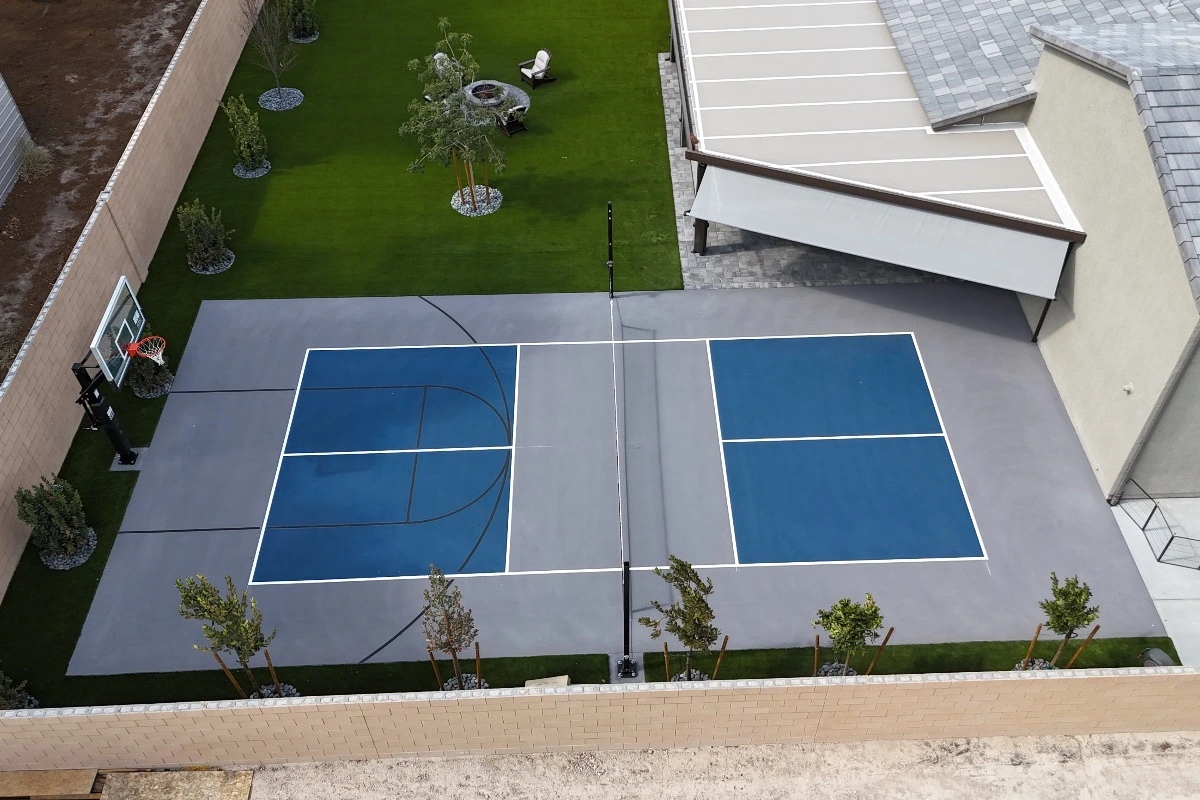
If you’re planning to build a pickleball court, one of the first and most important questions is: what are the correct single pickleball court dimensions?
Whether you are designing a backyard court, HOA facility, school recreation area, or professional game court, understanding the exact measurements is essential for proper gameplay, safety, and long-term usability.
A poorly sized court can create several problems, including limited movement space, incorrect gameplay experience, safety concerns, and reduced court performance. Proper sizing ensures players can move comfortably, react naturally, and enjoy the court the way the game was intended to be played.
This guide explains everything you need to know about pickleball court size, clearance recommendations, layout planning, backyard installation considerations, and common sizing mistakes.
The official standard pickleball court dimensions are 20 feet wide by 44 feet long.
These dimensions apply to both singles and doubles play. Unlike tennis, pickleball uses the same court size regardless of the number of players on the court.
This standardized layout allows recreational and competitive players to enjoy consistent gameplay across residential, community, and tournament courts.
A properly sized court ensures accurate ball placement, balanced movement, and realistic gameplay performance.
A complete pickleball court layout includes several important zones that must be marked accurately.
These include:
Each section of the court plays a specific role in gameplay strategy and movement. Proper striping is critical because even small measurement errors can affect gameplay consistency.
Professional court builders use precise measurements to ensure every line and zone matches official standards.
The non-volley zone extends 7 feet from the net on both sides of the court.
This area is one of the most important parts of pickleball because players cannot volley while standing inside it. The kitchen helps control gameplay strategy and prevents aggressive net dominance.
Because the kitchen affects nearly every rally, the dimensions and striping must be exact. Incorrect measurements can change the way the game feels and negatively affect competitive play.
The kitchen line must also remain highly visible so players can easily judge their position during fast exchanges.
Although the actual court measures 20 feet by 44 feet, additional clearance space is required around the court perimeter.
The minimum recommended total area for a residential or recreational court is approximately:
This extra pickleball court clearance space allows players to move safely during gameplay without immediately reaching fencing or obstacles.
Proper buffer zones improve comfort, safety, and overall court functionality.
For a more professional playing experience, many builders recommend approximately:
This larger layout is commonly used for HOA courts, recreational facilities, athletic complexes, and high-traffic backyard courts.
The additional space allows smoother player movement, safer recovery shots, and a more tournament-style playing environment.
|
Court Type |
Court Size |
Recommended Total Space |
Best For |
|
Basic Residential Court |
20′ x 44′ |
30′ x 60′ |
Compact backyard use |
|
Recreational Court |
20′ x 44′ |
32′ x 62′ |
HOA and casual community courts |
|
Professional-Style Court |
20′ x 44′ |
34′ x 64′ |
Competitive and high-use facilities |
|
Compact Multi-Use Court |
Variable |
Space-dependent |
Shared basketball and pickleball layouts |
|
Backyard Training Court |
Reduced clearance |
Custom layout |
Limited residential spaces |
A single pickleball court is one of the most space-efficient court options available. Compared to tennis, pickleball requires far less space, making it easier to integrate into residential properties.
A typical backyard pickleball court size works well in medium-sized residential yards, HOA common areas, side-yard conversions, and recreational outdoor spaces.
Many homeowners are surprised to learn that a pickleball court can often fit into areas where a full basketball or tennis court would not.
Even smaller properties can often accommodate pickleball through smart design planning. Professional builders may recommend compact layouts, modular court systems, efficient fencing placement, or multi-use configurations that combine basketball and pickleball into one recreational area.
Professional planning is especially important when dealing with limited backyard dimensions or irregular property shapes.
Most professional courts use acrylic athletic coatings because they provide consistent ball bounce, strong outdoor durability, UV resistance, and slip-resistant traction.
Acrylic systems are popular for both residential and commercial courts because they create a reliable and familiar playing surface.
For outdoor courts in Arizona and Nevada, UV-resistant acrylic coatings help reduce fading and weather-related deterioration.
Modular athletic tile systems are also popular for residential installations because they provide shock absorption, easy maintenance, and multi-sport flexibility.
These systems can work especially well for backyard recreation spaces where comfort and versatility are priorities.
Some homeowners choose modular tiles for courts that combine pickleball with basketball or other activities.
A smaller-than-recommended court can negatively affect gameplay in several ways. Players may experience restricted movement, more frequent collisions near fencing, and reduced safety during fast-paced rallies.
Without proper clearance space, players may hesitate during shots because they are worried about running into obstacles.
Improper sizing may also reduce gameplay quality. Players can experience inconsistent shot recovery, shorter rallies, awkward positioning, and a less realistic pickleball experience overall.
Even though the court itself may technically fit, the surrounding space is equally important for proper play.
One of the biggest mistakes is building only the 20-foot by 44-foot playing area without adding sufficient clearance around the court.
The extra space is critical for movement, safety, and realistic gameplay.
Fences placed too close to the court reduce playability and may create safety hazards. Players need enough room to move comfortably near the sidelines and baselines.
Many homeowners later decide they want basketball hoops, volleyball systems, or additional recreational functionality. Planning for multi-use features during the design stage helps avoid expensive changes later.
Improper court orientation may create sun glare issues during outdoor play. Professional builders typically evaluate sun positioning to improve player visibility and comfort.
Correct sizing ensures smooth rallies, natural movement, balanced competition, and a more authentic pickleball experience.
Players notice the difference immediately when a court feels too cramped or improperly laid out.
Adequate clearance space helps reduce trip hazards, fence collisions, and player injuries. This is especially important for recreational facilities and high-use community courts.
A professionally built court increases backyard functionality, recreational appeal, and overall property value. For many homeowners, a custom pickleball court becomes one of the most-used outdoor features of the property.
A properly designed court also improves long-term durability and helps preserve the appearance of the space.
The official size of a pickleball court is 20 feet wide by 44 feet long. This applies to both singles and doubles play.
Singles and doubles offer different playing experiences. Singles requires more movement and endurance, while doubles focuses more on teamwork and strategy. Most recreational pickleball is played as doubles.
Skinny singles is a modified version of pickleball played on a reduced portion of the court. Different variations exist, but it is typically used for practice or training rather than official competition.
There are no separate dimensions for singles pickleball. Official singles and doubles games both use the standard 20-foot by 44-foot court size.
Single court pickleball refers to gameplay taking place on one dedicated pickleball court rather than multiple courts or shared court systems.
Please Provide Your Contact Information and Project Details