
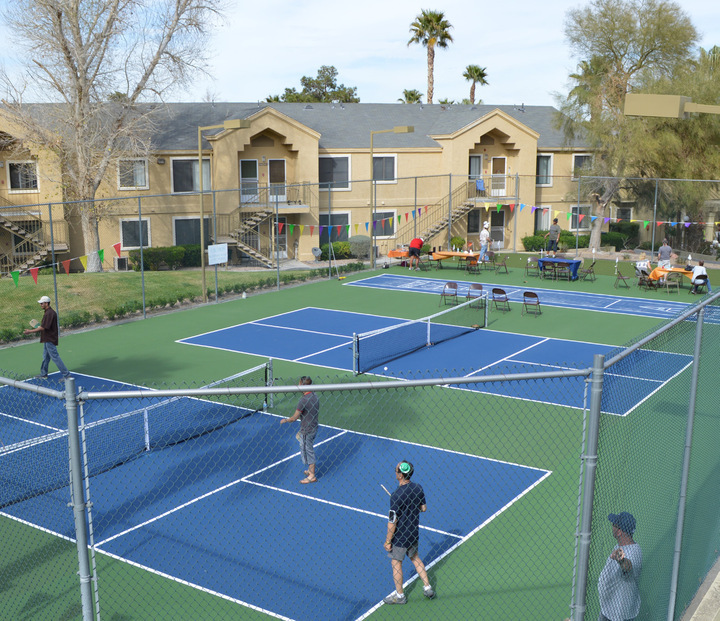
While tennis is a more familiar and widely-known game, with international championships, well-known athletes, and worldwide participation, its ‘sister sport’, pickleball, is quickly growing in popularity. While it may sound whimsical, pickleball is fast-growing and has its own unique appeal.
What is pickleball, and how is it different from tennis? Who should be interested in this creatively-named sport? Read more to find out.
A standard tennis court is about 78 feet in length and 27 feet wide for singles matches, extending to 36 feet wide for doubles. The net is placed at a height of 3.5 feet at the post and 3 feet in the center. Tennis courts can be made of grass, clay, or other hard surfaces, each surface impacting the tennis ball’s speed and bounce.
A pickleball court is smaller than a tennis court, about the size of a badminton court. A pickleball court measures 44 feet in length and 20 feet in width. The net’s height is 34 inches at the center. Pickleball courts can be many different surface types, including acrylic, concrete, and specialty rubber/plastic courts, providing a hard, even surface.
When playing tennis, players use a tennis racquet, which is strung and can be up to 29 inches long. The tennis ball is made of felt-covered rubber, pressurized to bounce effectively on the court. In contrast, pickleball uses a solid paddle, often made of wood, composite, or graphite, and it’s smaller than a tennis racquet. The ball is similar to a wiffle ball, with holes that affect its bounce and movement.
Tennis uses a unique scoring system, with points awarded in sequences of 15, 30, and 40 before reaching a game. A match is typically played in best-of-three or best-of-five sets, with each set requiring a player to win at least 6 games with a margin of 2 games. Pickleball utilizes a straightforward point system. The first team or player to reach 11 points with a lead of at least 2 points wins the game. Matches are often played best out of three games.
When playing tennis, the person serving stands behind the baseline, serving diagonally into the opponent’s service box. Players get two serves to start a point. If both serves fail, it’s a double fault, and the opposing player wins the point. In pickleball, serving is exclusively underhand, and it must clear the no-volley zone, landing in the diagonal service box. Players get only one serve attempt, and double faults don’t exist.
Tennis is known for its powerful serves, volleys, and groundstrokes. Players often use spin, slice, and topspin to maneuver their opponents and win points. Due to the smaller court and wiffle ball, pickleball focuses on strategy over power. The no-volley zone (or “kitchen”) prohibits players from smashing the ball while inside this area, emphasizing placement and strategy
Tennis and pickleball are both uniquely exciting sports, each offering different opportunities to showcase strategy and athleticism. While tennis has a longstanding history and international acclaim, pickleball’s rising popularity showcases its accessibility and fun. Whether you’re an athlete or a sports enthusiast, understanding these distinctions can only enrich your appreciation for these games. Choose your sport, grab your racquet or paddle, and meet up with a friend to play!
Both sports can be played on a variety of court surfaces. Each surface affects the speed, comfort, and maintenance of the game:
At Legendary Sports Construction, we specialize in custom court builds for both tennis and pickleball, providing durable and professional-level surfaces that suit your play style.
| Feature | Tennis | Pickleball |
|---|---|---|
| Court Dimensions | 78’ x 27’ (Singles), 78’ x 36’ (Doubles) | 44’ x 20’ |
| Net Height | 36″ at center | 34″ at center |
| Ball Type | Pressurized felt ball | Plastic wiffle ball with holes |
| Racket/Paddle | Strung racket (27–29 in) | Solid paddle (up to 17 in) |
| Skill Level | Moderate to advanced | Beginner to advanced |
| Movement | More lateral and baseline coverage | Compact, net-focused play |
| Serving Style | Overhand, two tries allowed | Underhand, one attempt |
| Scoring System | 15–30–40–game, best of 3 or 5 sets | First to 11, win by 2, best of 3 |
| Game Duration | 1–3 hours (competitive match) | 10–25 minutes per game |
| Popularity Growth | Global and established | Fastest-growing sport in the U.S. |
Pickleball has exploded in popularity—with over 8.9 million players in 2023. Cities like Scottsdale, AZ, and Nashville, TN have seen huge increases in demand for both public and private pickleball courts. As more real estate developments, HOAs, and sports facilities recognize this trend, pickleball courts are now a must-have amenity.
If you’re deciding which sport to feature at your home, club, or park:
Pickleball is played on a smaller court with paddles and a plastic ball, making rallies shorter and gameplay slower than tennis.
Both are great for fitness, but pickleball is easier on the joints and ideal for all ages, while tennis provides a more intense full-body workout.
Tennis requires more running, strength, and endurance due to its larger court and faster-paced rallies.
Yes! Tennis players often adapt quickly to pickleball since both share similar strokes, footwork, and strategies.
No, pickleball is generally slower, but it still offers quick reflex action and fast-paced exchanges near the net.
Whether you’re a sports club, HOA, or homeowner, Legendary Sports Construction can design and install the perfect tennis or pickleball court for your property.
Contact us today for a free consultation on custom sports court construction.
Please Provide Your Contact Information and Project Details