
Sport Court products only available in Nevada.
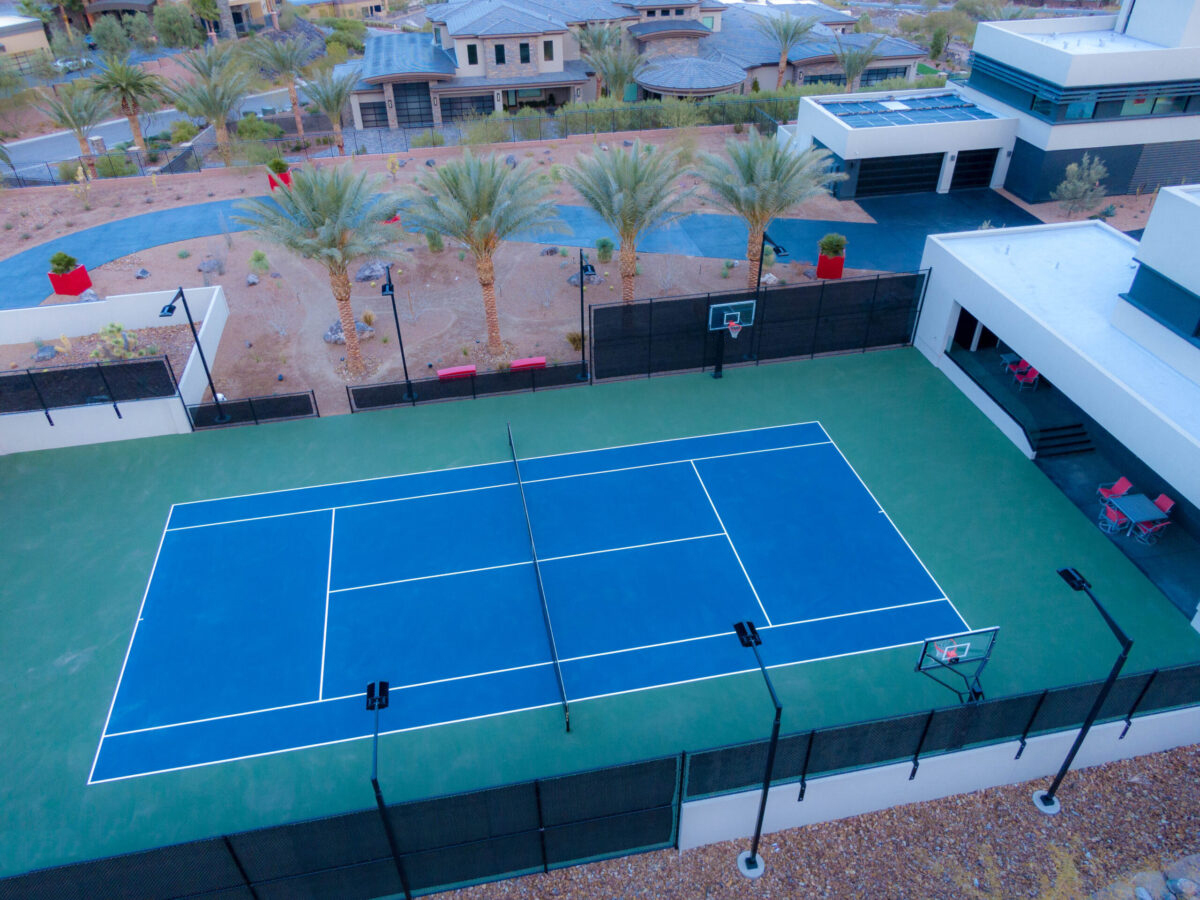
Acrylic tennis courts are one of the most popular and versatile court types in the world. Known for their consistent ball bounce, excellent traction, and long-term durability, acrylic surfaces are trusted by professional tournaments, clubs, and residential property owners alike. In Glendale, Arizona—where heat, sun exposure, and seasonal weather changes place heavy demands on outdoor surfaces—acrylic tennis courts offer a reliable, high-performance solution.
Legendary Sports Construction specializes in acrylic tennis court construction in Glendale, AZ for private residences, HOAs, schools, and commercial facilities. Each court is engineered for performance, safety, and longevity, with materials and construction methods specifically suited to Arizona’s climate.
Whether you’re building a new private court or adding a professional-grade surface to a shared facility, acrylic tennis court construction delivers a balance of playability, aesthetics, and durability.
Acrylic is a hard-court surface that provides predictable performance across all levels of play. It is the same surface category used at many professional tournaments, making it familiar and comfortable for recreational players and competitive athletes alike.
One of the biggest advantages of acrylic tennis courts is consistency. The surface provides uniform ball bounce, reliable footing, and minimal surface variability. This allows players to focus on technique, movement, and strategy rather than adjusting to unpredictable conditions.
In Glendale’s desert environment, acrylic courts are especially effective. When installed over a properly prepared base, acrylic systems resist cracking, fading, and surface breakdown caused by extreme heat and sun exposure.
The acrylic surface is the defining feature of this court type. Multiple layers of acrylic coating are applied over a stable base to create a smooth, textured finish that balances traction and speed.
This surface allows for:
The texture of the acrylic coating can be adjusted to fine-tune court speed, making it suitable for both casual and competitive play.
While regulation tennis courts measure 78 feet by 36 feet (doubles), residential and community installations often require customization.
Acrylic tennis court construction allows for:
Proper spacing around the court is also planned for safety, ball retrieval, and spectator movement.
Acrylic tennis courts are designed to withstand heavy use and harsh outdoor conditions. The materials resist UV damage, moisture intrusion, and surface wear when properly installed and maintained.
In Glendale, where temperature swings and sun exposure are constant factors, durability is critical. Professional construction ensures the court maintains structural integrity and surface performance year after year.
A complete acrylic tennis court includes more than just the playing surface. Professional installations often include:
Each component is installed to align precisely with the court layout and meet performance standards.
Acrylic tennis courts are highly customizable. Homeowners and facilities can choose from a wide range of color combinations for playing areas, out-of-bounds zones, and line markings.
Custom color schemes enhance visibility, reduce glare, and allow the court to complement surrounding landscaping or architecture.
| Surface Type | Play Style | Maintenance | Durability | Best Use |
| Acrylic Hard Court | Consistent, medium-fast | Low | High | Residential & commercial |
| Clay Court | Slower, high bounce | High | Medium | Clubs, specialty courts |
| Synthetic Grass | Cushioned, moderate | Moderate | Medium | Multi-use or comfort-focused |
This comparison highlights why acrylic is the most common choice for long-term, low-maintenance tennis courts.
Acrylic tennis courts provide a wide range of benefits for both property owners and players.
They deliver a professional-grade playing experience with consistent ball response and predictable footing. This makes them ideal for training, recreational play, and competitive matches.
From a maintenance standpoint, acrylic courts are relatively low-maintenance compared to clay or grass surfaces. Routine cleaning and periodic resurfacing keep the court performing well without intensive upkeep.
Acrylic courts also enhance property value and usability. For residential properties, they add a premium recreational feature. For community or commercial facilities, they support organized play, lessons, and events.
Every project begins with a detailed site evaluation. Property size, soil conditions, drainage requirements, and intended use are assessed to determine the ideal court layout and construction approach.
Design considerations include court orientation, color selection, fencing needs, and optional lighting.
Proper site preparation is critical for long-term performance. The area is graded and compacted, and drainage systems are installed to prevent water pooling beneath the court.
This step ensures a stable foundation and reduces the risk of cracking or surface movement.
Acrylic surfaces are typically installed over asphalt or post-tension concrete bases. The base is constructed to precise tolerances to ensure a smooth, level surface for coating application.
Multiple layers of acrylic coating are applied to build texture, color, and performance. Each layer is carefully cured to ensure durability and consistent play characteristics.
Court lines are painted according to regulation dimensions or custom layouts. Nets, fencing, and lighting systems are installed and aligned for optimal play.
The project concludes with a final inspection to confirm safety, surface quality, and play readiness.
Acrylic tennis courts are well-suited for both residential and commercial environments.
Residential acrylic tennis courts focus on customization, aesthetics, and family-friendly play. Compact layouts and custom colors are common.
Commercial and community courts are designed for higher traffic and may include reinforced bases, fencing, and lighting to support frequent use.
Professional builders tailor each court to its intended application.
Acrylic tennis courts use layered acrylic coatings applied over asphalt or concrete bases to create a textured, durable playing surface.
Acrylic hard courts are widely considered the best all-around option due to durability, consistency, and low maintenance.
Acrylic courts are hard surfaces with consistent bounce, while synthetic courts often include cushioned layers or turf-like systems for added comfort.
Costs vary by site and materials, but acrylic courts over asphalt bases are typically the most cost-effective long-term option.
Acrylic hard courts are considered the toughest on the body due to their firmness, which is why proper footwear and conditioning are important.
An acrylic tennis court is a long-term investment in performance, recreation, and property value. With professional design, durable materials, and precise installation, acrylic courts deliver reliable play in Glendale’s demanding outdoor environment.
For homeowners, HOAs, and facilities seeking expert acrylic tennis court construction in Glendale, AZ, professional builders ensure a court that looks great, plays consistently, and stands up to years of use—ready for peak performance every time you step on the court.
| Hardwood Type | Performance | Durability | Moisture Resistance | Best Use |
| Solid Maple Hardwood | Elite, professional | Very High | Moderate | Gyms, high-performance courts |
| Engineered Hardwood | Excellent, stable | High | High | Home courts, variable climates |
| Cushioned Hardwood System | Elite + joint protection | Very High | Moderate | Training & competitive facilities |
This comparison helps determine the best hardwood system based on performance needs and environmental conditions.
Hardwood basketball courts deliver unmatched benefits across performance, longevity, and aesthetics.
Players enjoy a professional-grade playing experience with consistent ball bounce and dependable traction. The natural shock absorption of wood reduces strain on joints, making hardwood ideal for frequent play.
From a durability perspective, properly installed and maintained hardwood floors can last decades. Individual boards can be sanded and refinished multiple times, extending the life of the court without full replacement.
Hardwood also enhances property value. In residential settings, it transforms a home gym into a premium athletic space. In commercial environments, it elevates the facility’s appeal and usability.
Every hardwood court begins with a detailed consultation. The space is evaluated for dimensions, ceiling height, structural considerations, and intended use.
Based on these factors, the appropriate hardwood type, court layout, and finishing system are selected to ensure optimal performance.
Subfloor preparation is critical for hardwood performance. The foundation must be level, stable, and moisture-controlled.
This step may include:
Proper preparation ensures the hardwood remains stable and responsive over time.
Hardwood planks are installed using tongue-and-groove or interlocking systems designed for athletic use. Each board is precisely aligned to maintain uniformity and structural integrity.
Installation methods vary depending on whether the system is solid maple or engineered hardwood.
Once installed, the court is sanded, sealed, and finished. Court lines, keys, and logos are painted according to regulation or custom specifications.
A protective finish is applied to enhance traction, protect the wood, and deliver a polished appearance.
Basketball hoops, backboards, and any additional equipment are installed and aligned with the court layout.
The process concludes with a comprehensive inspection to confirm safety, aesthetics, and play-ready performance.
Hardwood basketball courts are suitable for a wide range of applications.
Residential hardwood basketball courts are often installed in home gyms or detached structures. These courts prioritize performance, aesthetics, and family-friendly play while fitting within available space.
Commercial and institutional courts—such as schools, gyms, and recreation centers—require heavier-duty systems designed for constant use. These installations often include cushioned subfloors and reinforced finishes.
Professional installation ensures each court meets the demands of its environment.
Maple hardwood is the industry standard due to its strength, consistency, and performance. Engineered maple is also popular for added stability.
In basketball, “hardwood” refers to the traditional wooden playing surface used for indoor courts, known for consistent bounce and professional performance.
Yes. NBA courts are constructed from high-quality maple hardwood and are assembled and refinished regularly for peak performance.
Indoor courts typically use maple hardwood or engineered hardwood systems. Outdoor courts use acrylic or modular surfaces instead.
Most basketball courts use maple due to its durability, hardness, and predictable performance.
A hardwood basketball court is more than flooring—it’s a commitment to performance, quality, and long-term value. From private home gyms to professional training facilities, hardwood delivers an unmatched playing experience that stands the test of time.
With expert design, precision installation, and premium materials, a hardwood basketball court transforms any indoor space into a professional-grade athletic environment built for years of play.
Please Provide Your Contact Information and Project Details