
Sport Court products only available in Nevada.
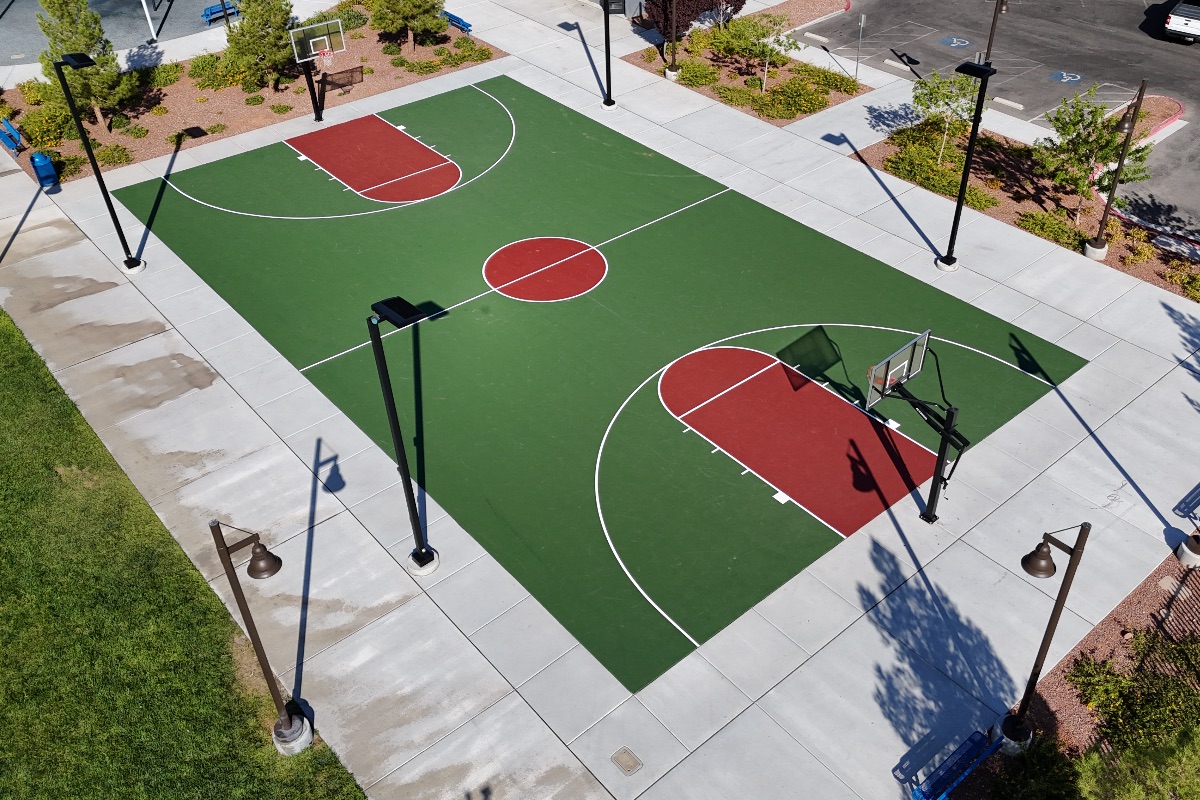
Installing a basketball court is more than a construction project—it’s an investment in recreation, fitness, and long-term property value. Whether envisioning a sleek indoor court or a backyard half-court, knowing where your money goes ensures smarter budgeting and smoother execution.
At Legendary Sports Construction, each project begins with transparency. Our experts break down every element—from excavation and surfacing to accessories and finishing details—so you can make informed decisions. Costs vary widely based on court type, materials, and complexity, but understanding the core components helps you create a plan that fits your goals and your finances.
The size of your basketball court is the most influential cost factor. A half-court typically requires fewer materials, less labor, and smaller land preparation compared to a full-sized court. However, scaling up involves more than doubling expenses; it multiplies the need for reinforced foundations, additional surfacing, and extended fencing or lighting.
Residential courts often measure around 30×30 feet for half-courts, while regulation full-courts span 94×50 feet. Each additional square foot adds incremental costs for materials, paint, and finishing work—so clarity on your desired size from the start helps refine your budget accurately.
Proper groundwork defines the longevity of your court. The site must be leveled, graded, and stabilized before any surface is laid. Excavation, drainage installation, and compaction prevent water accumulation and surface shifting.
Base material selection plays a major role:
Each of these factors contributes significantly to the overall basketball court installation cost and determines how much maintenance your court will need in the future.
Once the foundation is ready, it’s time to choose the surface—the heart of playability. Each type offers distinct advantages and cost ranges:
Add-ons such as custom logos, multi-sport striping, premium color schemes, or UV-protected coatings can elevate aesthetics but will modestly increase total cost.
Accessories turn a basic court into a dynamic sports environment. Premium hoops, backboards, lighting systems, fencing, and even spectator seating add to both functionality and enjoyment.
Common add-ons include:
These upgrades are optional but often enhance long-term satisfaction and overall property value.
|
Court Type |
Surface Material |
Durability |
Maintenance |
Cost Range |
Ideal Use |
|---|---|---|---|---|---|
|
Concrete with Acrylic Coating |
Reinforced Concrete + Acrylic Layers |
High |
Low |
$25,000–$60,000 |
Residential Homes, Private Clubs |
|
Asphalt with Acrylic Coating |
Asphalt Base + Acrylic Finish |
Moderate |
Moderate |
$15,000–$40,000 |
Schools, Community Parks |
|
Modular Tile System |
Interlocking Polypropylene Tiles |
High |
Very Low |
$30,000–$75,000 |
Indoor Gyms, Multi-Sport Facilities |
|
Post-Tension Concrete |
Steel-Reinforced Concrete Slab |
Exceptional |
Very Low |
$50,000–$100,000+ |
Professional & Tournament Facilities |
Cost Indicator: $ = lower budget, $$ = higher budget. Actual pricing depends on site conditions, material selection, and regional labor rates.
Basketball court installation costs vary dramatically based on project scale and materials. Here’s a general overview to guide your expectations:
In general, concrete with acrylic surfacing offers the best balance of cost, performance, and durability for outdoor projects, while modular tile systems are ideal for multi-use indoor facilities.
Knowing what each component costs helps avoid budget overruns. Accurate estimates ensure you allocate funds for essentials—like drainage and base work—while leaving room for upgrades.
Understanding cost ranges allows you to weigh performance against price. Higher-end materials like post-tension concrete or modular tile systems deliver longevity and superior performance, while asphalt or basic acrylic coatings provide affordability.
Defining the project scope early helps you determine what features truly matter—whether you need full lighting systems or simply a regulation half-court with a single hoop.
Cost awareness helps establish realistic timelines. Larger budgets often require longer planning and construction phases, while smaller residential projects can be completed swiftly.
A professionally built basketball court is more than an amenity—it’s an investment. Quality construction not only ensures years of play but also enhances property appeal and resale potential.
Legendary Sports Construction brings unmatched expertise to basketball court projects of all sizes. From site preparation and base installation to surfacing and finishing, we oversee every phase with precision and transparency.
Our approach is rooted in craftsmanship and communication. We provide detailed cost breakdowns before construction begins, so clients know exactly where every dollar goes. We tailor every project—whether it’s a backyard half-court or a professional training facility—to balance performance, longevity, and aesthetic excellence.
With a commitment to engineering integrity and long-term client satisfaction, we deliver courts that perform flawlessly and endure for decades.
Costs depend on size, surface, and features. Residential half-courts start around $8,000–$30,000, while full courts range from $20,000–$75,000+ depending on customization.
A regulation full-size court (94×50 feet) typically costs $60,000–$100,000 or more, depending on materials, accessories, and lighting.
An asphalt surface with acrylic coating is the most budget-friendly option, offering reliable performance and durability at a lower cost than concrete or modular systems.
Professional line striping averages $1,000–$3,000, depending on complexity, surface type, and whether multi-sport markings are added.
The final price depends on location, surface material, and added features. Expect $4–$16 per square foot for outdoor courts, with higher costs for premium indoor builds.
A basketball court is an investment in lifestyle, fitness, and lasting value. With Legendary Sports Construction, every project is built on transparency, craftsmanship, and enduring quality—ensuring your court performs beautifully, year after year.
Please Provide Your Contact Information and Project Details