
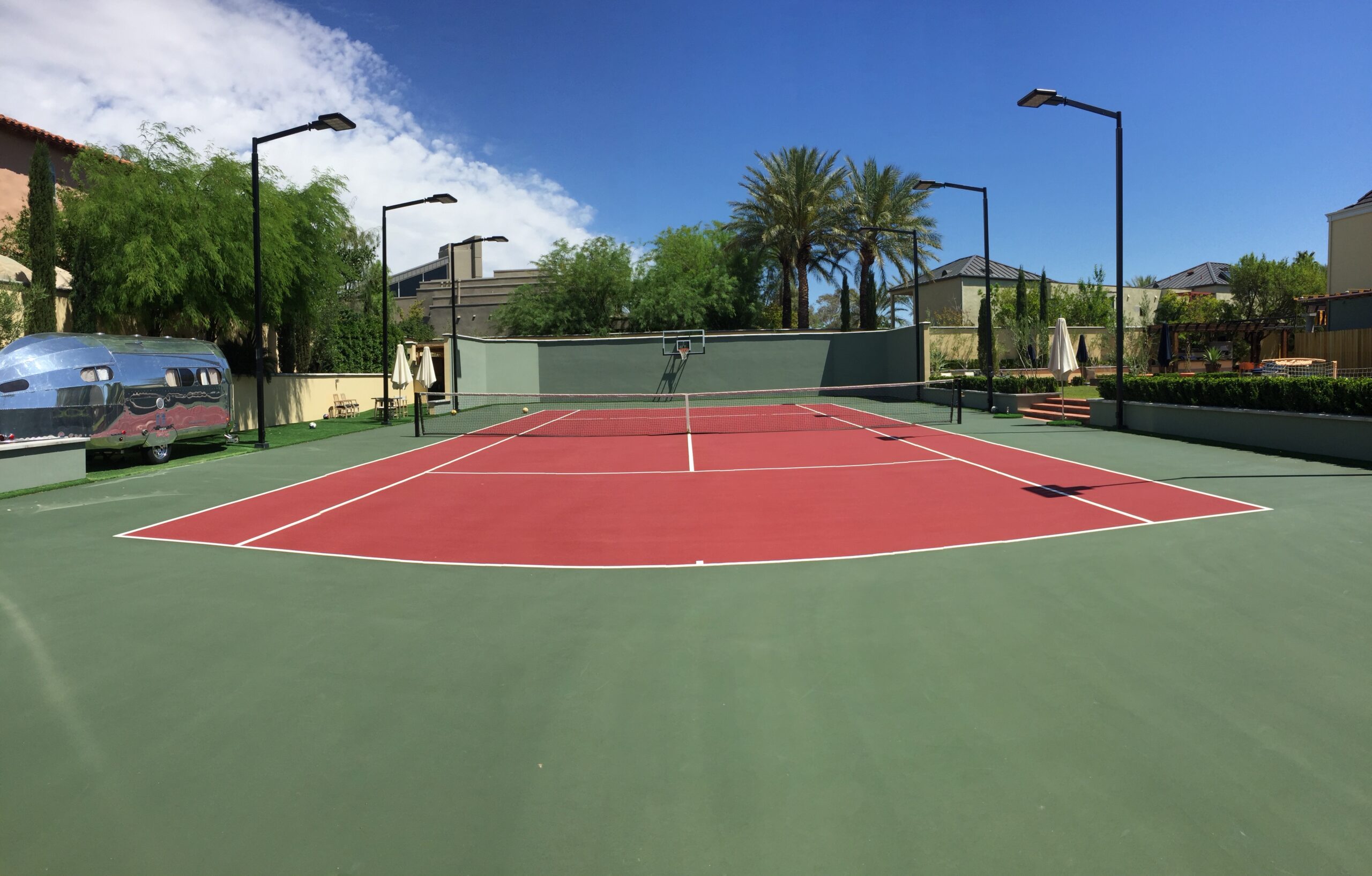
Choosing between a clay court and a hard court is one of the most important decisions when planning or upgrading a tennis facility. The surface you select directly impacts ball speed, player movement, injury risk, maintenance requirements, and overall user satisfaction.
Both clay and hard courts are proven, widely used tennis surfaces—but they serve different purposes. At Legendary Sports Construction, we help facility owners, clubs, schools, and private clients evaluate tennis court surface comparison factors such as climate, player demographics, usage intensity, and long-term maintenance expectations before making a recommendation.
If you’re weighing a clay tennis court vs hard court, understanding how each surface behaves in real-world conditions is the key to making the right investment.
Clay courts are constructed using crushed brick, stone, or shale, topped with a loose granular layer. This surface is softer than hard courts and requires consistent grooming to maintain playability.
Key characteristics include:
Clay courts are commonly associated with traditional European tennis facilities and professional tournaments focused on endurance and strategy.
Clay courts significantly alter how tennis is played. The surface absorbs energy, causing the ball to slow down and bounce higher. This favors baseline rallies, topspin-heavy shots, and patient point construction.
Gameplay effects include:
For training environments, clay courts are often valued for teaching consistency, stamina, and tactical play.
Hard courts are built on a solid base—typically concrete or asphalt—finished with acrylic coatings that provide texture, color, and traction. This creates a firm, uniform playing surface.
Key characteristics include:
Hard courts are the most common tennis surface worldwide, used in public parks, schools, clubs, and professional tournaments.
Hard courts produce a faster, more direct style of play. The ball maintains more of its speed after impact, and bounce height is consistent across the court.
Gameplay effects include:
Because of their versatility, hard court tennis surfaces are suitable for beginners, recreational players, and competitive athletes alike.
| Feature | Clay Court | Hard Court |
| Ball Speed | Slower | Faster |
| Bounce Height | Higher | Lower and consistent |
| Player Movement | Sliding common | Quick stops and starts |
| Joint Impact | Lower | Higher |
| Maintenance | High | Moderate |
| Climate Sensitivity | Affected by rain and wind | Performs well in most conditions |
| Ideal For | Training, endurance, strategy | Recreational and competitive play |
Clay courts offer unique advantages that make them appealing for certain facilities and player groups.
The forgiving nature of clay helps reduce impact on knees, ankles, and hips, making it popular with older players and high-volume training environments.
Slower ball speed promotes patience, shot placement, and tactical thinking rather than pure power.
In hot climates, clay courts tend to remain cooler than hard courts, improving comfort during extended play.
Many coaches prefer clay courts for developing consistency, footwork, and match endurance.
Clay courts offer a traditional aesthetic that many players associate with high-level tennis culture.
Hard courts are widely chosen for their practicality, performance consistency, and versatility.
Hard courts provide uniform bounce across the surface, which helps players develop timing and confidence.
Compared to clay, hard courts require significantly less daily upkeep—no rolling, watering, or resurfacing between matches.
From beginners to advanced competitors, hard courts accommodate a wide range of skill levels and play styles.
Hard courts can be adapted for pickleball, basketball, or other sports, making them ideal for shared recreational facilities.
With routine cleaning and periodic resurfacing, hard courts offer excellent longevity and predictable maintenance costs.
Legendary Sports Construction follows a structured approach to ensure every tennis court surface performs as intended.
We assess location, climate, player demographics, and usage goals to recommend the most suitable surface.
Proper grading, drainage, and foundation work are critical for both clay and hard court longevity.
We install clay layering systems or apply acrylic hard court surfaces with precision and consistency.
Regulation line markings, net posts, and accessories are installed to meet official standards.
Every court undergoes performance, safety, and surface consistency checks before completion.
Clay courts are often considered challenging because they require patience, endurance, and advanced footwork. The slower pace and sliding movement can be difficult for players accustomed to faster surfaces.
The main differences are ball speed, bounce height, movement style, and maintenance. Clay courts slow the game and reduce joint impact, while hard courts offer faster play and lower daily maintenance.
It depends on the player. For aggressive, power-based players, clay can feel more demanding. For strategic players who enjoy longer rallies, clay may feel more forgiving.
Key advantages include reduced joint stress, longer rallies, cooler playing temperatures, and strong training benefits for endurance and consistency.
Tennis balls are generally the same, but on clay courts, balls tend to pick up surface material and wear differently, while on hard courts, they maintain a cleaner surface and faster bounce.
When choosing between a clay tennis court and a hard court, there is no single “best” option; instead, it’s about finding the right fit for your facility’s goals. Clay courts are ideal for training environments and traditional tennis settings, while hard courts provide versatility, durability, and appeal to a broader range of players.
Legendary Sports Construction specializes in outdoor tennis court surfaces, helping clients select and install solutions that strike a balance between performance, maintenance, and long-term value. If you are planning a new court or considering surface upgrades, we are here to guide you every step of the way.
Please Provide Your Contact Information and Project Details