
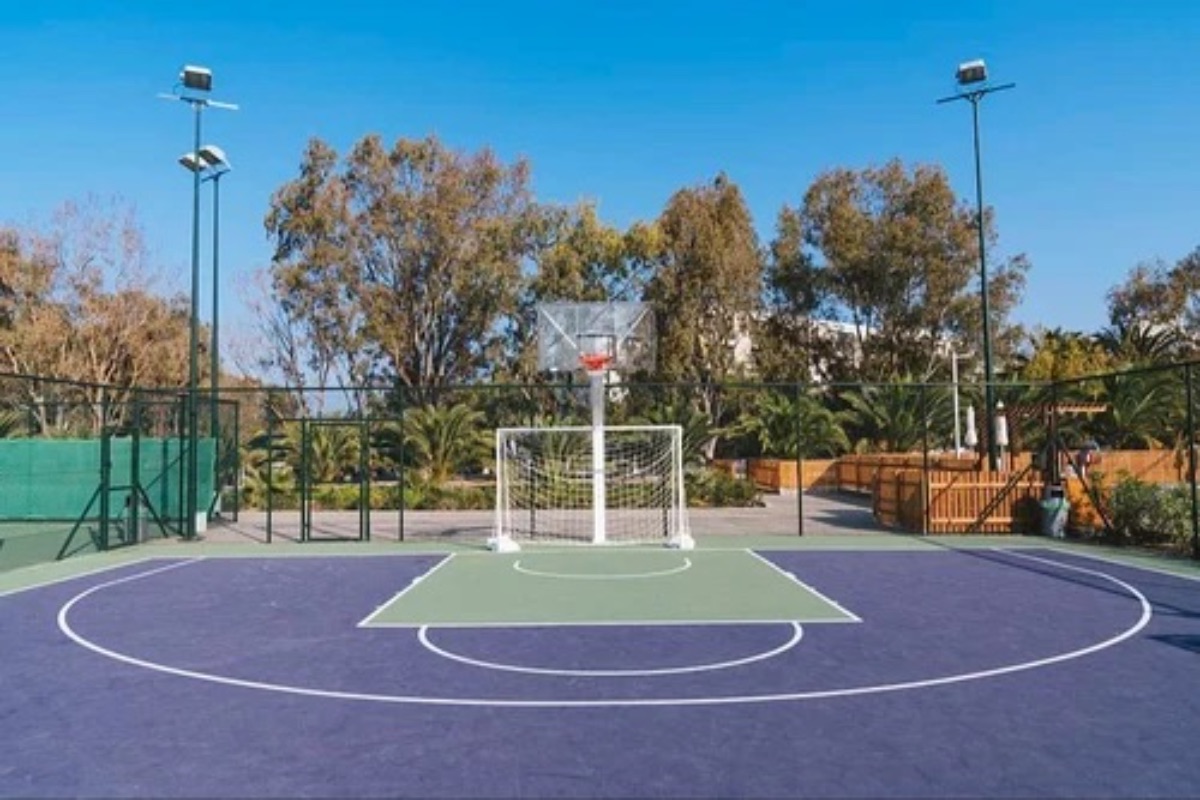
A half court backyard basketball court is one of the most practical and popular ways to bring the game home without needing the space required for a full-size court. It offers the perfect balance between functionality and efficiency, giving homeowners enough room for shooting drills, one-on-one games, and casual recreation while fitting comfortably into most residential properties.
Whether you’re designing a court for family fun, fitness, or skill development, a well-planned backyard half basketball court design can deliver excellent performance, durability, and long-term value. With the right layout, surface materials, and installation approach, even a compact outdoor space can become a high-quality basketball environment.
Understanding proper dimensions is essential to ensure your court plays well and feels comfortable.
A typical half court layout varies slightly depending on available space, but most residential courts follow these general guidelines:
This layout provides enough space for realistic gameplay while remaining adaptable to different backyard sizes.
Not every backyard can accommodate full half-court dimensions, but there are ways to adjust.
A compact basketball court backyard design allows homeowners to maximize functionality without sacrificing playability.
Choosing the right flooring is critical for durability, comfort, and performance.
Acrylic-coated concrete is one of the most common choices for outdoor courts.
This is a top option for permanent outdoor half court basketball installation projects.
Modular backyard basketball court systems are ideal for homeowners who want flexibility and comfort.
Tile systems are especially popular for families and recreational use.
Asphalt is another traditional base material often used for larger courts.
However, asphalt may require more maintenance over time compared to concrete.
|
Surface Type |
Best For |
Main Advantage |
Consideration |
|
Acrylic-Coated Concrete |
Permanent outdoor courts |
Professional bounce and durability |
Harder surface feel |
|
Modular Tile Systems |
Residential flexible courts |
Comfort and easy repair |
Higher upfront cost |
|
Asphalt with Coating |
Budget-friendly large courts |
Lower cost for bigger areas |
Requires resurfacing |
|
Painted Concrete |
Basic setups |
Affordable entry option |
Less durability over time |
A half court does not have to be basic. Smart design can elevate both function and appearance.
This is the most straightforward and widely used design.
Perfect for homeowners who want a simple, effective court.
A multi-use court adds flexibility for families.
This is a great option for maximizing backyard usability.
A practical solution for homes with existing concrete driveways.
Many homeowners start with this option and upgrade later.
Adding enclosure elements enhances safety and control.
This design is ideal for active families and frequent play.
A half court offers significant advantages for homeowners.
Unlike full courts, half courts can be adapted to a variety of backyard sizes.
Smaller size means reduced material, labor, and installation costs.
Perfect for shooting drills, conditioning, and casual gameplay.
Less surface area means easier cleaning, repairs, and upkeep.
A well-designed court adds both lifestyle appeal and property value.
Building a half court involves several key steps.
A strong foundation ensures long-term durability.
Small improvements can enhance gameplay significantly.
A typical half court ranges from 42–47 feet long and up to 50 feet wide, depending on available space.
For indoor half courts, a ceiling height of at least 18–20 feet is recommended for comfortable gameplay.
Yes, many half courts can include pickleball striping, creating a multi-use recreational space.
You should aim for at least 42 feet in length and 30–50 feet in width, depending on design and clearance.
The three-point arc on a half court typically follows standard basketball dimensions but may be adjusted for smaller residential courts.
A half court backyard basketball court is the ideal solution for homeowners who want a functional, high-quality playing space without the need for a full-size court. With thoughtful backyard half basketball court design, durable surface materials, and smart installation planning, you can create a court that delivers excellent performance in a compact footprint.
Whether you’re exploring small backyard basketball court ideas, planning a modular backyard basketball court, or investing in a permanent outdoor half court basketball installation, the right design transforms your backyard into a space for fitness, fun, and long-term enjoyment.
Please Provide Your Contact Information and Project Details