
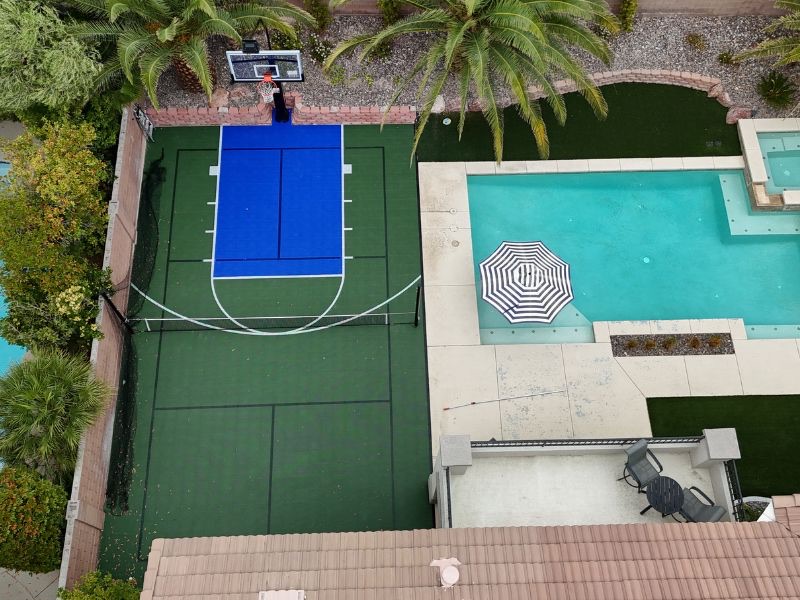
A multipurpose game court is designed to support several sports within a single playing area. Instead of building separate courts for basketball, pickleball, volleyball, or badminton, a multi-use court combines these activities into one versatile space. This approach is especially useful for residential backyards, community parks, schools, and recreational facilities where space may be limited.
Choosing the right court size is important because it affects player safety, game performance, and the overall functionality of the court. A properly sized court allows players to move freely while ensuring that sport-specific dimensions are maintained whenever possible.
Multipurpose courts can vary widely in size depending on the available space and the sports being played. Some courts are built at full regulation dimensions, while others are smaller backyard installations designed to accommodate several activities within a compact layout.
Understanding multipurpose game court size guidelines can help homeowners, developers, and recreation planners create courts that balance versatility, safety, and performance.
Multipurpose courts are generally designed in three main categories: full-size courts, half-size courts, and custom-designed courts. Each option serves different needs depending on the available space and the intended level of play.
Full-size multipurpose courts are designed to accommodate sports at or near regulation dimensions. These courts are commonly found in schools, sports complexes, community recreation centers, and large residential properties.
Because these courts provide ample space, they can often support multiple sports simultaneously by using different line markings and court zones.
These dimensions allow players to enjoy sports in a layout that closely matches official competition standards.
Full-size multipurpose courts are ideal for:
These courts provide the greatest flexibility for multi-sport recreational activities.
For residential spaces or areas with limited room, half-size or compact game courts offer a practical solution. These courts provide enough space for recreational play while maintaining flexibility for multiple sports.
Compact courts are commonly used in backyard multi-use courts because they fit comfortably in smaller outdoor areas while still supporting activities like basketball, pickleball, and volleyball.
Although smaller than full-size courts, these layouts still provide enough room for enjoyable recreational play.
Compact courts are ideal for:
Many homeowners choose compact courts because they offer maximum recreational value while using minimal space.
Custom-designed courts allow property owners to create a layout tailored specifically to their needs. These courts are often built to accommodate a unique combination of sports or to fit irregular property dimensions.
Custom courts can incorporate features such as multiple sport lines, adjustable net systems, and specialized surface materials.
Custom courts are popular for residential multi-sport courts and specialized recreation facilities where flexibility and personalization are important.
| Court Type | Typical Size | Sports Supported | Best Use |
| Full-Size Multipurpose Court | 50 ft × 84 ft | Basketball, volleyball, pickleball | Schools and recreation centers |
| Half-Size Backyard Court | 25 ft × 42 ft | Basketball, pickleball, badminton | Residential backyards |
| Custom Multi-Sport Court | Variable | Multiple sports | Residential or commercial recreation |
When designing a multipurpose game court, several factors should be considered to ensure the space functions effectively.
The size of the property is the first factor in determining court dimensions. Backyard courts often need to balance sports functionality with landscaping, patios, and other outdoor features.
It is recommended to leave additional clearance around the court to allow safe player movement.
Identifying the primary sports played on the court helps determine the most suitable dimensions.
For example:
By prioritizing key sports, the court layout can be optimized for performance and usability.
The court surface also affects design and durability. Common surface options include:
Outdoor courts typically use acrylic coatings or modular tiles because they are durable and weather-resistant.
Fencing is often installed around multipurpose courts to keep balls within the playing area and improve safety.
Proper placement of nets, posts, and boundary lines ensures that each sport can be played according to its rules.
A well-designed multipurpose court includes multiple line markings for different sports. Each sport typically uses a unique color to avoid confusion.
For example:
This design allows players to easily switch between sports without needing separate courts.
Multipurpose courts provide numerous advantages for both residential and community settings.
By combining several sports in one area, multipurpose courts maximize available space while supporting multiple recreational activities.
Building a single multi-use court is often more affordable than constructing several separate sports courts.
Backyard courts can enhance property appeal by adding a functional and attractive recreational feature.
Multipurpose courts allow players of all ages to enjoy different sports in the same location, making them ideal for family recreation and community gatherings.
A standard pickleball court measures 20 feet by 44 feet, although additional space is recommended around the court for safe movement.
The official size of a pickleball court is 20 ft × 44 ft, which is the same for both singles and doubles play.
No. A half basketball court is typically 25 ft × 42 ft, which is slightly larger in width but shorter in length compared to a pickleball court.
Standard court sizes vary depending on the sport. For example, basketball courts are typically 50 ft × 84 ft, while volleyball courts measure 30 ft × 60 ft.
A regulation pickleball court requires approximately 81.75 square meters, not including additional clearance space around the court.
Multipurpose game courts offer a flexible and space-efficient way to enjoy several sports in one location. By understanding the ideal court dimensions for different sports, homeowners and community planners can design courts that support safe gameplay and recreational enjoyment.
Whether building a backyard multi-use court, residential multi-sport court, or community recreation court, selecting the right size ensures the court remains functional and enjoyable for years to come.
With proper planning, a well-designed multipurpose court can become the centerpiece of outdoor recreation for families, neighborhoods, and sports enthusiasts alike.
Please Provide Your Contact Information and Project Details