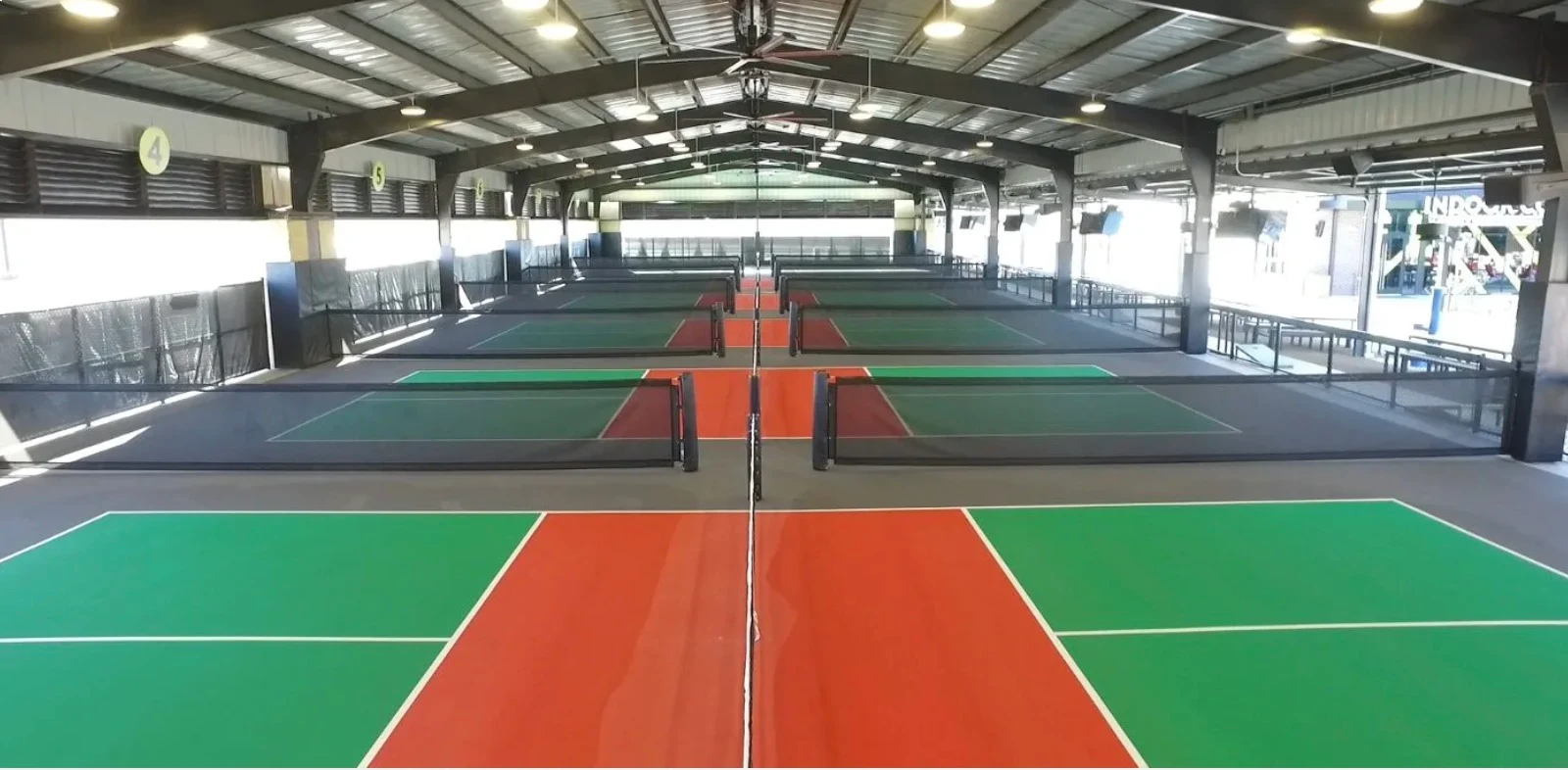
Pickleball is the fastest-growing sport in the country, and demand for properly built courts, backyard, HOA, and commercial, has grown right alongside it. Legendary Sport Construction designs and builds
pickleball courts from the ground up: correct dimensions, the right surface system, and lighting that extends play into the evening. Here’s what goes into a court built to last.
Pickleball Court Design and Layout
A regulation pickleball court measures 20 feet by 44 feet for the playing surface, but a functional court needs more than that footprint. Adequate run-off space around the perimeter (ideally 10 feet behind the baselines and 5 feet along the sidelines where space allows) keeps play safe and comfortable. Net height is set at 34 inches at the center and 36 inches at the posts.
For properties with tighter lots, we help clients decide between a dedicated regulation court and a smaller practice court, or a multi-use court that can be striped for pickleball alongside another sport like basketball or volleyball on the same pad.
Orientation matters. Courts should be oriented so the sun isn’t directly in players’ eyes during peak play times, typically a north-south orientation minimizes glare issues for most schedules.
Surface Options for Pickleball Courts
Acrylic surfacing is the standard choice for outdoor pickleball courts. A multi-coat acrylic system over a properly built concrete or asphalt base gives consistent ball bounce, good traction, and long-term UV stability, critical for courts that see full sun exposure in Las Vegas and Phoenix.
Cushioned acrylic systems add an extra layer of shock absorption, which many pickleball players value given the sport’s quick lateral movement and stop-start play style.
Post-tension concrete is increasingly used as a base option for pickleball courts because it resists cracking better than standard slab concrete, an important consideration since pickleball courts are unforgiving of surface irregularities that affect low, fast-bouncing shots.
Lighting for Pickleball Courts
Because pickleball is popular with players looking to avoid peak daytime heat, court lighting is one of the highest-value additions for a Las Vegas or Phoenix pickleball court. LED sports lighting systems, properly placed to avoid glare and shadow across the net area, let a court get used comfortably well after sunset, effectively doubling the practical hours of use during the hottest months.
Fencing and Amenities
Pickleball courts benefit from perimeter fencing both for ball containment and safety, especially at multi-court facilities or courts near shared community space. Windscreens can reduce wind interference on exposed sites, and shaded seating areas or pergolas are a popular add-on for courts that host groups or leagues.
What Goes Into the Build
- Design consultation — confirming dimensions, orientation, and any multi-sport striping needs.
- Base construction — excavation, compaction, and a concrete or asphalt pad poured to the correct slope.
- Surfacing — acrylic color coat system applied and cured.
- Striping — precise regulation lines, kitchen (non-volley zone) lines, and any additional sport overlays.
- Net posts and hardware — properly anchored net system installed to regulation height.
- Lighting, fencing, and amenities — added based on your usage and budget.
FAQ
What are the official dimensions of a pickleball court?
The playing surface is 20 feet by 44 feet, with recommended run-off space of at least 10 feet behind each baseline and 5 feet along the sidelines.
What surface is best for an outdoor pickleball court?
A properly installed acrylic surfacing system over a well-built concrete or asphalt base is the standard for outdoor pickleball courts in our climate. Cushioned acrylic is a strong upgrade for added shock absorption.
How much space do I need to build a pickleball court in my backyard?
Plan for roughly 30×60 feet minimum to comfortably fit the court plus adequate run-off space, though smaller practice courts are possible on tighter lots.
Is lighting worth adding to a pickleball court?
Yes, especially in Las Vegas and Phoenix, where evening play avoids peak heat. LED lighting significantly extends the practical hours a court can be used.
Can a pickleball court share a pad with a basketball or volleyball court?
Yes, multi-sport courts striped for pickleball alongside basketball or volleyball are a common and cost-effective solution for properties with limited space.
How long does pickleball court construction take?
Most standalone pickleball court projects take one to two weeks from base construction through final striping, depending on site conditions.
This page links to our pickleball court builder pages for Las Vegas and Phoenix and our court dimensions guide. Ready to build your pickleball court? Get a quote from Legendary Sport Construction today.