
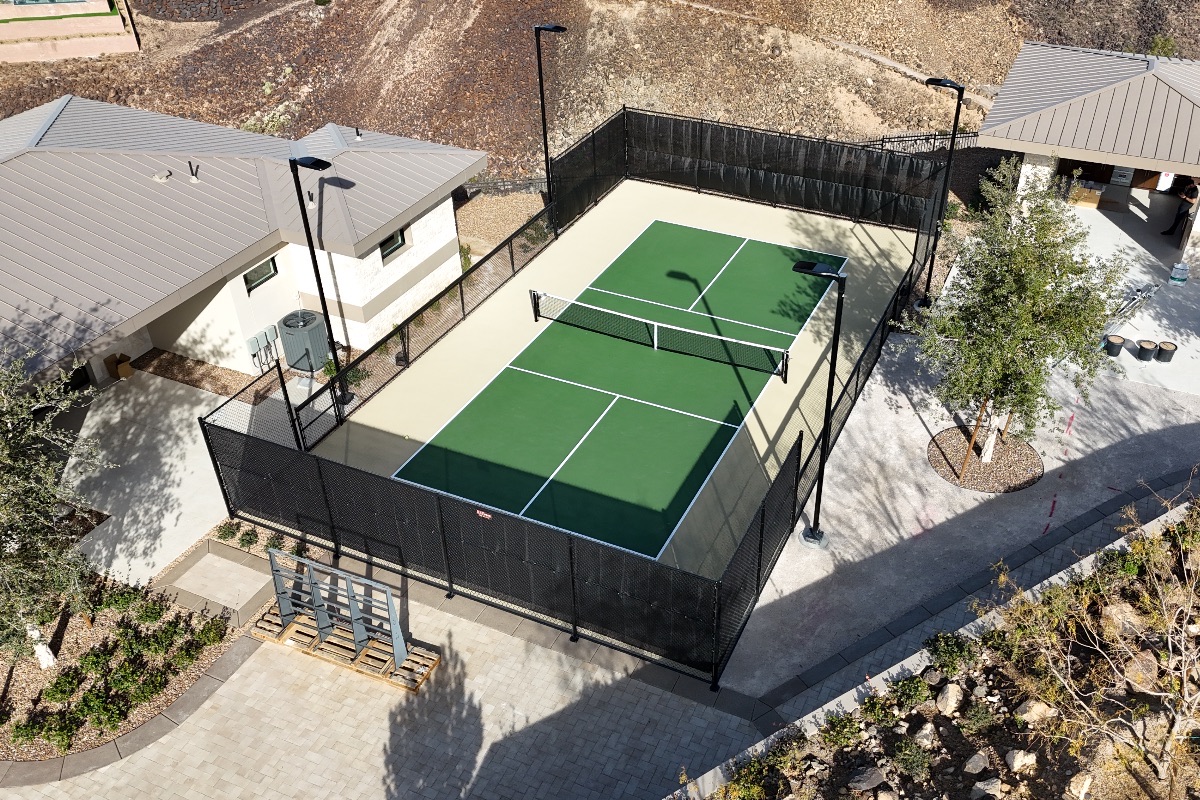
If you’ve started researching a new pickleball court, you’ve probably noticed one thing fast: pricing is rarely “one number.” And honestly, that’s a good thing—because a pickleball court can be as simple as a clean slab with lines and a net, or as polished as a club-grade facility with fencing, lighting, custom colors, and a surface built to stay consistent in desert heat.
In Nevada and Arizona, installation cost is influenced by more than surface choice alone. The biggest cost drivers typically come down to the condition of the site, how much base work is required, the surface system you select, how the court is laid out, and which amenities you add to make the court more functional (and more enjoyable).
Legendary Sports Construction builds courts across Nevada and Arizona for homeowners, HOAs, schools, parks, and commercial facilities. Our job is to help you understand where your budget goes and how to get the best long-term value—meaning a surface that plays predictably, holds up under sun and use, and doesn’t turn into a maintenance project six months after the first game.
This guide breaks down the major factors behind pickleball court installation cost, explains surface options, and shows how smart planning can protect your investment.
Your surface system is one of the most visible parts of the project—and one of the most influential cost categories. Different materials create different play experiences and different ownership realities over time.
Common options include:
Acrylic-coated concrete or asphalt
This is a traditional approach used in many public and club facilities. Acrylic coatings add texture and color over a rigid base. The play feel is firm and predictable, and it’s widely recognized.
Modular tile systems
Interlocking tile surfaces are installed over a properly prepared base, offering consistent traction, built-in drainage (especially with perforated designs), and the ability to replace individual sections if damage occurs.
Cushioned court systems
These surfaces incorporate shock-absorbing layers beneath the top finish to reduce joint impact. They’re popular for players who want comfort during long sessions or for communities serving multi-age groups.
How surface choice affects cost:
If you’re comparing pickleball court design and surface options, it helps to balance upfront cost with what you’ll spend over the next 5–10 years maintaining playability.
A court is only as good as the base beneath it. Base preparation is one of the most important “hidden” cost drivers, and it’s also the area where cutting corners tends to become expensive later.
Base and site conditions can include:
If a site is already flat, stable, and well-draining, preparation is simpler. If it needs grading, drainage correction, or repairs, the work increases. That base work protects your surface investment—because without it, you’ll see issues like pooling water, premature cracking, or inconsistent play.
For both residential pickleball court installation and facility builds, proper base preparation is the difference between a court that performs for years and a court that becomes a repair cycle.
A standard pickleball court measures 20 ft x 44 ft for the playing area, but that’s not the full footprint you should plan for. The recommended total space includes run-off room so players can move safely beyond the lines.
Layout considerations that impact cost:
If you’re building for an HOA or facility, multiple courts can be more cost-efficient per court than building one at a time, because prep and mobilization can be streamlined. For homeowners, adding extra run-off space makes the court feel more “real” and less cramped.
Accessories can transform a court from basic to premium. They also have real functional value—especially in windy areas, high-traffic community settings, or facilities that want extended play hours.
Common amenities include:
These elements add to total cost, but they also increase usability and satisfaction. For example, fencing is often the difference between “constant ball chasing” and uninterrupted play—especially in community environments.
| Surface Type | Best For | Play Feel | Drainage | Durability | Maintenance |
| Acrylic-Coated Concrete | Residential & community courts | Firm, predictable | Poor | Good | Moderate |
| Modular Tile Systems | Outdoor & multi-use courts | Athletic, consistent | Excellent | Excellent | Low |
| Cushioned Court Systems | Comfort-focused play | Soft, joint-friendly | Moderate | High | Moderate |
A great court doesn’t just happen—it’s planned. When you design the court intentionally (based on climate, usage, and budget), you get better performance and lower long-term costs.
The right surface and installation method produce consistent ball bounce and dependable traction. That makes the game more enjoyable and helps players improve faster because the court behaves the same across the entire surface.
Choosing durable systems and building a strong base reduces future costs. Courts that drain properly and resist UV breakdown stay playable longer with less upkeep.
Slip resistance, consistent traction, and impact absorption reduce injury risk. For communities and facilities, safety is often a top concern—especially for multi-age player groups.
Many facilities want flexibility. With the right layout and striping, courts can support pickleball plus other recreation needs. Smart planning can maximize the value of limited space.
A professionally installed court is a lifestyle upgrade for homeowners and a value-add amenity for HOAs and commercial properties. Clean design, durable finishes, and good accessories make a court look like an asset—not a DIY project.
Legendary Sports Construction follows a proven process to keep projects organized, efficient, and built for long-term performance in Nevada and Arizona.
We start by evaluating the space and the goals:
This phase sets the direction so the build avoids expensive mid-project changes.
Base work is handled with precision:
This stage is where durability is built.
Depending on the surface system:
We focus on consistency—because a court should feel uniform from baseline to kitchen.
Once the surface is complete, we add:
Details matter here. Professional striping and correct layout are key to playability.
Before completion, we verify:
Then the court is ready for real use.
The most budget-friendly route is usually using an existing concrete slab that’s already level and in good condition, then applying proper court markings and installing a basic net system. However, bare concrete can be hard on joints and may not provide ideal traction. Many homeowners find that upgrading the playing surface delivers better long-term satisfaction.
The playing area is 20 ft x 44 ft, but you should plan additional space around the court for safe movement. More space creates a better experience and reduces collision risk when chasing wide shots.
Yes, but it’s not always ideal. Concrete can be slippery when dusty or wet and is unforgiving on joints. Many courts improve the slab by adding acrylic surfacing or installing modular tile systems to enhance traction and comfort.
For outdoor environments, modular tile systems and acrylic-coated surfaces are popular. Modular systems often stand out for drainage and easy repairs, while acrylic provides a traditional feel. The “best” choice depends on usage level, comfort goals, and long-term maintenance expectations.
Costs vary based on base preparation, surface choice, site access, and amenities like fencing and lighting. The most reliable way to budget is to evaluate the full scope: base work + surface system + accessories + layout. That gives a realistic picture of the investment and the expected lifespan.
Understanding installation cost starts with understanding the drivers: base preparation, surface system, layout size, and amenities. When those factors are planned correctly, you get a court that performs well in desert conditions and stays enjoyable long after the first match.
Legendary Sports Construction supports projects across pickleball court installation Nevada and pickleball court installation Arizona, working with everyone from backyard pickleball court builders to larger commercial pickleball court setup needs. If you’re planning a court and want guidance on the right surface and design for your space, our team is ready to help you build it right from the ground up.
Please Provide Your Contact Information and Project Details