
Sport Court products only available in Nevada.
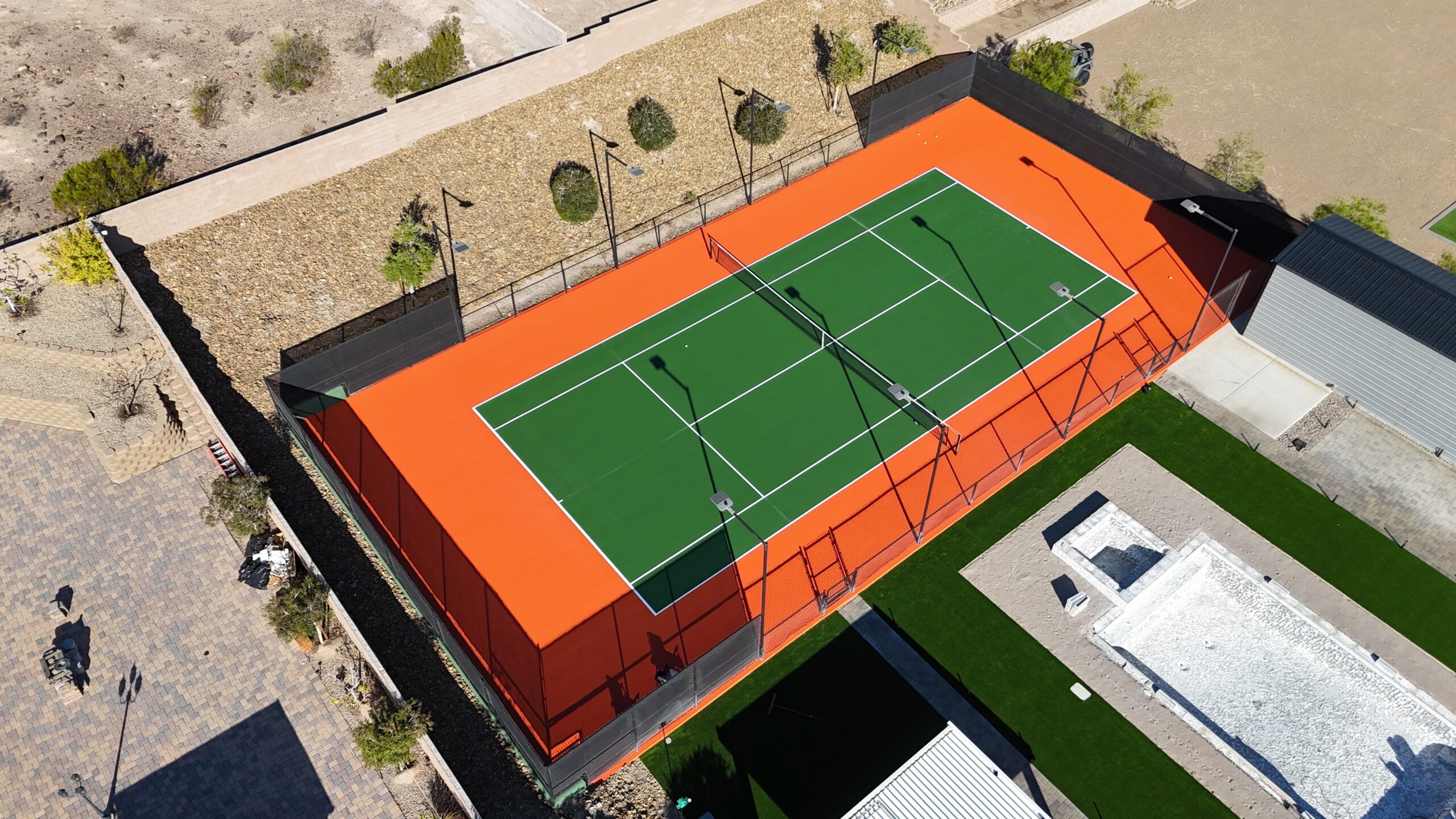
Choosing the right tennis court surface is as vital as selecting the right racket. It influences how fast the ball travels, how your body absorbs impact, and how much upkeep you’ll face over the years. From professional-grade hard courts to soft, slide-friendly clay, each material tells its own story of performance, cost, and endurance.
Whether you’re a homeowner envisioning a private court oasis or a facility manager planning multiple installations, understanding these options helps ensure your court fits both your environment and play style. Let’s break down the leading tennis court surfaces used in Arizona, Nevada, and Utah, where heat, UV exposure, and durability are critical considerations.
The acrylic hard court is the modern standard for tennis facilities worldwide. Built atop a stable concrete or asphalt base, it’s finished with layers of pigmented acrylic resin and silica sand for texture and traction.
This surface offers a medium-fast play speed with a consistent, predictable bounce—perfect for players who value control and precision. Acrylic is also extremely durable, weather-resistant, and customizable. Its UV-stable color coatings resist fading under intense sunlight, and it requires minimal upkeep beyond periodic cleaning and resurfacing every 7–10 years.
In regions like Phoenix, Las Vegas, and Salt Lake City, acrylic’s ability to handle heat and withstand temperature fluctuations makes it a standout choice for residential and public courts alike.
The clay court remains a timeless classic—synonymous with patience, strategy, and endurance. Commonly seen at the French Open, these courts are constructed from crushed brick, shale, or stone.
Clay’s granular texture slows the ball and creates a higher bounce, giving players more time to react and rally. This makes it ideal for defensive players and those who prefer long exchanges. Additionally, clay’s softness provides superior shock absorption, reducing strain on knees and ankles.
However, beauty comes with effort. Clay courts demand daily maintenance, including rolling, watering, and line sweeping to retain their structure and consistency. While less common in the arid climates of Arizona and Nevada, they can be maintained effectively with modern irrigation and surface stabilizers.
A nod to tradition, grass courts are the fastest of all playing surfaces. Known for their elegant appearance and use in prestigious tournaments like Wimbledon, they deliver a low, skidding bounce that rewards agility and finesse.
Grass’s natural cushioning offers a gentle feel on joints, but its upkeep is intensive. Regular mowing, rolling, aeration, and watering are essential to preserve performance. In dry or high-temperature climates, maintaining healthy grass year-round can be both labor-intensive and costly.
For private estates or clubs seeking a touch of exclusivity, however, grass courts bring unmatched aesthetic value and nostalgic appeal—symbolizing tennis at its most refined.
Synthetic turf courts bridge the gap between performance and practicality. Made from artificial grass fibers filled with silica sand or rubber granules, they mimic the feel of clay or grass without the heavy maintenance.
This surface offers consistent bounce, quick drainage, and excellent durability, making it a versatile option for multi-use athletic facilities. It’s also ideal for residential properties that want a year-round, low-maintenance surface capable of handling Arizona’s scorching summers and Utah’s freezing winters.
Synthetic turf requires only occasional brushing and infill replacement, making it a cost-effective choice over time. Its forgiving texture also helps reduce fatigue, making it a great option for players of all ages.
For long-term reliability and structural integrity, post-tension concrete stands at the top of the engineering spectrum. Unlike standard concrete slabs that can crack under stress, post-tension systems are reinforced with steel cables tightened after curing, creating a resilient and stable foundation.
This technology eliminates most cracking and structural movement, even in regions with extreme temperature swings. It’s especially beneficial in desert climates, where conventional asphalt courts may deteriorate prematurely.
These courts can be finished with acrylic coatings or cushioned systems, combining toughness with comfort. Though the initial investment is higher, post-tension concrete courts offer a lifespan of over 25 years, making them a smart, long-term investment for schools, clubs, and municipalities.
|
Surface Type |
Play Speed |
Comfort |
Maintenance |
Durability |
Best For |
|---|---|---|---|---|---|
|
Acrylic Hard Court |
Medium-Fast |
Moderate |
Low |
High |
Residential & Public Facilities |
|
Clay Court |
Slow |
Excellent |
High |
Moderate |
Clubs & Competitive Players |
|
Grass Court |
Very Fast |
Excellent |
Very High |
Low |
Private Estates & Elite Venues |
|
Synthetic Turf Court |
Medium |
High |
Low |
High |
Multi-Sport or Residential Use |
|
Post-Tension Concrete |
Medium-Fast |
Moderate |
Very Low |
Very High |
Commercial Facilities & Hot Climates |
The Southwest’s intense sun and dry conditions demand surfaces that can withstand UV exposure and thermal expansion. Acrylic and post-tension concrete courts handle this best, maintaining integrity and color under relentless heat. Grass and clay, while playable, require additional water management systems to thrive.
Fast hitters may prefer acrylic or grass courts for quicker rallies, while strategic players who rely on spin and control gravitate toward clay. For recreational or family use, synthetic turf offers balanced play with reduced upkeep.
Budget-conscious projects often start with acrylic hard courts, which provide excellent long-term value. Clay and grass have lower initial installation costs but much higher upkeep. Post-tension concrete carries the highest upfront investment yet delivers the best lifetime cost efficiency.
If your court will host competitive events, regulation acrylic or post-tension concrete surfaces are ideal. For schools or community centers, synthetic turf offers versatility for tennis, pickleball, or basketball without significant wear.
Durability varies dramatically between materials. Acrylic and post-tension concrete can last decades with periodic resurfacing. Grass and clay require near-daily care, while synthetic turf provides a strong middle ground—lasting 10–15 years with minimal effort.
What are the 4 tennis surfaces?
The four primary tennis court surfaces are hard (acrylic), clay, grass, and synthetic turf. Each has unique characteristics that influence speed, comfort, and maintenance.
What is the best surface for a tennis court?
For hot, dry regions like Arizona and Nevada, acrylic or post-tension concrete courts are best. They offer superior durability, UV resistance, and consistent play with minimal upkeep.
What is an acrylic tennis court surface?
An acrylic surface consists of layered coatings applied over asphalt or concrete. It provides a smooth, textured finish designed for traction, ball control, and weather resilience.
Why are there different tennis court surfaces?
Different surfaces promote variety in play style and strategy. Each one offers distinct ball behavior—faster on hard and grass, slower on clay—and caters to specific environments and budgets.
What is the hardest surface in tennis?
Post-tension concrete is the toughest and most stable. Its reinforced design prevents cracking, even under heavy use or extreme temperature swings.
The type of tennis court surface you choose shapes not only the quality of play but also the court’s longevity, comfort, and cost of ownership. Whether it’s the all-weather versatility of acrylic, the classic charm of clay, or the structural strength of post-tension concrete, each surface brings its own strengths to the court.
For the climates of Arizona, Nevada, and Utah, where durability meets design, acrylic and post-tension concrete courts deliver the perfect balance of performance and endurance. Pair that with professional installation and proper maintenance, and your court will serve generations of players—rain or shine.
Please Provide Your Contact Information and Project Details