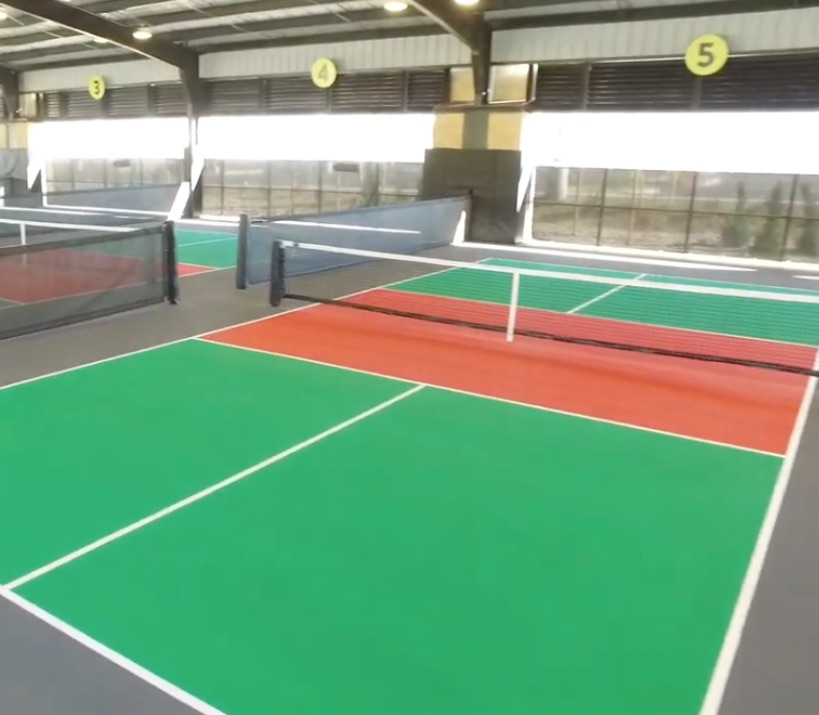
Legendary Sport Construction is bringing our pickleball court construction expertise to Phoenix, Arizona. As pickleball demand grows across the Valley, homeowners, HOAs, and commercial property owners need a builder who understands both the sport’s exact specifications and what it takes to make a court survive Phoenix’s extreme heat and sun. That’s exactly what we do.
Building Pickleball Courts for the Phoenix Climate
Phoenix presents some of the harshest conditions in the country for an outdoor sports surface. Summer surface temperatures on unshaded pavement regularly exceed 150°F, and UV exposure is relentless nearly year-round. A pickleball court built with generic materials or a rushed base will show cracking, surface breakdown, and color fading far faster here than almost anywhere else.
We address this directly:
- Reinforced, properly compacted bases designed to resist the expansion and contraction cycles caused by extreme heat swings.
- UV-stable acrylic surfacing systems formulated to hold color and texture under sustained high-heat exposure.
- Slope and drainage engineering that accounts for Phoenix’s intense, brief monsoon rain events, which can overwhelm poorly graded surfaces quickly.
- Lighting packages that make evening play genuinely comfortable, which matters enormously in a market where daytime summer play is often not an option.
What We Build in Phoenix
New pickleball court construction for backyards, HOA amenity spaces, churches, and commercial recreation facilities, built to regulation 20×44-foot dimensions with proper run-off space.
Multi-sport court builds, striping pickleball lines alongside basketball or volleyball on a shared pad, an efficient option for properties balancing multiple activities on limited land.
Court lighting, fencing, and windscreens to make courts comfortable and usable across more of the day and year.
Resurfacing and recoating for existing Phoenix-area pickleball courts already showing wear from sun and heat exposure.
Why a Purpose-Built Court Matters in Phoenix
A pickleball court is unforgiving of an uneven or poorly built surface, low, fast-bouncing shots reveal imperfections that a basketball court might hide. Combined with Phoenix’s climate demands, that means base quality and surface selection matter even more than in milder markets. We treat every Phoenix court build with the same base-first standard we’ve applied for years in Las Vegas, adapted for the specific soil and climate conditions across the Valley.
Our Process
- Site visit and design consultation — reviewing your space, sun orientation, and layout goals.
- Base construction — excavation, compaction, and a concrete or asphalt pad built to handle Phoenix heat cycling.
- Acrylic surfacing and striping — a UV-stable multi-coat system with precise regulation lines.
- Net system and accessories — properly anchored net posts, plus any lighting, fencing, or shade additions.
FAQ
Do you build pickleball courts throughout the Phoenix metro?
Yes, we are expanding our service area to cover the Phoenix, AZ metro for new pickleball court construction and resurfacing.
How does Phoenix heat affect pickleball court construction?
Extreme surface temperatures and constant UV exposure require heat-cycle-resistant bases and UV-stable acrylic surfacing. Generic materials break down far faster under these conditions.
What size court do I need for pickleball in my backyard?
Plan for roughly 30×60 feet to comfortably fit the regulation 20×44-foot playing surface plus adequate run-off space.
Is lighting important for a Phoenix pickleball court?
Very much so. Given how much play shifts to evening hours to avoid daytime heat, quality LED lighting is one of the highest-value additions for a Phoenix court.
Can an existing Phoenix court be resurfaced instead of rebuilt?
Often yes, if the base is still structurally sound. We evaluate existing courts and recommend resurfacing when it will restore performance without a full rebuild.
How long does construction take?
Most standalone pickleball court projects take one to two weeks from base construction through final striping, depending on site conditions.