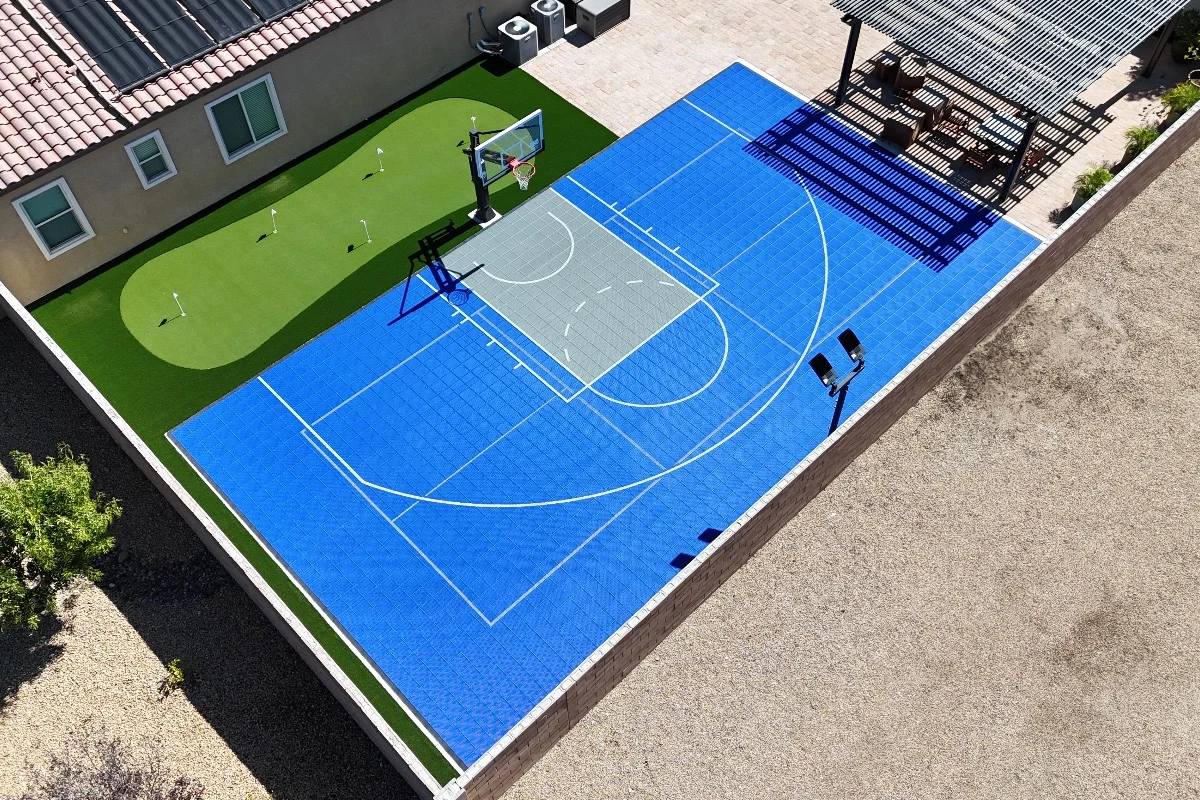
Building a basketball court is a bigger decision than picking a hoop and pouring concrete. The surface, the base, the drainage plan, and the finish system all determine whether you get a court that plays true for twenty years or one that cracks, fades, and needs rework in five. Legendary Sport Construction has installed basketball courts across Las Vegas and the Phoenix Valley for homeowners, HOAs, schools, and commercial property owners who want a court built once and built right.
Outdoor vs Indoor Basketball Court Installation
The core engineering question on every project is where the court lives.
Outdoor courts have to survive direct sun, temperature swings, and in the Southwest, UV exposure that is more intense than almost anywhere else in the country. That means the base (typically compacted aggregate under a concrete or asphalt pad), the crack-resistant membrane, and the surface coating all need to be rated for exterior use. Drainage and slope also matter more outdoors than indoors: a properly built outdoor court is sloped at a slight, even grade so water sheets off instead of pooling and undermining the surface.
Indoor courts (gyms, converted warehouses, home sport rooms) don’t face weather, but they carry different requirements: subfloor moisture control, sound and shock absorption, and often a different surface category altogether, such as modular tile or hardwood-style synthetic systems instead of acrylic coatings. Indoor installs also need to account for HVAC and humidity, since a slab that never gets exposed to sun can still trap moisture that damages a coating from underneath.
Both settings need a properly prepared base. This is where most court failures actually start. If the sub-base isn’t compacted correctly or the concrete/asphalt pad isn’t cured and finished to spec, no surface system on top of it will hold up. We treat base prep as the most important step in the build, not a formality before the “real” work begins.
Acrylic vs Specialty Surface Systems
Once the pad is ready, the surface system is the next major decision.
Acrylic surfacing is the standard for most outdoor basketball courts in our region, and for good reason. A multi-coat acrylic system (typically a resurfacer coat to fill minor texture and cracks, followed by color coats and line striping) creates a surface that is UV-stable, textured for consistent ball bounce and traction, and available in essentially any color scheme. Acrylic systems are also the most cost-effective way to get a professional, tournament-grade playing surface, and they are straightforward to recoat every several years rather than replace.
Specialty surfaces cover a range of alternatives:
- Modular tile systems (interlocking polypropylene tiles) are popular for driveways, garages, and situations where you want a surface that can be installed over existing concrete without extensive prep, or even removed and relocated later. They offer excellent shock absorption and drainage through their perforated design.
- Cushioned acrylic systems add a rubberized layer beneath the color coats for extra joint protection, which matters for high-usage courts or players concerned about long-term impact on knees and ankles.
- Synthetic hardwood-look systems are used mostly indoors where the goal is to replicate the look and feel of a gymnasium floor without the maintenance demands of real hardwood.
The right choice depends on usage (backyard pickup games vs. daily training), budget, climate exposure, and whether the court needs to double as a pickleball or multi-sport surface with different striping.
What Goes Into a Professional Installation
A basketball court installation is not one trade, it’s a sequence:
- Site evaluation and layout — confirming dimensions, orientation (minimizing glare for players shooting into the sun), and grading.
- Excavation and base prep — compacting the sub-base to the density needed to prevent future settling or cracking.
- Concrete or asphalt pad installation — poured and finished to the correct slope, with control joints placed to manage natural cracking.
- Surface system application — resurfacer, color coats, and cushioning if specified, applied in the correct number of coats and cure times.
- Line striping and graphics — court lines, logos, or multi-sport overlays painted to regulation spacing.
- Accessories — hoop systems, anchoring, and lighting installed and tested.
Skipping or rushing any one of these steps is the most common reason a “new” court needs major repair inside a few years.
Why Professional Installation Matters
DIY and low-bid court installations tend to fail in predictable ways: inadequate base compaction leads to cracking, incorrect slope leads to standing water and surface delamination, and cheap acrylic coatings chalk and fade within a season or two under desert sun. A properly engineered court, by contrast, is built to handle decades of use with routine maintenance rather than repeated rebuilds.
Legendary Sport Construction builds every court, whether it’s a single backyard half-court or a full commercial installation, on the same standard: correct base, correct surface system, correct slope, and a finish that plays true from the first game to the thousandth.
FAQ
How long does a basketball court installation take?
Most residential courts take one to three weeks from excavation to finished striping, depending on size, base conditions, and surface system. Commercial or multi-court projects take longer.
Is acrylic or modular tile better for a backyard court?
Acrylic is generally the better choice when you want a permanent, tournament-quality surface with maximum color and design flexibility. Modular tile is a strong option when you need faster installation, easier future removal, or a surface that can go directly over existing concrete with minimal prep.
Can an existing driveway or slab be converted into a basketball court?
Often yes, if the existing concrete is structurally sound and properly sloped. We evaluate the pad first, since a resurfacing system only performs as well as what’s underneath it.
How often does an acrylic court need to be recoated?
Typically every four to seven years for heavily used courts, depending on sun exposure and traffic. Recoating is far less expensive than a full rebuild.
Do outdoor basketball courts in Las Vegas or Phoenix need special UV-resistant coatings?
Yes. Standard interior paints and generic coatings break down quickly under intense desert UV. We use acrylic systems specifically formulated for sustained sun exposure and high surface temperatures.
This page links to the Basketball Court Construction hub and the relevant service-area page for your city. Ready to plan your court? Get a quote from Legendary Sport Construction today.