Building a sport and game court, basketball, pickleball, tennis, volleyball, or a multi-sport combination, is a significant investment, and getting a realistic budget picture up front prevents surprises later. This comprehensive guide breaks down every major cost factor across sport types so you can plan with confidence before requesting a quote.
The Core Cost Drivers Across All sport and game court
Regardless of which sport you’re building for, the same core variables drive total cost:
Court size. Larger courts require more base material, more surfacing, and more striping, scaling cost accordingly. A backyard basketball half-court costs meaningfully less than a full regulation court; a single pickleball or tennis court costs less than a multi-court facility.
Site conditions. Flat, accessible, well-draining lots cost less to prepare than sloped sites, sites with poor soil, or locations with difficult equipment access.
Base type. Concrete costs more upfront than asphalt but generally lasts longer and needs less frequent resurfacing. Post-tension concrete, increasingly popular for pickleball, costs more than standard slab but resists cracking better under heat stress.
Surface system. Standard acrylic coating is the most cost-effective way to achieve a professional playing surface. Cushioned acrylic and premium modular tile systems cost more but offer benefits in shock absorption or installation speed.
Accessories. Hoops, nets, fencing, and lighting are typically quoted separately from the base court construction and add up based on how many you include.
Cost by Sport Type
Basketball courts scale primarily with size (half-court vs. full court) and whether you add an adjustable hoop system, breakaway rim, or lighting package.
Pickleball courts are smaller in footprint than basketball or tennis but benefit from post-tension bases in our climate, which adds cost relative to standard concrete. Net systems and fencing are common add-ons.
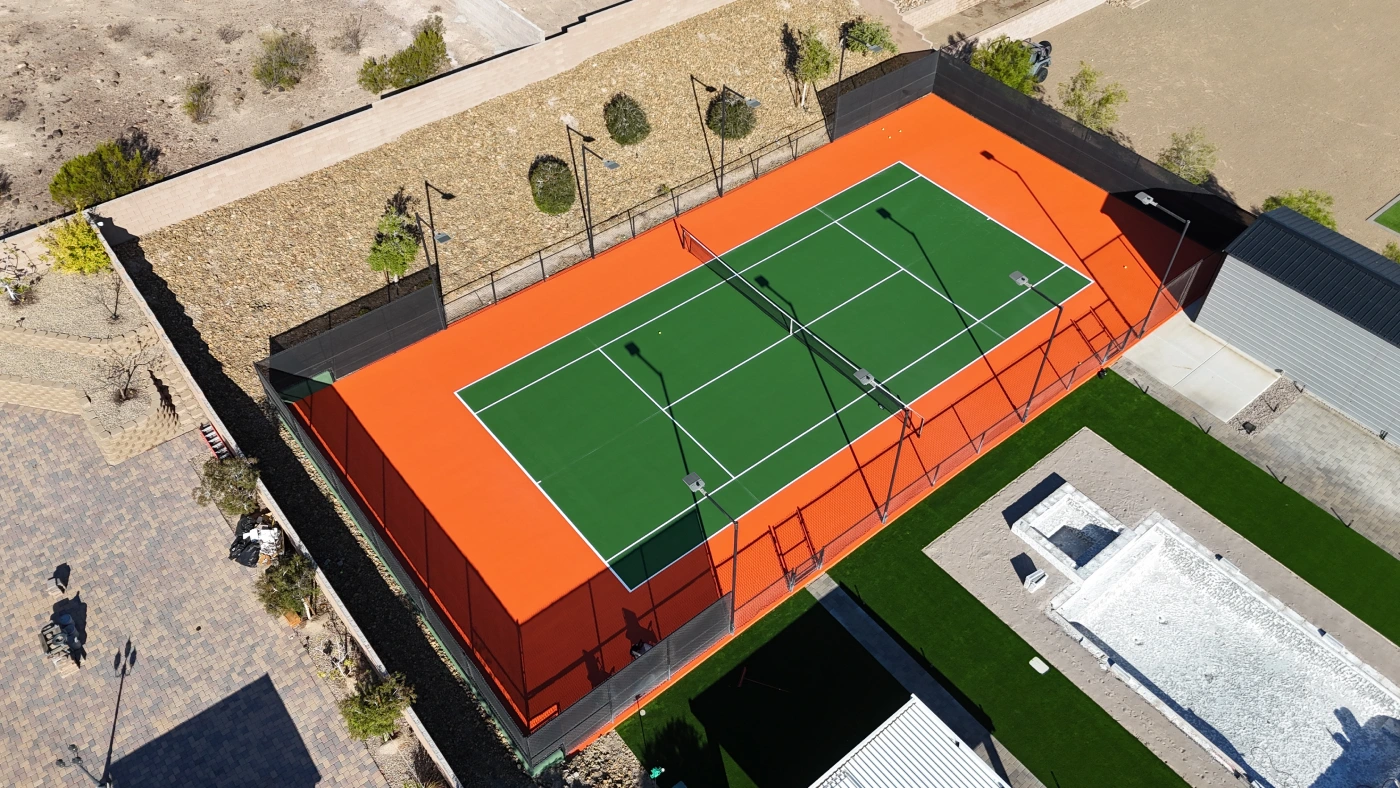
Tennis courts require the largest single-court footprint of the major racquet and ball sports, which drives up base material and surfacing costs relative to pickleball or basketball. Fencing is a near-universal addition for tennis courts.
Volleyball courts vary significantly based on sand vs. hard-surface construction. Sand courts require contained borders and a drainage layer; hard-surface courts follow similar cost logic to basketball and pickleball.
Multi-sport and game court cost more than a single-sport and game court due to larger pad size and more complex striping, but cost considerably less than building multiple standalone courts.
New Construction vs. Resurfacing
If you already have an existing court that’s aged, resurfacing costs substantially less than a full rebuild, provided the underlying base is still structurally sound. A full rebuild becomes necessary when the base itself has failed through significant cracking, heaving, or drainage breakdown.
Where Costs Commonly Go Wrong
The most expensive mistake in sport and game court construction is under-investing in the base to save money upfront. A cheaper, improperly compacted or sloped base leads to cracking and drainage failure that requires costly repair or a full redo within a few years, costing far more in the long run than paying appropriately for base work from the start.
The second most common issue is choosing a generic, non-climate-rated surface coating to save a small amount upfront, only to see it fade, chalk, or crack within a season or two under Las Vegas or Phoenix sun.
Getting an Accurate Quote
Because so many variables affect final pricing across sport types, sizes, and site conditions, the most reliable way to budget accurately is a site visit and itemized proposal. Legendary Sport Construction evaluates your specific property and goals, then provides a detailed quote breaking down base work, surfacing, and accessories separately.
FAQ
What is the biggest factor in sport and game court construction cost?
Court size and site conditions are typically the two biggest drivers, since they scale every downstream cost from base material to surfacing to striping.
Is it cheaper to build a basketball, pickleball, tennis, or volleyball court?
Pickleball courts generally have the smallest footprint and lowest base material cost, while tennis courts require the largest single-court footprint. Actual cost also depends heavily on surface system and site conditions.
Should I resurface my existing court instead of rebuilding?
If the base is structurally sound with functioning drainage, resurfacing is usually the more cost-effective choice. A rebuild becomes necessary when the base itself has failed.
Does adding lighting significantly increase project cost?
Lighting adds meaningful cost but delivers strong value in Las Vegas and Phoenix by extending usable court hours into cooler evening periods.
Can I build a multi-sport and gamecourt to save money over separate courts?
Yes, a well-designed multi-sport and game court costs more than a single court but considerably less than building multiple standalone courts.
How do I get an accurate cost estimate for my property?
Request a site visit and itemized quote from our team, since soil conditions, access, and layout all affect final pricing.