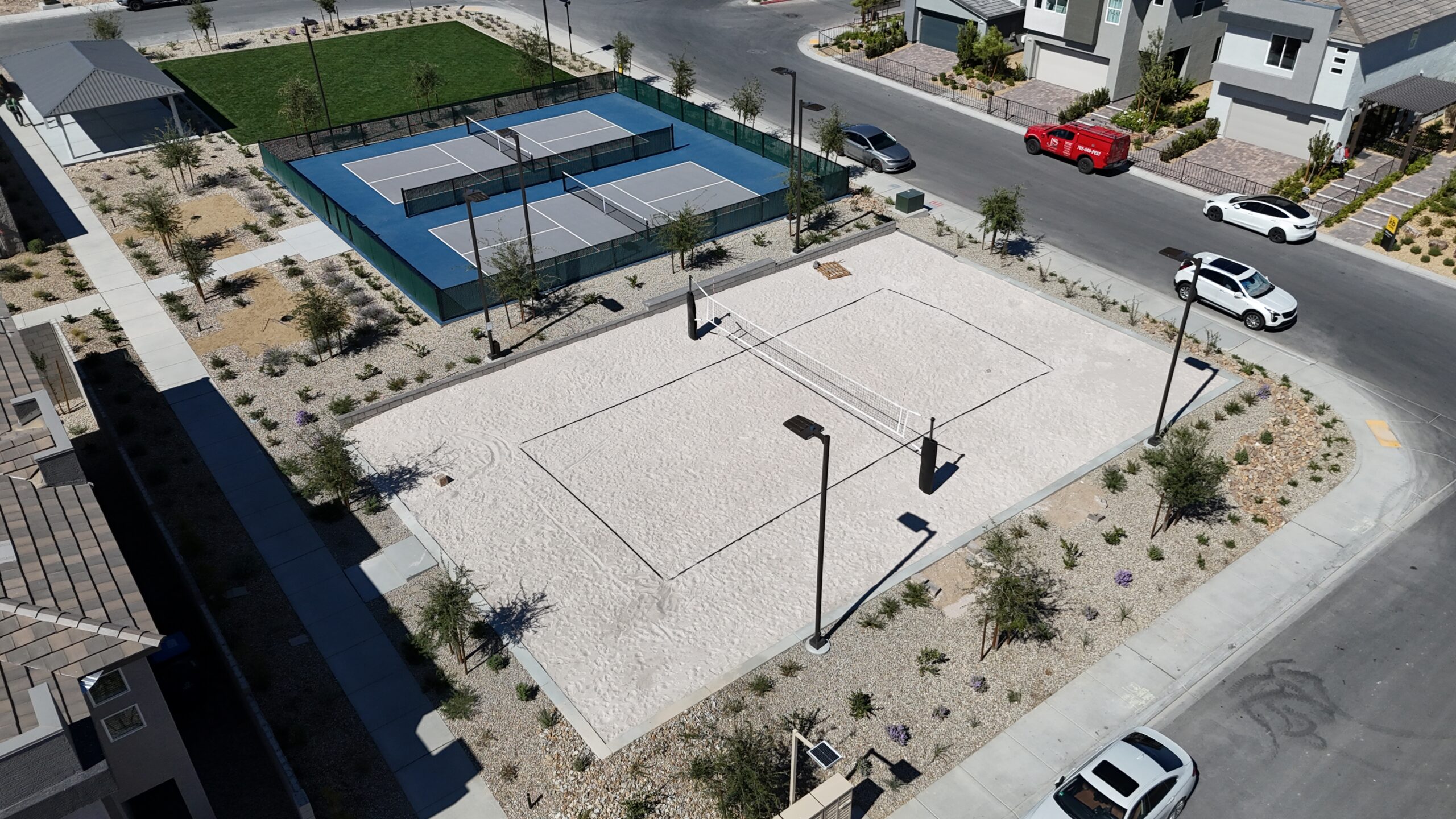
Getting court dimensions right is the foundation of a court that plays correctly and looks professional. Whether you’re planning a backyard build or a commercial installation, this guide covers the regulation dimensions for
basketball, pickleball, and
tennis courts, plus the extra space you actually need around each one.
Your One Stop for Every Court Size
Court sizing questions almost always start the same way. Someone has a space in mind and wants to know whether the sport they want will fit in it. The answer depends on two numbers that often get confused: the playing surface, and the total footprint once you add the space around it.
This page brings together the regulation dimensions for every sport we build, along with the clearance each one needs in practice. Use it as the starting point, then let a site visit confirm what your specific property can hold.
Playing Surface vs. Total Footprint
The playing surface is the area inside the lines. The total footprint is that surface plus the run-off space around it, and the difference between the two is where most planning mistakes happen.
A pickleball court is 20 by 44 feet on the lines. Add the recommended 10 feet behind each baseline and 5 feet along each sideline and you are planning for roughly 30 by 60 feet. That is half again as much space as the court itself.
Run-off is not padding. It is the room a player needs to chase a ball down without running into a fence, a wall or a planting bed. Cut it and the court still measures correctly, but it stops playing correctly and it stops being safe.
When you measure your space, measure for the footprint, not the surface.
Basketball Court Dimensions
A regulation full basketball court measures 94 feet by 50 feet (NBA/college) or 84 feet by 50 feet (high school). For backyard installations, a half-court, roughly 47 feet by 50 feet, is far more common and gives most households and neighborhoods plenty of room for real games.
Key measurements within the court:
- Free-throw line: 15 feet from the backboard.
- Three-point line: varies by level, from about 19.75 feet (high school) to 23.75 feet (NBA) at the top of the arc.
- Hoop height: 10 feet, regulation for all standard adult play.
Beyond the painted lines, plan for at least 5-10 feet of clear run-off space around the perimeter so players aren’t at risk running out of bounds into a fence or landscaping.
Pickleball Court Dimensions
A regulation
pickleball court measures 20 feet by 44 feet for the playing surface, the same size for both singles and doubles play. Key measurements:
- Net height: 34 inches at the center, 36 inches at the posts.
- Non-volley zone (“the kitchen”): extends 7 feet from the net on both sides.
Run-off space matters more for pickleball than most sports because of the sport’s fast lateral movement. Plan for a minimum of 10 feet behind each baseline and 5 feet along each sideline where space allows, meaning a comfortable pickleball court footprint is closer to 30 feet by 60 feet including clearance.
Tennis Court Dimensions
A regulation tennis court measures 78 feet by 27 feet for singles play, or 78 feet by 36 feet for doubles. Net height is 3 feet at the center, rising to 3.5 feet at the posts.
Additional clearance space is needed around the court, typically at least 12 feet behind each baseline and 6 feet along each sideline for proper play, bringing the total footprint closer to 120 feet by 60 feet for a fully clear regulation court.
Volleyball, Hockey, and Multi-Sport Courts
Beyond the three sports above, three more come up regularly, and each sizes differently.
Volleyball. An indoor court is 29.5 by 59 feet on the lines. Outdoor and recreational courts are frequently scaled down. Clearance matters as much as the surface here, since play regularly carries well past the sidelines.
Hockey. Roller and street hockey surfaces vary far more than the court sports, because there is no single governing dimension for backyard and community installations. What stays constant is that the surface needs to be larger than players expect, and the boards or containment system is part of the footprint rather than an addition to it.
Multi-sport courts. These overlay several sports on one surface with color-coded striping. The footprint is usually driven by the largest sport in the mix, so a court built for both pickleball and a basketball half-court sizes to the basketball requirement and fits the pickleball lines inside it. This is the most space-efficient way to get several games into one yard.
Comparing the Three at a Glance
| | | Recommended Total Footprint |
| | | ~55 x 60 ft with clearance |
| | | ~30 x 60 ft with clearance |
| | | ~90 x 40+ ft with clearance |
Sizing a Court for a Smaller Yard
Most yards will not take a regulation court, and that is a far smaller problem than people expect.
Courts scale. A basketball half-court can come down from 47 by 50 feet and still play well, provided the key and the three-point arc stay in proportion and the clearance behind the hoop is protected. Pickleball is the most forgiving of the three, which is a large part of why it fits so many properties that could never hold a tennis court.
What should not be scaled is the safety clearance. Shrinking the surface is a design decision. Removing the run-off is a hazard.
Where space is genuinely tight, the two options worth considering are a multi-sport layout that prioritises one sport at full size and fits the others around it, or a single-sport court sized to the space rather than to the rulebook. Both play better than a regulation court squeezed in without room to move.
A site visit answers this properly. We measure the usable area, account for slope, setbacks and access, and show you the largest court the property will genuinely hold.
Why Getting Dimensions Right Matters
Undersized courts don’t just look off, they change how the sport actually plays. A pickleball court without adequate kitchen clearance or a basketball court without enough run-off space creates real safety and playability issues. We lay out every court to regulation spec (or a clearly communicated, intentional modification for tight lots) so the finished product plays the way it’s supposed to.
FAQ
What is the standard size of a backyard basketball half-court?
A backyard half-court usually plans around a 47 by 50 foot playing surface with a 10-foot rim, then adds 5 to 10 feet of clearance for a total footprint near 55 by 60 feet. It can be scaled down for smaller yards while keeping safe clearance and true play.
How much space do I need for a pickleball court including clearance?
The court itself is 20 by 44 feet, and with about 10 feet behind each baseline and 5 feet along the sidelines the total footprint is roughly 30 by 60 feet. Its compact size is why pickleball fits so many yards and community spaces.
What is the difference between singles and doubles tennis court dimensions?
Both are 78 feet long. Singles is 27 feet wide and doubles is 36 feet wide. With recommended run-off of about 12 feet behind the baselines and 6 feet along the sidelines, a full tennis court plans to a total footprint near 120 by 60 feet.
Can court dimensions be adjusted for a smaller yard?
Yes. Courts can be scaled to fit your space. We shrink the surface or prioritize certain sports on a multi-sport layout while protecting safety clearance and playability, so the court still plays true. A site visit shows you the largest, best-playing court your yard can hold.
Do multi-sport courts have to compromise on dimensions?
Not in the ways that matter. A multi-sport court overlaps several sports on one surface with color-coded striping, laid out so each game plays well. It is our favorite way to fit more play into less space.
Which sport needs the most space, and which needs the least?
Tennis needs the most room, pickleball needs the least, and a basketball half-court sits in between. Multi-sport courts are the space-saving option when you want several games on one footprint.
How do I plan the right court size for my specific property?
The numbers here are the starting point, but your yard’s shape, slope, setbacks, and access decide what actually fits. Our site visit sorts all of that out. Call us at 702-883-8386 and we will help you plan the right footprint.