
Pickleball Noise: What the Complaints Are Really About and How to Mitigate It

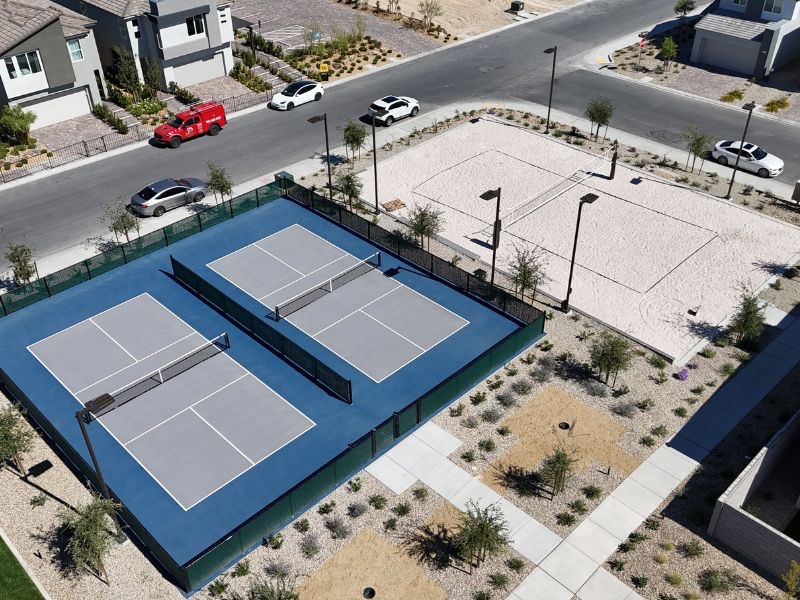
Pickleball noise mitigation has become the deciding factor on a lot of backyard and community court projects, and most of the advice floating around gets the problem wrong. People assume the complaint is about volume. It is not. A leaf blower is louder than a pickleball rally and nobody files a petition about the leaf blower.
The complaint is about the character of the sound and its repetition. Understanding that changes which fixes are worth paying for.
Why the sound is different
A pickleball hit is a short, sharp impact. A rigid composite paddle strikes a hard hollow plastic ball, and the result is a fast transient with most of its energy concentrated in a frequency band the human ear is very good at noticing. It is not a rumble. It is a crack.
Then it repeats. A rally produces a string of these impacts at a fast, irregular cadence, and the irregularity is the part that defeats habituation. Steady sound fades into background. Sound that keeps surprising you does not. A neighbor can sleep through highway traffic and be driven out of their yard by a doubles game two hundred feet away.
This is why measuring an average sound level and declaring the court compliant frequently satisfies nobody. Average levels describe energy over time. Annoyance from impulsive, repetitive sound is not captured well by an average, which is why some jurisdictions have started evaluating these installations differently than they would a mechanical noise source.
Distance and orientation are the cheapest tools you have
Sound level falls off with distance from the source. That relationship is the most reliable lever in the entire toolkit, and it costs nothing if you use it during siting rather than after construction.
Move the court as far from the nearest occupied structure as the lot allows, and pay attention to which structure. The nearest wall of your own house is not the concern. The concern is the neighbor’s bedroom window, their patio, and the outdoor space they actually use. Look at where those are before you pick a corner of the yard.
Orientation matters too, though less than distance. Play tends to project along the length of the court, so aligning the long axis away from the closest sensitive receiver helps at the margins. Court orientation is usually driven by sun angle first, and on a residential lot by whatever fits inside the buildable area, but where there is a choice, noise deserves a vote. We work these constraints together when laying out backyard pickleball court construction projects.
Barriers: what actually works
An acoustic barrier only does something if it meets three conditions. It has to break the line of sight between the impact point and the listener’s ear. It has to have enough mass per unit area to resist being driven by the sound. And it has to have no gaps.
Gaps are where most attempts fail. A barrier with a two inch gap along the bottom or open joints between panels leaks sound straight through, and the leak dominates whatever the panel itself would have blocked. Chain link fencing provides zero acoustic benefit no matter how tall it is, because it is almost entirely air.
Options that do work, in rough order of effectiveness:
- Solid masonry walls and earth berms. Heavy, gapless, permanent. The best performers when height and setback allow them.
- Mass-loaded acoustic curtain systems mounted to the fence. Purpose-built panels with a rated surface density, installed with overlapping seams and closed at grade. Effectiveness depends entirely on installation quality.
- Dense composite or solid fence panels. Better than nothing, much better if sealed at the bottom, and their benefit degrades quickly if the boards shrink and open gaps.
Placement rule: a barrier does the most good when it is close to the source or close to the receiver, and the least good stranded in the middle of the gap. On a residential lot that usually means the court fence itself, which is a point in favor of treating the fence and the acoustic strategy as one design decision rather than two.
One more thing that surprises people: hard vertical surfaces near the court reflect sound. A tall stucco house wall running parallel to the court can bounce impacts toward a neighbor who would otherwise be shielded. Two parallel hard walls can create a corridor effect. Look at the reflective surfaces, not just the direct path.
Equipment changes the source itself
Everything above manages sound after it has been made. Equipment changes how much gets made.
Paddle and ball combinations vary meaningfully in how sharp the impact sounds. Manufacturers have responded to the noise conversation with lower-noise paddle designs and softer ball formulations, and USA Pickleball publishes equipment listings that reflect these categories. Verify current listings rather than accepting a marketing claim on a box.
For a private residential court, equipment is often the single most practical mitigation available, because you control it completely. You can buy the paddles. For a community or club installation it is harder, since you are asking players to change habits, but a posted equipment policy is still worth having.
Surfacing and enclosure choices that make it worse
Nothing about the court surface itself generates meaningful noise, but a few adjacent decisions can make the situation worse than it needed to be.
Fully enclosing a court with hard reflective surfaces on multiple sides increases reverberation inside the enclosure and can raise what escapes over the top. Solid vinyl windscreen is often assumed to be an acoustic product; it is not, and its main acoustic effect is reflection rather than absorption. Where a court sits in a hard-surfaced side yard between two walls, the geometry is working against you before a single ball is struck.
If you are converting an existing tennis court to pickleball, understand that you are changing the acoustic profile of that space substantially. More impacts per minute, sharper transients, and often more courts in the same footprint. A conversion that the neighbors accepted as a tennis court can generate real friction as a pickleball venue, which is worth discussing during the planning of any court conversion.
Operations do the rest
Design gets you most of the way. Behavior closes the gap.
Set and honor start and stop hours, and be conservative about early mornings, which generate more complaints than late evenings in most neighborhoods. If your court is lighted, put the curfew in the controller rather than in your memory. Talk to the adjacent neighbors before construction rather than after the first complaint, because people object far more strongly to what appears without warning. For shared or community courts, post the hours and the equipment policy where they are visible.
None of this is legally required in most places. All of it is cheaper than a dispute.
If you already have complaints
Work in this order. Change the equipment first, since it is immediate and inexpensive. Tighten the hours next. Then look for gaps in any existing barrier and close them, because sealing an existing fence usually outperforms adding height to it. Then add or upgrade the barrier where the direct path actually runs, which may not be where you assumed. Relocating the court is the last option and rarely necessary.
Get a measurement before and after each change if the situation is formal enough to involve a code officer or an HOA board. Documented improvement is far more persuasive than an assurance that it is better now.
We plan noise mitigation into layout, fencing and equipment selection on pickleball court projects, on residential backyard courts, and on commercial court installations where multiple courts sit close to occupied buildings. If you are in an HOA community anywhere in the valley, including Henderson, expect noise to be part of the approval conversation.
Frequently asked questions
Why is pickleball noisier than tennis?
The sound is not necessarily louder, it is sharper and more frequent. A rigid paddle striking a hard hollow ball produces a short impulsive crack with energy concentrated in a band the ear notices readily, and rallies produce those impacts at a fast irregular cadence. Impulsive, repetitive sound is far more annoying than steady sound at the same level.
Do acoustic barriers actually reduce pickleball noise?
Yes, when they are built correctly. A barrier must break the line of sight between the impact and the listener, have real mass, and have no gaps at the bottom or between panels. Chain link provides no benefit. A well-sealed solid wall, berm or mass-loaded acoustic curtain system does.
Do quieter paddles and balls make a real difference?
Equipment changes the sound at its source, which is why it is often the most practical fix on a private court. Paddle and ball combinations differ meaningfully in impact character, and USA Pickleball publishes equipment listings that reflect lower-noise categories. Check current listings rather than relying on packaging claims.
How far should a pickleball court be from a neighbor’s house?
There is no universal distance, and the right answer depends on lot geometry, barriers, intervening structures and local rules. Sound level drops with distance, so more separation always helps. Measure to the neighbor’s bedroom windows and outdoor living space rather than to the property line.
Can I convert a tennis court to pickleball without creating a noise problem?
You can, but plan for it. A conversion typically means more impacts per minute and often more courts in the same footprint, so the acoustic profile changes even though nothing about the location did. Address barriers, hours and equipment as part of the conversion rather than afterward.
If noise is the obstacle standing between you and a court, we can work the siting, fencing and equipment together. Call Nevada at (702) 883-8386 or Arizona at (480) 878-2292, or request a project quote.