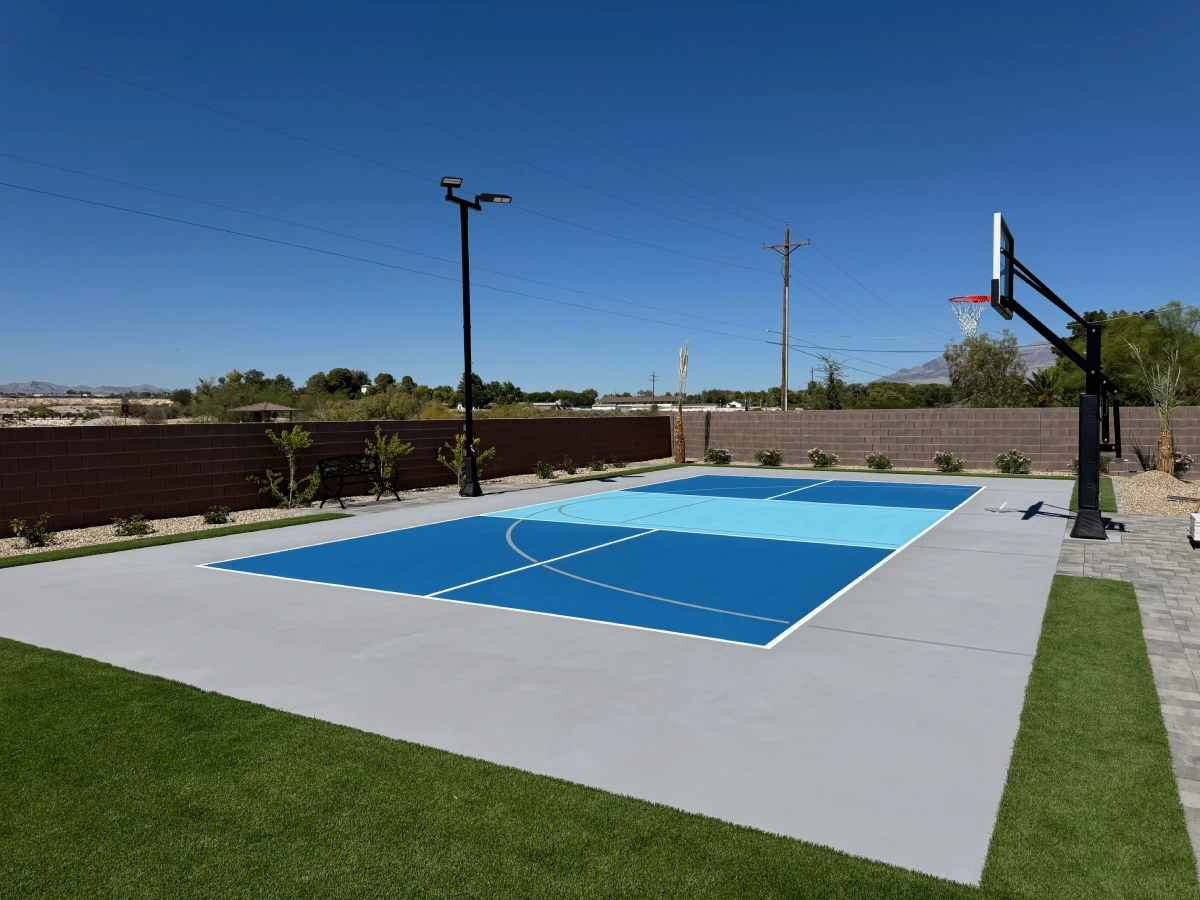
A basketball court is only as good as the hoop it’s built around, and in Las Vegas and Phoenix, that hoop often needs to work well after dark too. This guide covers the hoop systems and lighting options that turn a good court into a court that gets used every day, from casual backyard shooting to serious training sessions.
Basketball Hoop System Options
Fixed-height in-ground systems are anchored directly into a concrete footing and set at regulation height (10 feet). They’re the most affordable permanent option and the standard choice for most backyard and community courts where height adjustment isn’t needed.
Adjustable in-ground systems allow the rim height to be raised or lowered, which matters for households with younger kids who aren’t ready for a regulation hoop, or programs that train multiple age groups on the same court. These systems cost more but add flexibility that fixed hoops can’t match.
Breakaway rims are worth the upgrade for any court that will see real gameplay. A breakaway rim flexes under the weight of a hang or dunk and springs back, protecting both the rim and the backboard from the kind of damage that snaps a rigid rim clean off its mount.
Portable/wheeled systems are an option for temporary or multi-use spaces, but they trade stability and durability for mobility. For a permanent court, an anchored in-ground system is almost always the better long-term investment.
Backboard material matters too. Tempered glass backboards give the truest rebound and are standard for serious play. Acrylic and polycarbonate backboards are more affordable and more impact-resistant, which can make sense for high-traffic community courts.
Anchoring and Footing
Regardless of which hoop system you choose, the footing underneath it is what keeps it standing through wind, impact, and years of use. We pour dedicated concrete footings sized and reinforced for the specific hoop system being installed, not a generic post hole. Skipping proper anchoring is one of the most common (and most dangerous) shortcuts taken on budget installations.
Court Lighting Systems
Court lighting extends usable hours dramatically, which matters most in a region where daytime summer heat can make midday play uncomfortable and evening play the preferred time to use the court.
LED sports lighting is the standard today over older metal halide fixtures. LEDs use less energy, produce more consistent light without the flicker or warm-up delay of older bulbs, and last significantly longer before needing replacement.
Pole-mounted vs. wall-mounted fixtures. Pole-mounted lighting is typical for standalone courts and gives the most even coverage across the full playing surface. Wall-mounted fixtures can work for courts adjacent to a structure but may create more shadow and uneven lighting depending on placement.
Lumens and coverage. The number and placement of fixtures should be based on court size and desired brightness level, casual backyard play needs less intensity than a court intended for serious evening training or hosting games.
Glare control. Fixture angle and shielding matter, especially for residential courts near neighboring properties, to avoid light spilling where it isn’t wanted.
Putting It Together
The right hoop and lighting package depends on how the court will actually be used. A casual backyard half-court for family play doesn’t need the same specification as a court built for a training facility or HOA amenity space that sees daily, high-intensity use. We help clients match the hoop system, backboard type, and lighting package to actual usage and budget, rather than defaulting to either the cheapest or most expensive option available.
FAQ
Should I choose a fixed-height or adjustable basketball hoop?
Fixed-height regulation hoops are best for most serious play and cost less. Adjustable systems are worth the extra cost if younger players or mixed age groups will use the court.
Are breakaway rims worth the extra cost?
Yes, for any court that will see real gameplay including dunks or hangs. Breakaway rims protect the rim and backboard from damage that a rigid rim can’t absorb.
What type of backboard lasts longest outdoors?
Tempered glass gives the best rebound but is more exposed to impact damage. Acrylic and polycarbonate backboards are more impact-resistant and often preferred for high-traffic community courts.
Is LED lighting worth the upgrade over older lighting systems?
Yes. LED sports lighting uses less energy, lasts longer, and provides more consistent, flicker-free illumination than older metal halide systems.
How many light fixtures does a backyard court need?
It depends on court size and desired brightness. A half-court for casual evening play typically needs fewer fixtures than a full court intended for serious training or hosting games. We size lighting packages during your site visit.
Can hoop and lighting systems be added to an existing court?
Yes, both can be retrofitted onto an existing court as long as the base can support proper anchoring or fixture mounting.
- This page is part of our Basketball Court Construction hub. See our guides on basketball court installation and surface options, or find your local service-area page. Ready to plan your hoop and lighting setup? Get a quote from Legendary Sport Construction today.