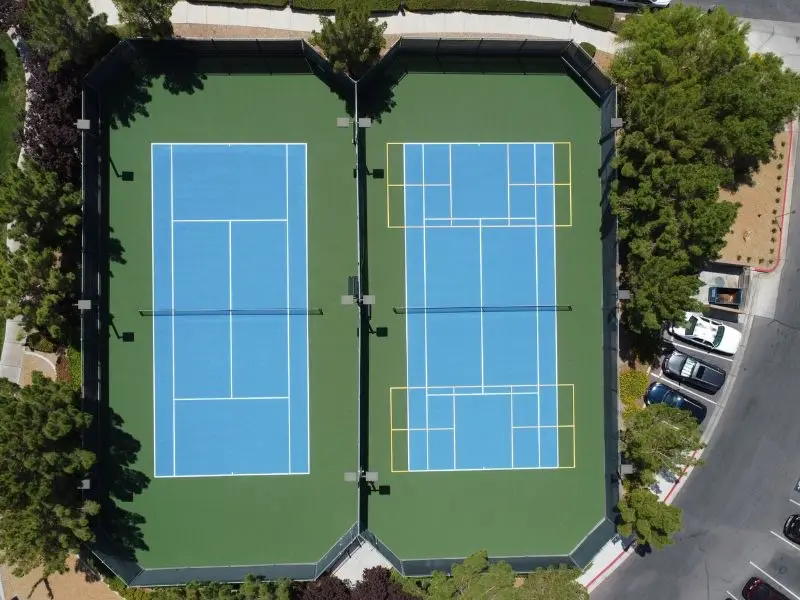
Your court doesn’t look the way it used to. The color has gone flat, the lines are ghosting, maybe a crack has opened up near the baseline and you’ve started to wonder whether the whole thing is on its way out. So which is it: a resurface that freshens it back up, or a full replacement that starts over from the ground?
Here’s the good news before we get into the weeds. Most of the time it isn’t a coin flip, and it isn’t a judgment call you need a decade in the trade to make. There’s one question that decides the answer, and once you know how to ask it, you can look at your own court and make a pretty confident guess.
We’ve built and rebuilt courts across Las Vegas, Henderson, and the Phoenix valley for over 20 years, and some of the courts we poured back then are still being played on 30 years later. That kind of longevity comes down to one thing, and it’s the same thing that decides resurface versus replace.
The one question that decides it: is your base still sound?
A sport court is really two things stacked on top of each other. There’s the base, the engineered concrete or asphalt foundation underneath, and there’s the surface, the acrylic coating and striping you actually play on. The surface is what you see. The base is what holds everything together.
Resurfacing only touches the top. We repair the coating, correct the small stuff, and lay down fresh acrylic and lines. Replacing means tearing out the base and starting over, because the foundation itself has failed.
So the whole decision collapses into a single test. If the base is sound and the problems live on the surface, you resurface. If the base is moving, settling, or breaking apart, no coating on earth will save it, and it’s time to replace. Everything below is just how to tell which situation you’re in.
Signs you only need a resurface
These are surface problems. They look worse than they are, and a proper resurface makes them disappear.
- Faded, chalky color. Year-round desert UV breaks down coatings faster than almost any climate in the country. Color loss is cosmetic, not structural.
- Worn or ghosting lines. Striping wears off with play and sun. It’s a recoat item, nothing more.
- A slick or worn playing texture. The acrylic has thinned and lost grip. Resurfacing rebuilds the texture.
- Minor hairline cracks that aren’t moving. Thin, shallow cracks that stay put season after season can be cleaned, filled, and coated over.
- Small low spots (birdbaths). After it rains, if a puddle is roughly deeper than a nickel laid flat, that’s a birdbath. Small ones get feathered out and corrected right in the resurfacing process.
If what you’re looking at is on this list, you almost certainly don’t need a rebuild. You need a resurface, and honestly, that’s the outcome we hope for every time we walk a client’s court.
Signs you need a full replacement
These are base problems. They’re the court telling you the foundation underneath has given up, and they don’t respond to surface work.
- Structural cracks that keep coming back. Wide, deep cracks, or the ones you’ve already filled that reopen anyway, mean the base is shifting. You can fill a moving crack a dozen times and it will reappear a dozen times, because the ground beneath it won’t hold still.
- Alligator cracking. A web of interconnected cracks that looks like cracked leather is the classic sign of advanced base failure, usually from water getting underneath over a long stretch of time.
- Settling or heaving. If whole sections have sunk or lifted, the sub-base has moved. Out here that’s often expansive desert soil expanding and contracting under a base that wasn’t engineered for it.
- Chronic drainage failure. Water that pools and never sheets off, again and again, is a grading and structure problem, not a coating problem.
- Root intrusion. Trees planted too close send roots under the slab, and once they lift it, there’s no patching your way back.
The through-line here is movement. A surface coating is designed to sit still on something that sits still. The moment the base starts moving underneath it, the surface is fighting a battle it can’t win, and resurfacing just buys you a season before the same cracks push right back through.
How often should a court be resurfaced?
Most courts want a resurface somewhere in the range of every four to eight years, and here in the desert you should plan for the shorter end of that. The heat, the daily temperature swings, and the relentless UV run the clock faster than they would in a mild climate. A court in Henderson takes more punishment from the sun in five years than a court in a cooler part of the country takes in eight.
The point of staying on that rhythm is that resurfacing is protective. A fresh coat isn’t only cosmetic. It seals the surface against water and sun, and water is exactly what eventually finds its way down to the base and starts the failures we just talked about. Skip resurfacing long enough and you shorten the life of the whole court, base included. Stay on top of it and you protect the foundation for decades.
What makes a resurface last, and when it just delays the inevitable
Not every resurface is created equal, and this is where being straight with you matters more than making a sale.
A resurface holds when the base is genuinely sound and the prep is done right: cracks properly repaired first, birdbaths corrected, the surface cleaned and profiled so the new acrylic bonds. Do that over a stable foundation and it can last years and look factory-fresh the whole time.
A resurface fails, or really just stalls, when it’s laid over a base that’s already moving. And that happens more than it should, because a fresh coat can hide a failing foundation for a little while. It looks brand new on the day the crew leaves. Then the base shifts again, the cracks telegraph back through, and you’ve spent time and effort postponing the rebuild you needed all along. We’ve been called out to more than one court like that. It’s a frustrating thing to be on the receiving end of, which is why we’d rather tell you the honest answer up front.
What we check on a site visit before recommending either
You can make a good guess from the list above. Before anything gets recommended for real, though, we come out and look, because the base doesn’t always announce itself from the surface.
On a visit we’re reading the crack pattern (is it shallow and cosmetic, or does it signal movement below), checking for settling or heaving across the slab, running water or a flood test to find birdbaths and see how the court drains, and looking at the edges, the surrounding soil, and anything (like nearby trees) that could be working against the foundation. Then we tell you what the court actually needs. Sometimes that’s a rebuild. Plenty of times it’s “your base is in great shape, let’s just resurface it and keep it that way.” We’d genuinely rather say the second one.
That’s the whole idea behind being there for the life of your court. The goal isn’t to sell you the biggest job. It’s to keep a well-built court playable for as long as possible, and to be honest with you the one time it isn’t worth saving.
If you’re looking at your court right now and you’re not sure which side of the line it’s on, that’s exactly what a site visit is for. We’ll come take a look and tell you straight. For more on why desert courts crack in the first place, and how to spot a structural crack versus a surface one, see our guide on
why sport courts crack. When it’s time for the work itself, here’s how our
resurfacing and maintenance process works.
FAQ
Can you resurface over cracks? Over shallow hairline cracks that aren’t moving, yes, once they’re properly cleaned and filled first. Over structural cracks caused by a shifting base, no. You can coat over them, but they’ll push back through the new surface within a season, because a coating can’t bridge a base that’s moving underneath it.
Will a resurface actually last? When the base is sound and the prep is done right, absolutely, for years. A resurface’s lifespan is really a reflection of the foundation under it. Solid base, lasting resurface. Failing base, and you’re just delaying a rebuild.
Does a resurface ever just postpone a full rebuild? It can, and that’s the case we want to catch before you spend on it. If the base is already failing, a fresh coat hides the problem for a short while and then the same cracks return. That’s exactly why we look at the base before recommending anything, so you’re not paying to postpone the inevitable.
How do I know if my base has failed? Look for movement: cracks that reopen after being filled, sections that have settled or lifted, alligator-pattern cracking, or drainage that has clearly stopped working. Those point at the structure. Faded color, worn lines, and small low spots point at the surface, and the surface is fixable.