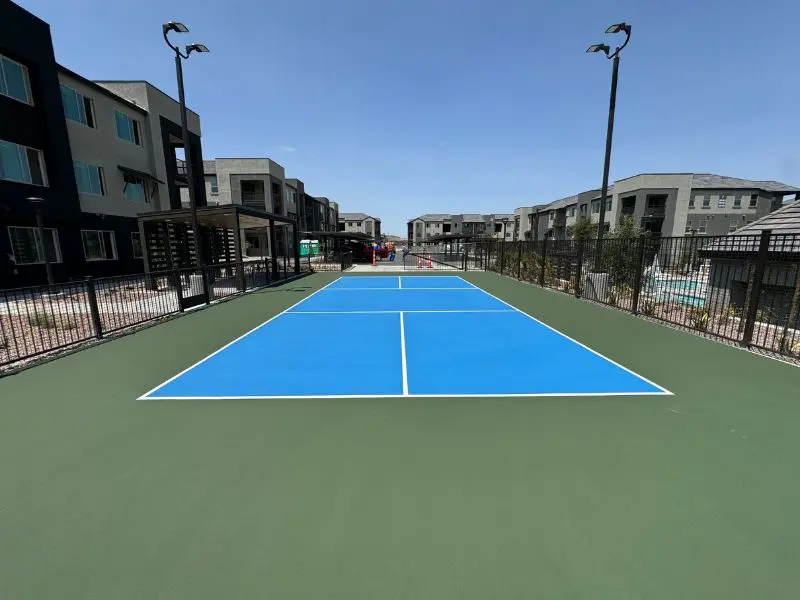
You noticed the first line one morning, running along the baseline, thin as a hair. A year later it’s wider, a little raised at the edges, and now you’re wondering whether the whole court is going bad. It’s the question we hear most often out here: why do sport courts crack, and did something go wrong? Here’s the honest answer, and it’s the one almost nobody leads with. Most of the “why courts crack” advice online was written for cold, wet climates where ice is the villain. Water gets into the surface, freezes, expands, and pries the court apart over a few winters. That story is real. It’s just not our story. In Las Vegas and Phoenix, courts almost never crack from ice. They crack for reasons that are specific to the desert, and once you understand them, most of the damage is preventable.
The short answer: most cracks start under the surface
A cracked court looks like a surface problem. It usually isn’t. The color coat and the acrylic on top are only a few millimeters thick, and they crack because something moved underneath them. In our experience across more than 10,000 projects, the crack you can see is almost always reporting news from below, from the base and the soil the court is sitting on. That’s why patching the surface without understanding the base is like painting over a wall that keeps cracking because the foundation is settling. It buys you a season, maybe two, and then the line comes right back through your fresh coating.
So the real question isn’t “how do I fill this crack.” It’s “what moved, and why.”
What actually causes court cracks in Las Vegas and Phoenix
Soil movement and expansive desert soils
This is the big one, and it’s the one people don’t expect in a place this dry. A lot of Southern Nevada and Arizona sits on expansive clay soils. When those clays take on water, during monsoon storms or from a leaking irrigation line or bad drainage, they swell and push up. When they dry back out over a long hot stretch, they shrink and pull away. Engineers call that cycle heave, and it happens under slabs, footings, and yes, sport courts. When one part of a court’s soil moves more than another, the slab flexes, and something has to give. Usually it’s the surface, in the form of a crack. The
American Sports Builders Association and the USTA construction manuals both treat unstable subgrade as a leading cause of court failure, and in the desert that instability is driven by these wet-dry clay swings rather than frost.
Extreme heat and daily temperature swings
A court in Henderson can hit surface temperatures well over 140 degrees on a July afternoon and then drop 30 or 40 degrees by early morning. Concrete and acrylic expand in that heat and contract when it cools, every single day, all summer long. Do that thousands of times and the material fatigues. Coatings that were never rated for that kind of thermal cycling lose their elasticity and start to fracture, which is why so many hairline cracks show up on the sunniest, most exposed part of the court first.
Year-round UV breaking down cheap coatings
We get roughly 300 sunny days a year, and UV is relentless on a surface with no shade. Bargain coatings chalk out, get brittle, and lose the flexibility they need to move with the court. A
UV-stable acrylic surfacing system is built to take that punishment. A cheap one isn’t, and after one or two desert summers you can usually tell which one you got.
Water and poor drainage
Dry climate, still a water problem. When a court isn’t sloped correctly or the surrounding grading sends runoff toward the slab instead of away from it, water pools and finds its way into the soil underneath. That’s the fuel for the expansive-clay cycle above. A flat-looking court that holds a puddle after a storm is quietly feeding the exact movement that cracks it.
A weak or rushed base, the real culprit
Here’s where all of it comes together. Soil moves, heat cycles, water intrudes. A court engineered to handle those forces stays put. A court built on a thin, poorly compacted, or under-reinforced base doesn’t have the strength to resist them, so it cracks early and keeps cracking. Nine times out of ten, when we’re called to look at a badly cracked court, the base is where the corner was cut.
Structural cracks vs. surface cracks: how to tell them apart
Not every crack means the same thing, and knowing the difference saves you a lot of worry.
Surface, or hairline, cracks are thin, usually less than an eighth of an inch, and shallow. They live in the coating and the top of the slab. They often come from coating age and everyday thermal stress, and they’re frequently manageable with proper repair and resurfacing. Alligator cracking (a scaly, interlocking pattern) and fine shrinkage cracks fall in this family too.
Structural cracks are a different animal. They’re wider, often a quarter inch or more, and they run down through the surface into the base itself. These are the ones that tell you the slab or the soil beneath it has moved. A good rule of thumb: if a crack is wide enough to catch your fingernail, changes elevation from one side to the other, or keeps coming back through every repair, treat it as structural until a professional says otherwise.
Can you repair a cracked court, or does it come back?
Both, and which one you get depends entirely on the base.
If the base is sound and you’re dealing with surface cracks, a proper crack repair followed by
resurfacing and maintenance can give you many more good years of play. That’s the whole point of a resurfacing cycle, which most court bodies put in the range of every five to seven years depending on use and sun exposure.
If the base is failing, though, a surface repair is a delay, not a fix. The soil is still moving, the slab is still flexing, and the crack will telegraph right back through your new coating within a season or two. We’d rather tell you that up front than take you through a resurface we know won’t hold. Sorting out which situation you’re in is exactly the decision we walk through in
resurface vs. replace.
How we prevent cracks: base-first engineering
We’ve built courts in this valley for over 20 years, and some of the ones we poured decades ago are still going strong after 30-plus years of daily play. That doesn’t happen by accident, and it doesn’t happen because of the color coat. It happens because we engineer from the ground up, in that order: Design, Build, Play, Maintain.
Post-tension and reinforced concrete bases
For desert soils, this is the difference-maker. A post-tension slab has steel cables run through it that get tensioned after the concrete cures, holding the whole slab in constant compression. When the expansive soil underneath swells or shrinks, the slab essentially floats and moves as one stable piece instead of cracking apart. Regions with difficult soils have leaned on post-tension for decades for exactly this reason, and the
Post-Tensioning Institute documents the crack-resistance benefit in detail. It’s the single best insurance against the soil movement we described up top.
Proper sub-base prep, compaction, and slope
Before any concrete is placed, the ground has to be right: excavated to the correct depth, compacted properly so it won’t settle unevenly, and graded so water runs away from the court instead of pooling under it. This is the unglamorous work that never shows up in a photo, and it’s the work that decides whether your court is still flat in ten years.
UV-stable acrylic surfacing
Once the base is doing its job, the surface can do its job. We finish with UV-stable acrylic built to flex through the heat cycles and hold its color and grip through our summers, not chalk out after one. You can read more about the
different surface types and which one fits how you actually play.
When a crack means it’s time to resurface or replace
A few faded lines, minor hairlines, a slick spot where the texture has worn down? That’s a resurface conversation. Widening structural cracks, a section that has visibly settled, chronic puddling, or damage that keeps returning after repair? That’s a sign the base needs a real look, and it may be time to rebuild rather than recoat. If you’re not sure which camp your court is in, that’s exactly what a site visit is for.
FAQ
Do all courts crack eventually? Every outdoor court lives with movement, so hairline surface cracks over many years aren’t unusual and are normal wear. What isn’t inevitable is early structural cracking. A court engineered base-first for desert soil can go decades without a structural crack, which is why we treat the base as the thing that determines a court’s real lifespan.
Do concrete courts crack more than asphalt? It’s less about concrete versus asphalt and more about how the base is engineered. Plain slabs and asphalt can both crack when the soil moves under them. A properly reinforced post-tension concrete base is specifically designed to resist that movement in expansive desert soils, which is why we recommend it for courts built to last out here.
Is a cracked court covered under warranty? That depends on the cause and the builder, so the honest answer is that it varies. What we can tell you is how we approach it: we build to prevent the structural cracks in the first place, and we stay in the relationship for the life of your court so there’s someone to call when a question comes up.
If your court is starting to show its first cracks, don’t wait for the line to widen before you find out what’s really going on underneath it. Book a site visit and we’ll tell you honestly whether you’re looking at a simple resurface or something the base is trying to warn you about.