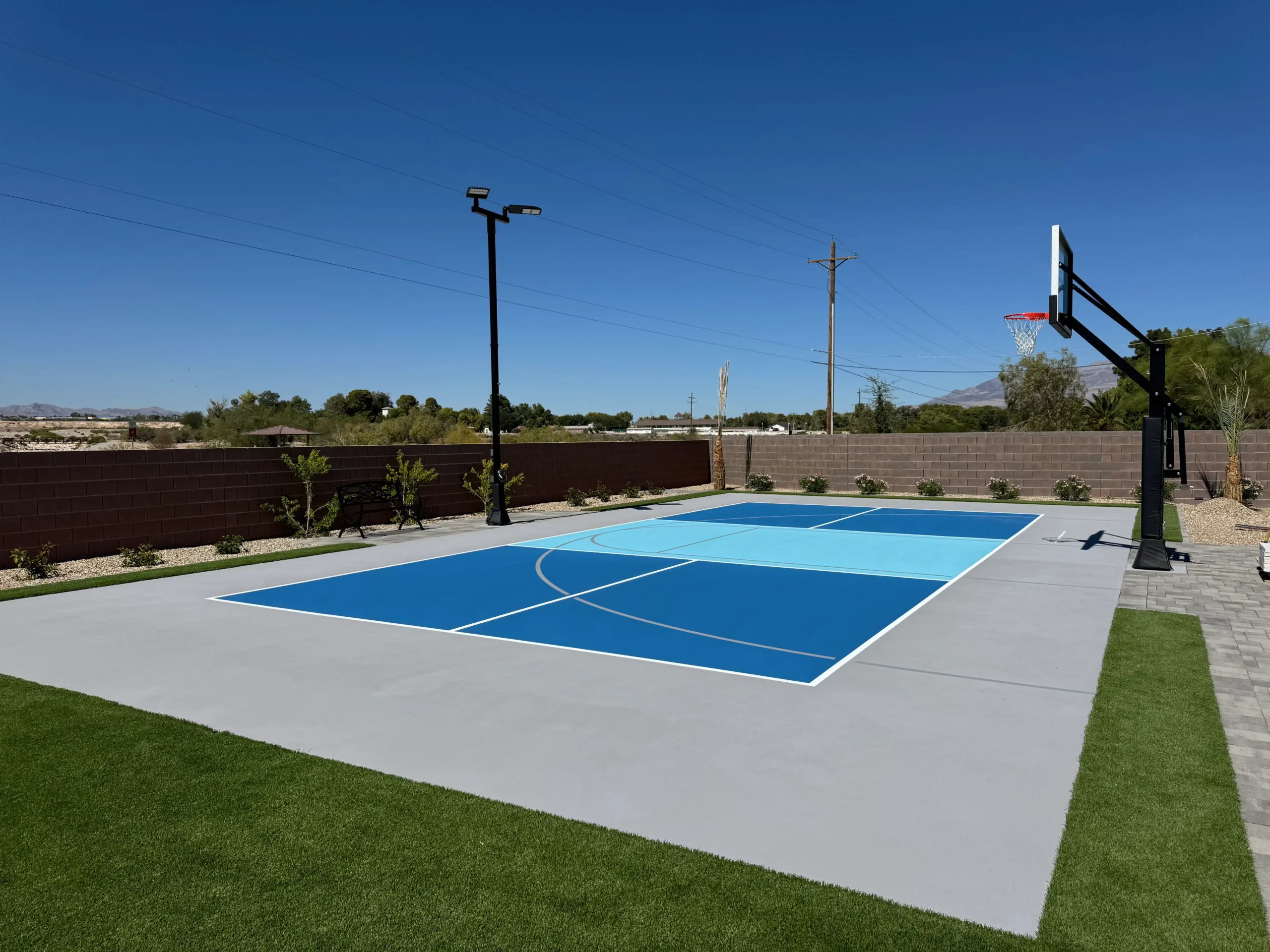
Most people who ask us “is a backyard sport court a good idea?” already want one. What they’re really asking is quieter than that. Will our family actually use it? Does our yard fit? Are we the kind of household this makes sense for, or are we about to build something that sits empty by the second summer?
Fair questions. We’ve built courts across Las Vegas, Henderson, and out into the Phoenix and Scottsdale suburbs for over 20 years, and we’ve learned that the happiest court owners aren’t the ones with the biggest yards or the fanciest surface. They’re the ones who matched the court to how their family really lives. So instead of a sales pitch, here’s an honest look at fit.
The two questions that really decide it
Everything comes down to two things: how you’ll use it, and whether your space can hold it well.
Use is the one people skip. It’s easy to picture weekend games with the kids and harder to be honest about whether that picture lasts. A court that gets played on three or four times a week is a completely different decision than one built for a maybe. Neither is wrong. But knowing which one you are changes what you should build, and whether you should build at all.
Space is the more concrete question, and we’ll get into real numbers below. The short version: a court needs room not just for the lines, but for the run-off around them, the fence clearance, and the space behind the hoop where half the rebounds actually go.
Answer those two honestly and the rest of this article mostly sorts itself out.
Who a backyard court is genuinely right for
There’s a type of household that gets tremendous mileage out of a court, and after thousands of projects the pattern is pretty clear.
Multi-sport families. If your kids rotate through basketball, pickleball, and whatever their friends brought over that afternoon, a single well-designed surface gives all of it a home. A
multi-sport game court can carry basketball keys, pickleball kitchen lines, and more inside the same footprint, which is why it’s our most-requested build for growing families.
Households with kids still at home. This is the big one. A court in the backyard is the difference between “go outside” being a suggestion and being the obvious thing to do. Our founder, Miles Reynolds, grew up playing on his driveway court every day with three brothers, and that’s genuinely the origin of this company. Courts are where athletes grow, families connect, and neighbors end up staying for dinner.
Entertainers. If your yard is already the gathering spot, a court extends it. Game nights, birthday parties, the neighborhood kids who somehow always know where the good hoop is.
Pickleball converts. We’ve watched this one accelerate. People pick it up at a rec center, get hooked, and want a court steps from the kitchen. Pickleball’s low barrier and cross-generational appeal (grandparents and grandkids on the same court, genuinely) make it one of the strongest fits we see.
Who should think twice
We’d rather tell you now than have you regret it later, so here’s the honest counterpoint.
If your available space is genuinely tight, forcing a court into it usually means cramped run-off and a surface that never feels quite right to play on. Sometimes the better call is to wait until you can do it properly, or to choose a smaller single-sport layout instead of squeezing a full multi-sport court where it doesn’t belong.
If the use is rare (a court you’ll touch a handful of times a year), be honest about that before you build. And if nobody in the household is willing to give it the light upkeep it needs, that’s worth naming too. A court isn’t demanding, but it isn’t zero. We’d rather you know that going in.
None of these are permanent no’s. They’re “not yet,” or “not this version.” That distinction matters.
How much space do you actually need?
Here are the numbers people ask us for most, in real feet, so you can walk your yard this weekend.
- Pickleball: the playing area is 20 by 44 feet, but you want closer to 30 by 60 feet once you add safe run-off on the sides and behind each baseline. Players chase lobs well past the line, so that buffer isn’t optional if you actually want to play.
- Half-court basketball: plan for roughly 2,350 square feet to have comfortable room around the key and behind the hoop.
- Multi-sport: a 30 by 60 foot area is the sweet spot, and it’s enough to combine a half-court with pickleball on one surface.
If your yard clears those comfortably, you’re in great shape. If it’s close, that’s exactly the kind of thing we sort out on a site visit before anyone commits to a layout. For more layout inspiration once you know your dimensions, our
backyard sport court ideas gallery is a good next stop.
Matching the court to how you actually play
The right court is the one built around your real weekends, not a spec sheet.
A family that lives and breathes basketball might want a proper half-court with a regulation-height, breakaway rim and room to run a real game. A pickleball-first household wants accurate kitchen lines and a surface that plays true. Most people, though, land somewhere in the middle and are best served by a multi-sport layout that does several things well rather than one thing perfectly. Surface choice follows the same logic: cushioned acrylic feels different underfoot than a modular tile system, and what’s right depends on who’s playing and how hard.
There’s no single best answer here, and anyone who gives you one without seeing your yard is guessing.
Desert considerations before you build
Building here isn’t like building in a mild climate, and a few things deserve a look before you fall in love with a layout.
Space and run-off we’ve covered. Beyond that, sun and shade matter more than people expect, because a west-facing court with zero shade turns into an oven by mid-afternoon in a Vegas or Scottsdale summer. Orientation, and sometimes a shade structure, can change how many months a year the court actually gets used. Then there’s HOA design review, which is a real step across much of Southern Nevada and Arizona and worth starting early. And drainage: our monsoon bursts are short but serious, so slope and water handling get engineered in from the start, not patched on later.
Why quality decides whether you love it in ten years
Here’s the part that separates a court you’re glad you built from one you quietly wish you hadn’t.
You can’t see the base once the court is finished, which is exactly why it’s the thing that decides everything. We engineer the base first, on properly compacted sub-base with correct slope, then surface it with UV-stable acrylic that won’t chalk out after one desert summer. That’s the difference between a court that looks great on day one and one that’s still going strong decades later. We have courts in Vegas that families have played on for over 30 years. The reason isn’t the color they picked. It’s what went in underneath. If you want to understand what goes wrong when that base gets rushed,
why cutting corners on a sport court backfires walks through it.
Follow our Design, Build, Play, Maintain process and the court earns its keep in family time, not regret.
Keeping it great for the life of your court
Upkeep is lighter than most people fear. Sweep it, rinse it, keep an eye on the surface, and plan on a periodic resurface down the road to refresh the color and the lines. That’s most of it. The specifics live in our guide to
keeping it in shape, and we stay in the picture for the life of your court, not just the day we hand you the keys. Want to see how these hold up over the years? Take a look at
real courts we’ve built.
FAQ
What’s the best court type for my family? It depends on how you play. Basketball-first households lean toward a half-court, pickleball converts want accurate lines and a true surface, and most families are happiest on a multi-sport layout that handles several games well. A quick look at your yard and your weekends usually makes the answer obvious.
How much space do I really need? Plan for about 30 by 60 feet for pickleball with proper run-off, roughly 2,350 square feet for a comfortable half-court, and 30 by 60 feet for a multi-sport court. If your yard is close but not certain, that’s what a site visit is for.
Does a backyard court need maintenance to stay good? Yes, but not much. Regular cleaning, keeping the surface clear, and a periodic resurface down the line keep it playing and looking right. A well-built court asks very little to stay great for decades.
Still weighing it? The honest way to know if a court fits your family and your yard is to have someone stand in the space with you. Book a site visit and we’ll walk it together, no pressure to build.