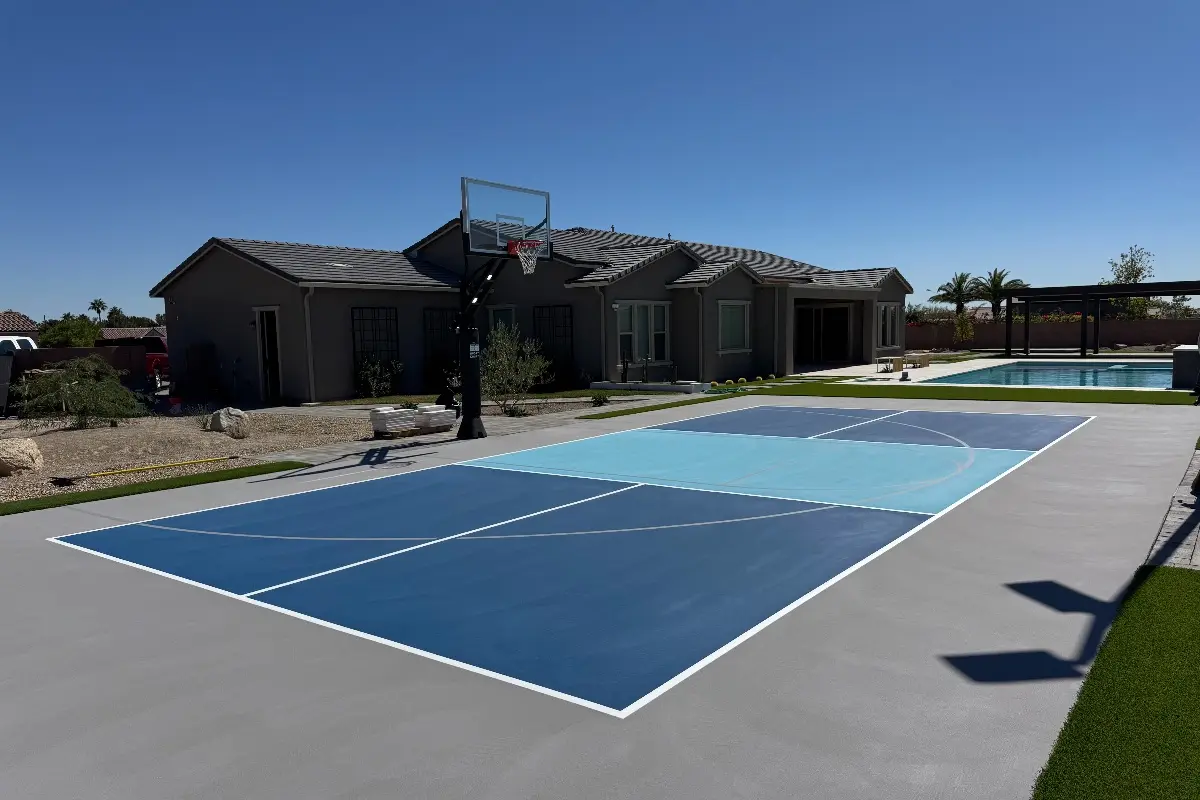
A new court almost never looks like the shortcut it was. On day one, a corner-cut court and a properly engineered one can sit side by side and look identical: fresh acrylic, crisp lines, a hoop that still swings true. That is exactly why poorly built sport court problems catch so many families off guard. The trouble doesn’t announce itself at the ribbon-cutting. It waits.
We’ve built courts across Las Vegas, Henderson, and the Phoenix valley for more than 20 years, and some of the ones we poured early on are still going strong three decades later. We’ve also been called out to look at courts we didn’t build, the ones that started lifting, cracking, or holding water somewhere in year three. Almost every time, the story is the same. The corner that got cut was underground, in the part nobody sees once the surface goes down.
Where corner-cutting actually happens (it’s the base)
Here’s the uncomfortable truth about shortcuts: they don’t come out of the color coat or the striping. They come out of the base.
The base and sub-base are the parts of the job that take the most time, the most equipment, and the most discipline, and they are also the parts a homeowner can’t inspect after the fact. Excavation depth, soil evaluation, compaction, the crushed stone layer that distributes load and breaks the path moisture takes up into the slab, the reinforcement inside the concrete itself. Skip or shrink any of those and the court will still look finished. It just won’t behave finished for long.
That’s what makes base corner-cutting different from every other shortcut. A faded surface can be recoated. Worn lines can be restriped. A failing base can’t be repaired from the top down. You fix it by tearing the court out and starting over, which is the one outcome we build specifically to help you never face.
The failures that show up in years 2 through 10
Base problems keep a schedule. They tend to surface slowly, and here in the desert the clock runs a little differently than it does in cooler, wetter climates.
Cracking and settling from a weak sub-base
Expansive desert soils move. They shrink as they dry out in summer and swell when they finally take on water, and that constant push-and-pull is one of the leading causes of long, diagonal cracks running through a slab. When the sub-base underneath wasn’t properly evaluated and compacted, the ground opens small voids, the slab loses its uniform support, and it starts to settle unevenly. You’ll see it as a ridge through the key, a low spot that never quite drains, or a crack that keeps coming back no matter how many times it’s patched.
Premature surface breakdown
Year-round UV is relentless out here. A surface coating that was under-spec’d or applied too thin can chalk out, fade, and lose its grip after just a season or two of desert sun, while a properly built UV-stable acrylic system holds its color and traction for years. When the coating goes early, the court gets slick, the lines wash out, and what should be a straightforward recoat turns into a bigger conversation because the layers underneath were compromised too.
Drainage and water damage
Water is patient, and it does its damage from the edges inward. When slope and drainage get estimated instead of engineered, puddles form, the perimeter softens, and moisture works its way under the surface. It rarely fails the court overnight. Instead you get algae, slick patches, surface breakdown, and a base that stays wet long enough to lose strength. Poor drainage is probably the most underestimated of all the poorly built sport court problems, precisely because it looks fine right up until it doesn’t.
The tear-out-and-redo outcome
This is the one we most want families to avoid. When the base fails structurally, there is no patch, no overlay, no coat that makes it right. The court has to come out and go back in. Everything that was saved in effort up front gets spent, and then some, on doing the whole thing twice.
DIY and rushed builds: what actually goes wrong
We hear it a lot: how hard can a slab and a couple of hoops really be? The honest answer is that the pouring isn’t the hard part. The engineering under it is.
Most DIY and rushed low-effort builds go sideways in the same predictable places. The site never gets a real soil and topography evaluation, so nobody knows what the ground underneath is going to do. The sub-base gets compacted by eye rather than to spec. Drainage gets set by a rough slope guess. Reinforcement gets thinned or skipped. None of that shows on day one. All of it shows up later, usually as some combination of cracking, settling, and standing water that arrives right around the time the court should have been hitting its stride.
Where more isn’t better
Now the honest counterpoint, because building it right is not the same as building it heavy everywhere.
We don’t believe in over-building a court for how it will actually be used. A light-use backyard hoop for weekend shooting doesn’t need every premium system a tournament-grade multi-sport facility calls for, and we’ll tell you that on the site visit rather than talk you into it. There’s a difference between the things that must never be compromised and the things that are genuinely optional. The base, the compaction, the drainage, the reinforcement, the surface’s UV protection: non-negotiable, because they decide whether the court lasts. Cushioned layers, competition-grade lighting, fencing, extra square footage: real options, matched to how you play, not padded on for the sake of it. Cutting a corner on the base is a mistake. So is spending effort where it won’t change how long you enjoy the court.
How we build for longevity, not shortcuts
Everything we do follows the same order for a reason: Design, Build, Play, Maintain. It starts with understanding your yard and your soil before a single form goes in, engineering the base to hold up to desert heat and movement, and finishing with a UV-stable surface built to take the sun.
That base-first philosophy is why we lean on reinforced and post-tension concrete for the courts that need to last. A post-tensioned slab is held together under tension, which lets it flex with temperature swings and resist the cracking that flexible pavement gives in to over time. It’s the difference between a court that’s still true after 25 or 30 years and one that’s fighting itself by year five. If you want to go deeper on why courts fail in this climate specifically, our guide on
why sport courts crack in the desert breaks it down, and the
most common court-building mistakes we get called to fix covers the rest of the pattern. You can also read up on our
UV-stable acrylic surfacing and how it holds up here.
We pride ourselves on the relationship, and we’re there for the life of your court. That’s not a slogan. It’s the whole reason we refuse to cut the corners that would end the relationship early.
If you’re weighing a court and want to know it’ll be built right, book a site visit and we’ll walk your space with you and lay out an honest plan.
FAQ
Is asphalt or post-tension concrete more durable long-term? For longevity in the desert, post-tension concrete is the stronger choice. It’s engineered to flex with heat and resist cracking, and a well-built post-tension court can stay true for 25 to 30 years and beyond. Asphalt is a flexible pavement, which means cracking tends to arrive sooner and resurfacing comes around more often, especially under year-round sun and moving soils.
Can a poorly built court be fixed later? It depends entirely on whether the base is sound. Surface and cosmetic problems (faded color, worn lines, a slick coat) can be resurfaced. A failing base can’t be patched from the top. If the sub-base is settling or the slab is cracking structurally, the honest fix is a rebuild, which is exactly why the base is the one place you never want a shortcut.
What should never be compromised on a sport court? The parts you can’t see and can’t fix later: soil evaluation, sub-base compaction, drainage and slope, the reinforcement in the slab, and UV protection on the surface. Those decide whether the court lasts. Everything else is a matter of matching the build to how you’ll actually play.