
Does a Backyard Sport Court Add Resale Value?

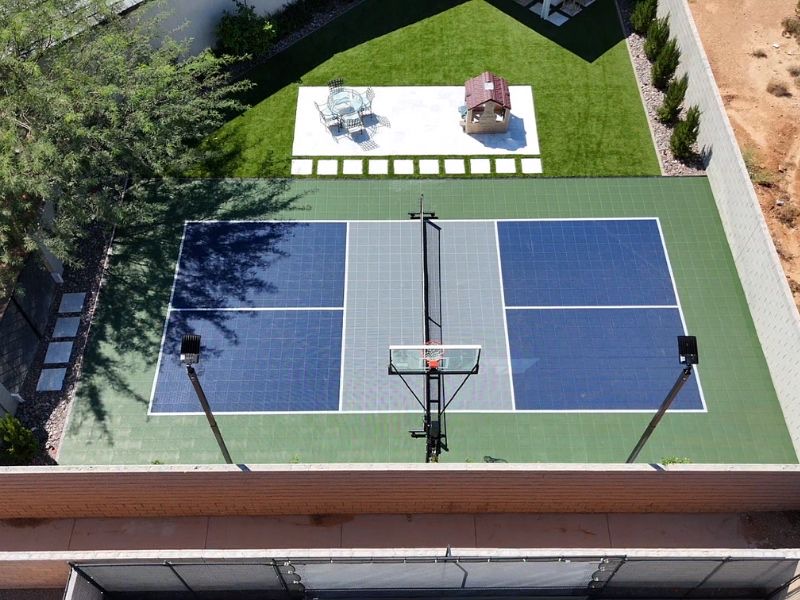
People ask whether a sport court adds value to your home expecting a yes or a no. The honest answer is conditional, and the conditions are more interesting than the question.
A court can help a sale. It can also sit there as a neutral feature that neither adds nor subtracts. In a few cases it works against you. Which outcome you get depends on decisions made during construction, on how the court has been maintained, and on the specific buyer pool for your neighborhood.
What follows is how this actually plays out. We build courts for a living, so treat this as a builder’s view of the market rather than an appraisal opinion. For a valuation on a specific property, talk to a licensed appraiser or a listing agent who knows your submarket.
How an appraiser treats a court
A court is a site improvement. Appraisers assign what is called contributory value, which is what the feature adds to the property as a whole, and that is not the same as what it cost to build.
The method depends on comparable sales. If several homes in your area have sold recently with and without courts, an appraiser can isolate the difference. In practice those paired sales rarely exist, because courts are uncommon enough that a clean comparison is hard to assemble. When the data is thin, the adjustment tends to be conservative.
The takeaway most owners need to hear: money spent does not convert one for one into appraised value. That is true of pools, outdoor kitchens, casitas and most site improvements. It does not mean the improvement is worthless. It means the return shows up partly in valuation and partly in how quickly the house sells and how many buyers compete for it.
The buyer pool gets narrower and more motivated
This is the part that decides most outcomes.
A court does not appeal to every buyer. It appeals strongly to a subset: families with kids in sports, players who would otherwise be driving to a public facility, and buyers who see a finished amenity they do not have to build. For that subset, a well-built court can be the reason your house wins.
The rest of the market sees something different. Some buyers see maintenance they do not want. Some see a large slab occupying the yard they wanted for grass, a garden, or a pool. Some see an expense to remove.
Narrowing the pool is not automatically bad. A smaller number of highly motivated buyers can produce a better result than a larger number of indifferent ones. The risk is when the court narrows the pool without exciting anyone, which is what happens when it is single-purpose, worn out, or sized wrong for the lot.
What raises the odds it helps
Flexibility. A court that plays one sport speaks to buyers who play that sport. A layout that handles basketball, pickleball, volleyball and general use speaks to almost everyone in the amenity-seeking group. This is the strongest single argument for a multi-game court over a single-sport build when resale is part of the thinking.
Condition. A court with tight, even color and no visible cracking reads as an asset. A faded surface with map cracking reads as deferred maintenance and invites the buyer to price a repair into their offer. Condition is controllable, which makes it the highest-leverage thing you can do in the year before listing. Our page on sport court resurfacing and maintenance covers what that involves.
Proportion. A court that leaves usable yard around it presents as one feature among several. A court that consumes the entire back yard presents as a commitment the buyer has to accept or undo. On smaller lots this argues for a reduced configuration rather than a full footprint.
Appearance. Residential-looking fencing, thoughtful color selection, integrated landscaping and shade all change how the feature photographs and how it feels in person. Industrial chain link around a bare slab reads like a school yard. The same court with darker coated fencing, planting along the perimeter and a shade element reads like a designed part of the property.
Build quality. This one is invisible until it is not. Proper subgrade, base and drainage are why some of the courts we built decades ago are still in service and still flat, while others in the valley needed replacement in a fraction of that time. A structurally sound court holds its presentation. One built on a bad pad starts telling on itself, and the reasons are covered in why sport courts crack.
What reduces the odds
Visible deterioration is first. Cracking, standing water, faded lines, sagging net posts and rusted fencing all read as neglect, and buyers extrapolate from what they can see to what they cannot.
Unpermitted work is second and more serious. Improvements built without required permits can complicate a sale in ways that go beyond value. Disclosure obligations, appraiser questions, lender scrutiny and buyer nervousness all attach to work that was never inspected. If the court included electrical for lighting, walls, or structures, having the permit record in hand is worth real money at the closing table.
Poor siting is third. A court crowding a neighbor’s property line, or one that clearly generates light or noise conflict, hands the buyer a problem along with the amenity.
The Las Vegas and Phoenix picture
Two regional factors work in favor of courts here.
The first is climate. Outdoor play is viable across most of the year in both markets, which is not true in much of the country. A court in a place with four months of usable weather is a seasonal amenity. Here it is a year-round one, provided the surface and shade are handled for heat.
The second is lot size in specific submarkets. Established neighborhoods with larger parcels in both valleys have the space to hold a court without eliminating everything else, and that combination is where courts do best on resale.
Working against them: the pool. In both markets a pool is the default expectation for a back yard, and a buyer who wants both needs a lot that can hold both. Where a court occupies the only space a pool could go, you have made a choice on the buyer’s behalf. Where the two coexist, the property reads as fully amenitized.
If resale is part of your reasoning
Build it flexible, build it to last, keep the paperwork, and maintain it.
Keep the permit records, the construction documents, the surface specification and the warranty in one file, and hand that file to your agent when you list. It answers the questions a skeptical buyer will otherwise answer pessimistically on their own.
Maintain on a schedule rather than in response to problems. A resurfacing cycle handled proactively costs less and presents better than a repair done under time pressure during escrow. Our court maintenance services exist for exactly this.
And be honest with yourself about the primary reason. The best case for a court is that your family uses it several times a week for years. Value at resale is a secondary benefit and should be treated as one. If you would not build it for the use, do not build it for the appraisal.
You can see the range of what we build across backyard courts and in our sport court project gallery, and our page on whether a backyard sport court is right for you covers the lifestyle side of the same decision.
Frequently asked questions
Does a sport court add value to your home?
It can, but not dollar for dollar with construction cost, and not for every buyer. A court is treated as a site improvement with contributory value, and appraisers often have few comparable sales to work from. The clearest gains come from a well-maintained, flexible, properly permitted court in a neighborhood where buyers value outdoor amenities.
Will a sport court make my house harder to sell?
Usually it narrows the buyer pool while making the property more compelling to the buyers it does attract. It becomes a liability mainly when the court is deteriorated, unpermitted, single-purpose, or so large that it eliminates the rest of the yard.
Do appraisers give credit for a backyard court?
Appraisers assign contributory value based on market evidence, primarily comparable sales. Where paired sales are scarce, adjustments tend to be conservative. Providing permit records, construction documentation and maintenance history gives the appraiser something concrete to work with.
Is a multi-sport court better for resale than a single-sport court?
Generally yes. A layout that supports several sports appeals to a wider slice of the amenity-seeking buyer pool than a court dedicated to one game, and it reads as a flexible family feature rather than a specialist installation.
Does an unpermitted court hurt a home sale?
It can. Unpermitted improvements raise disclosure, appraisal and lender questions, and buyers tend to assume the worst about work that was never inspected. Keeping permits and inspection records for the slab, electrical, walls and structures protects the value you built.
If you are weighing a court and want it built to hold its value, call Nevada at (702) 883-8386 or Arizona at (480) 878-2292, or request a project quote.