
Basketball Goal Systems: What Actually Matters
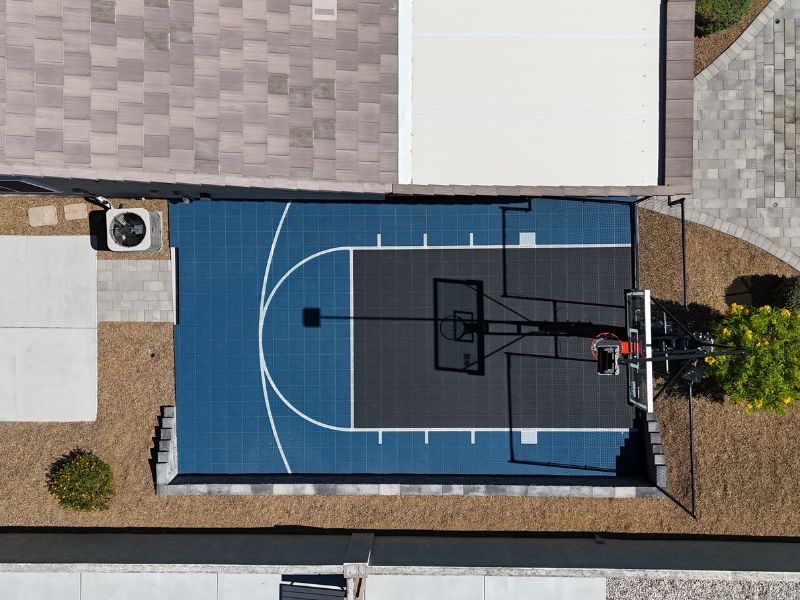
Most people choosing a basketball goal compare backboard size and little else. Backboard size matters least of the decisions on this page, and two of the items nobody asks about are what separate a goal that plays well from one that does not. Here is what each specification actually does.
Extension, which is the one nobody asks about
Extension is the distance from the pole to the backboard. It determines how much usable space exists under the goal before a player runs into the post. A short extension means the pole sits close to the backboard, which means a driving layup ends at the pole. A longer extension puts the pole well back from the playing area.
This is the specification that most affects how a goal plays, and it is the one most often ignored because it is not on the front of the box. For a half court where players will drive to the basket, extension is worth prioritizing over almost everything else. The court layout itself is covered in backyard basketball court dimensions.
Pole size and mounting
The pole is the structure, and it determines rigidity. A larger section pole with proper footing gives a goal that does not move when the rim is hit. A light pole flexes, which is both distracting in play and hard on the system over time.
Mounting comes in three forms.
- In-ground, meaning the pole is set in a concrete footing. This is the durable answer, it is the most rigid, and it is permanent. The footing is sized for the system and for local conditions.
- Portable, with a weighted base. Movable, which suits a driveway or a temporary arrangement, and never as rigid as in-ground. Bases need filling properly and they still move when the rim is hit hard.
- Wall or roof mounted, which suits a situation where there is a suitable structure and no good location for a pole. The structure carries the load, which means it has to be adequate for it.
For a built court, in-ground is the answer in nearly every case, and the footing goes in with the slab rather than afterward. That is covered in basketball hoop installation.
Backboard material
- Tempered glass is what the game is played on. The ball rebounds off glass the way players expect, and nothing else quite matches it. It is heavier, which means the pole and the mounting have to be adequate, and it is breakable, though tempered glass in a properly specified system is not fragile.
- Acrylic approximates glass at lower cost and lower weight, with a rebound that is not quite the same. Acrylic also ambers and degrades under ultraviolet exposure over time, which in this region is faster than elsewhere.
- Polycarbonate is the most impact resistant and the least like glass in rebound.
- Steel and aluminum backboards exist for environments where durability outranks play, such as some public installations.
For a court where real basketball is played, glass is the answer. For a casual family driveway, acrylic is a reasonable compromise.
Backboard size
Regulation size gives the correct bank angles and the geometry players learn on. Smaller boards fit smaller spaces and change the bank shot.
For a full or half court, regulation is the right answer. For a narrow driveway where a regulation board would overhang something, a smaller board is a legitimate compromise. This is a genuine consideration and it is less important than extension and pole rigidity, which is the opposite of how most people prioritize.
Rim type
A breakaway rim flexes under load and returns, which protects both the rim and the backboard when someone dunks or hangs. On any goal where that is possible, it is a requirement rather than an upgrade.
A static rim is simpler and suits a goal where dunking is not in prospect. Spring quality in a breakaway rim varies considerably, and it is one of the places cheaper systems economize. A rim that flexes too easily affects shooting; one that does not flex enough does not protect anything.
Adjustability
Height adjustment is what makes a goal work for a household with children, since a goal fixed at regulation height is unusable for a young player. Crank or lever adjustment at the pole, which is the common residential answer.
Fixed height, which suits a court used only by adults and by serious players, and which is one fewer mechanism to maintain. The trade is that an adjustment mechanism is a moving part exposed to sun and dust, and it is the component most likely to need attention in five years. Where a household has young children, that trade is clearly worth making.
Two goals or one
On a full court the answer is obvious. On a half court it is worth considering a second goal on the opposite end anyway, where space allows, because it changes what the court supports. Where only one is possible, the layout decision is covered in half court backyard basketball court.
What the desert does to a goal
Three local considerations.
- Ultraviolet exposure degrades acrylic backboards, padding, nets and any plastic component. Glass is unaffected and padding is a consumable.
- Heat and thermal cycling work on fasteners and on adjustment mechanisms.
- Dust and wind get into mechanisms, and wind loading on a backboard is a real design input for the pole and footing, particularly on a portable system that can be blown over.
The practical responses are to specify glass over acrylic where the budget allows, to expect padding and nets to be consumables, and to size the footing for wind rather than only for weight.
Padding and safety
Pole padding is worth having wherever players can reach the pole at speed, which is most half courts. Backboard edge padding matters on a goal with a low adjustment setting, since the board edge comes within reach. Both are consumables in this sun and are replaced rather than restored.
Lighting the goal
Lighting a basketball court has a specific requirement: the shooter looks at the rim, so a fixture should not sit behind the backboard in the shooter’s sight line. That is a placement decision made with the court layout rather than afterward, and it interacts with the orientation question in court orientation and sun angle. Ordinance considerations are in sport court lighting, glare and shielding ordinances. Our installation work is on the basketball court installation page.
Frequently asked questions
What is extension and why does it matter?
The distance from the pole to the backboard, which determines how much usable space exists under the goal before a player runs into the post. A short extension means a driving layup ends at the pole. It affects how a goal plays more than any other specification and it is the one most often overlooked.
Glass, acrylic or polycarbonate backboard?
Glass for a court where real basketball is played, because the rebound is what players expect and nothing else matches it. Acrylic is a reasonable compromise for a casual family setup at lower cost, with the caveat that it ambers and degrades under ultraviolet exposure faster here than elsewhere. Polycarbonate is the most impact resistant and the least like glass.
In-ground or portable?
In-ground for any built court, because it is far more rigid and the footing goes in with the slab rather than afterward. Portable suits a driveway or a temporary arrangement and never matches in-ground rigidity, and in this region wind loading on a portable base is a genuine consideration rather than a footnote.
Do I need an adjustable height goal?
If children will use it, yes, since a goal fixed at regulation height is unusable for a young player. The trade is that the adjustment mechanism is a moving part exposed to sun and dust and is the component most likely to need attention in five years. For an adults-only court, fixed height is one fewer thing to maintain.
What is a breakaway rim and do I need one?
A rim that flexes under load and returns, protecting both the rim and the backboard when someone dunks or hangs on it. On any goal where that is possible it is a requirement rather than an upgrade. Spring quality varies considerably between systems, and it is one of the places cheaper goals economize.