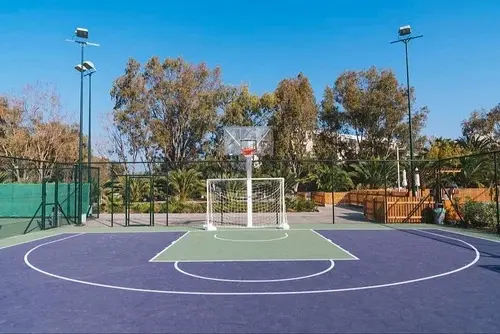
After more than 20 years and 10,000-plus projects across Las Vegas, Henderson, and the Phoenix valley, we’ve built a lot of courts from scratch. We’ve also been called out to fix a lot of courts other people built. And here’s the pattern we see over and over: the mistakes that end up hurting homeowners the most were almost never made on the day someone picked a surface color. They were made weeks earlier, in the dirt, before anyone laid a hand on the acrylic.
That’s the honest version of this list. These aren’t scare stories. Most of the basketball court construction mistakes worth worrying about are quiet ones that look perfectly fine on day one and only show themselves in year three, year five, year eight. The good news is every single one of them is avoidable when you slow down at the start.
So let’s walk through what actually goes wrong, whether you’re planning a backyard basketball court, a pickleball court, or a multi-sport setup for the whole family.
Mistake #1: Skipping a real site and soil evaluation
You’d be surprised how many courts get planned off a rough eyeball of the backyard. Someone paces it out, decides where the hoop goes, and that’s the “site plan.”
Out here, the ground itself is the first thing that lies to you. Desert soils move. They expand and contract with moisture and heat in ways that a slab poured on unstudied dirt simply cannot survive long term, and that movement is the root of a huge share of the cracked courts we get called to look at. A proper evaluation looks at soil type, how the lot drains, where the sun tracks across the yard, and whether the ground needs to be cut, filled, or compacted before anything structural happens. Skip that, and you’re building on a guess.
The fix is boring and it’s everything: look before you dig.
Mistake #2: Cutting corners on the base and sub-base
If there’s one mistake we’d underline twice, it’s this one. The base is the part of your court you will never see again once it’s finished, which is exactly why it’s the part people are tempted to rush.
When the sub-base isn’t compacted properly, it settles unevenly over time. That’s where “birdbaths” come from, those low spots that hold a puddle for two days after it rains and throw off the bounce of the ball. It’s also where a lot of cracking starts, because a surface is only ever as stable as what’s underneath it. Base material matters too. Loose material like pea gravel or sand can feel like a shortcut, but it doesn’t lock together and hold the way a properly compacted crushed-stone sub-base does under years of play.
This is the corner you can’t fix later. You can recoat a faded surface. You can restripe worn lines. You cannot go back and add the compaction and engineering that should have gone under the court without tearing the court out. We go deeper on this in
Why Cutting Corners on a Sport Court Backfires, because it deserves its own conversation.
Mistake #3: Getting drainage and slope wrong
Here’s one that catches even careful homeowners: they ask for a “perfectly flat” court. It sounds right. It’s a mistake.
A court needs a very slight, deliberate slope, usually somewhere around one to two percent, so water runs off the surface instead of sitting on it. No slope means water pools, and pooled water is patient. It works into the surface, softens the ground around the edges, and stains the finish. On top of the slope itself, a real drainage plan may call for the surrounding grade to carry water away from the court, and sometimes catch basins or a French drain where the lot needs it.
Water is the enemy of a sport court, and in the desert people underestimate it because it rains so rarely. But when the monsoon does come through Phoenix or a storm rolls over the valley, an inch of rain in an hour finds every drainage mistake you made.
Mistake #4: Underestimating the space you actually need
A court is not just the lines. It’s the lines plus the room around them, and that run-off space is where a lot of backyard projects come up short.
You want clearance so a player chasing a loose ball doesn’t run into a fence, a wall, or the pool equipment. As a rough rule, you’re looking for meaningful buffer on the sides and more behind the baselines, and behind a basketball hoop you want room to rebound and drive without stopping short. A court that technically fits but leaves no breathing room ends up feeling cramped, and it plays cramped too. Pickleball has its own footprint, its own kitchen lines, and its own clearance needs that differ from basketball.
Before you commit to a size, it’s worth understanding
how much space you actually need for the sport you have in mind. Sometimes the answer reshapes the whole plan, and better to learn that now than after the concrete is down.
Mistake #5: Ignoring HOA design review and permits
This is the desert-specific one, and it trips up more people than any other item on this list, because it has nothing to do with construction and everything to do with paperwork.
In Clark County, a sport court generally needs a permit through the county’s building department, and in many Las Vegas and Henderson communities the HOA architectural review isn’t a suggestion, it’s a required step with its own standards for setbacks, height, fencing, and lighting. Phoenix-area cities and Maricopa County have their own permitting, and Arizona HOAs run their own design-review processes too. Skip the approval and you’re not just risking a fine. Some associations can require you to tear out or modify a court that went in without a green light, which is about the worst outcome we can imagine for a project this significant.
The good news: a builder who does this every week knows what each jurisdiction and most local HOAs want to see, and can hand you the contractor license, insurance, and timeline details that most improvement-request forms ask for. You don’t have to figure out the bureaucracy alone.
Mistake #6: Choosing the wrong surface for how you’ll actually play
Not every court should be built the same way, and picking a surface based on a photo instead of your actual use is a quiet mistake.
A surface tuned for competitive basketball plays differently than one meant for kids learning, or for a family that wants pickleball three nights a week and hoops on the weekend. Cushioning, grip, and how the surface holds up to our year-round UV all factor in. A coating that isn’t UV-stable can chalk out and fade fast after one full Vegas summer, which is not a mistake you want to discover the hard way. It’s worth walking through the
different sport court surface types so the finish matches how your family will really use the court, not just how it looks in a brochure.
Mistake #7: Choosing a contractor without vetting the base work and the track record
We saved this for last because it’s the one that quietly causes most of the others.
When people compare builders, it’s tempting to compare the surface, the colors, the extras you can see. Those are the easy things to look at. The hard thing to look at, and the thing that actually determines whether your court is still going strong in 20 or 30 years, is the part that gets buried: the base, the drainage, the engineering. Ask a prospective builder how they prep and compact the sub-base. Ask how they handle slope and drainage on a desert lot. Ask to see courts they built years ago, not just last month, because a court’s real report card is written by time.
A builder who competes only on what’s visible is telling you where their attention goes. The ones worth hiring will talk your ear off about what’s under the court, because they know that’s where a court is won or lost. Some of the courts we built in Vegas two and three decades ago are still being played on today, and that longevity didn’t come from the top coat.
How we help you avoid all of this
Every mistake on this list traces back to the same thing: rushing past the start. That’s exactly why our process opens with a plan, not a shortcut.
We work in four stages, Design, Build, Play, and Maintain. Design is where the site and soil evaluation, the drainage plan, the space check, and the HOA and permit legwork happen, before a shovel moves. Build is where we engineer the base first and surface it with UV-stable acrylic that’s made for this climate. Play is the part you’re actually here for. And Maintain is the reason we say we’re there for the life of your court, because a court is a long relationship, not a one-time pour. If you’re weighing whether to start, a
backyard basketball court installation or a
pickleball court build both begin the same way: with a site visit and an honest plan.
The single best way to avoid every mistake above is to have someone who’s done it 10,000 times walk your yard with you before any decisions are locked in.
Frequently asked questions
Can I just pour a court myself to save the hassle? You can pour concrete yourself, but a sport court isn’t really a concrete project, it’s an engineering project. The base prep, compaction, slope, and drainage are where DIY courts most often go wrong, and those are the parts you can’t correct after the fact. Most homeowners who start down the DIY road call us when the first low spots and cracks show up, and by then the fix is harder than doing it right the first time.
Do I need a permit for a backyard court in Las Vegas or Phoenix? In most cases, yes. Clark County and Phoenix-area jurisdictions typically require a permit, and on top of that many HOAs in both markets require architectural approval with their own rules for setbacks, height, fencing, and lighting. It’s very local, so the safest move is to confirm before you plan the build. A builder who works in your area every week can guide you through exactly what your jurisdiction and HOA expect.
How much space do I really need? More than the court markings alone, because you need run-off room around the playing area so it’s safe and comfortable to play on. The exact footprint depends on whether you want a full or half basketball setup, pickleball, or a multi-sport court, and it’s worth checking real dimensions before committing to a size.
Building a court you’ll love in ten years starts long before you pick a color. If you’re thinking about it, let’s walk your yard and put a real plan together. Request a site visit and we’ll take it from there.