
Phasing a Backyard Court Build: What to Do First When You Cannot Do It All at Once

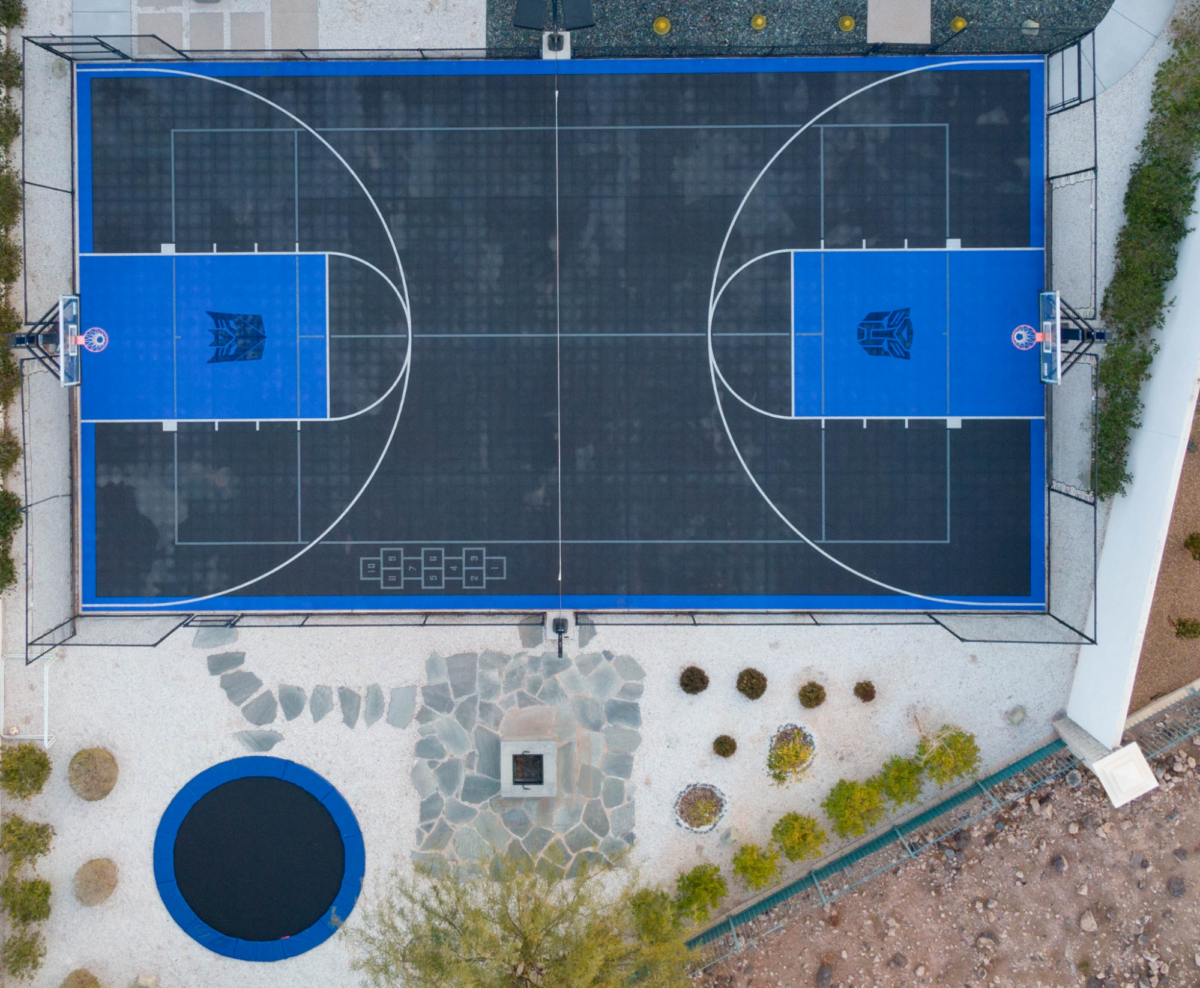
Phased backyard court construction is a legitimate strategy, and most people do it wrong. The instinct is to build a reduced version of everything: a thinner slab, a smaller footprint, cheaper base, skip the drainage, and upgrade later. That is not phasing. That is building a court you will replace.
Real phasing follows one rule, and everything else in this article is a consequence of it.
The rule: never phase what gets buried
Anything under the concrete, inside the concrete, or under the ground next to it goes in phase one at full specification. Anything that sits on top of the finished court, or bolts to something already in place, can wait.
The logic is not about quality standards in the abstract. It is about what retrofitting costs. Adding a light pole to a finished court means excavating a footing next to a slab and trenching conduit across a surface you just paid to install. Adding a net post sleeve means core drilling. On a post-tension slab, every one of those operations requires tendon scanning first, and none of it is a small job. Adding a basketball goal to a court that already has an anchor in the concrete takes an afternoon.
That is the entire difference, and it is worth thousands of dollars of your future money.
Phase one, at full specification
These items are not candidates for deferral or reduction.
- Site work and drainage. Grading, the slope plane, perimeter drainage and the discharge path. Water management is not upgradeable later without demolition.
- Subgrade and base. Stripping, moisture conditioning, compaction, separation fabric and the full base thickness. Invisible forever after day one.
- The slab at full size. Build the footprint you eventually want. Adding to a slab later creates a cold joint that will crack and will always be visible.
- Slab thickness, reinforcement and joints. Structural, permanent, not improvable.
- Conduit, sleeves and blockouts. Lighting conduit and junction boxes to every future pole location, net post sleeves, goal anchors, shade structure anchors or footings, drain lines, and a water line if you might ever want a hose bib or a mister at the court.
The conduit item is the one people skip and regret. Running empty conduit and capping it costs very little during construction. Trenching it later across a finished surface costs a great deal and leaves a repair line you can see. Cutting the base spec or the slab spec to save money in phase one is the classic version of the problem covered in cutting corners on a sport court.
What can genuinely wait
Plenty, as it turns out.
Surface upgrades. The slab needs a surface, but the surface is a wear layer that gets renewed on a cycle anyway. A straightforward acrylic system now and a more elaborate specification, custom colors or additional sport lines at the first resurfacing is a reasonable sequence. Modular tile can also be installed over a properly built slab later, which is covered under court flooring tiles.
Fencing. Fencing phases well by run. Build the tall run where balls actually escape, which is usually one end, and add the remaining runs later. The footings and layout should be planned for the full enclosure so the later work lines up.
Lighting fixtures and poles. If the conduit, junction boxes and pole base locations are in the ground, adding poles and fixtures later is a discrete project with no demolition.
Shade structures. Same principle. Footings and anchors in phase one, structure later.
Windscreen. Attaches to fence that already exists, assuming the fence was engineered for the added wind load.
Equipment. Goals, nets, posts, seating, storage and rebounders all install onto anchors and sleeves already in place.
Surrounding landscape and hardscape. Planting, seating areas, paths and lighting around the court are naturally separable, and doing them later lets you see how the court is actually used first.
Three sequences that work
Play sooner. Phase one is site work, slab, all conduit and sleeves, a basic surface system, and one goal or net. You are playing at the end of phase one. Phase two adds the fence. Phase three adds lighting. Phase four adds shade and the surrounding landscape. This is the right sequence when the household is impatient and the court sits well away from neighbors.
Neighbors first. Phase one is site work, slab, conduit, surface, and the full fence enclosure. Phase two is lighting done properly with shielding and controls. Phase three is shade and equipment upgrades. This sequence suits tight lots, HOA communities, and anyone who would rather not have a conversation about balls in the neighbor’s pool.
Whole yard integration. Phase one is the court and everything buried, including conduit stubs for future yard elements. Phase two is the larger landscape project the court sits inside. This works when the court is one part of a bigger plan and you would rather not tear up finished landscaping to build it.
All three share the same phase one. That is not a coincidence.
What phasing actually costs you
Phasing is a cash flow tool, not a savings tool. Doing a project in three trips costs more in total than doing it once, and it is worth understanding where that shows up.
Every phase carries its own mobilization: crews, equipment delivery, site protection and setup. Later phases mean working around a finished court that now has to be protected. Material and color matching gets harder as time passes, so a fence run added years later may not match exactly and a resurfacing will not match an older adjacent coat perfectly. Approvals can need re-engagement, since an HOA architectural committee and a building department may both need to review phase two separately.
The mitigation on that last point is straightforward: submit the whole plan for approval up front, including the future phases, even if you are only building part of it now. Approved and unbuilt is a much better position than unapproved and needed.
One more: keep the same builder across phases if you can. When two companies work on the same court, responsibility for anything that goes wrong becomes a conversation neither one wants to have with you, and warranty coverage gets complicated in exactly the way that benefits nobody.
How to approach the budget
Price the complete build first, even the parts you know you cannot fund yet. You need the total to make sensible decisions, and it tells you whether the full vision is realistic or whether the design should change now rather than later.
Then fund phase one at full specification rather than funding a percentage of everything. A correctly built slab with no fence is a court. A thin slab on a poor base with a beautiful fence around it is a problem with a fence around it.
Put your contingency in phase one, because that is where the unknowns live. Soil surprises, caliche, unmarked utilities and drainage complications all surface during excavation. Later phases are mostly known quantities.
Set a trigger for each subsequent phase rather than a vague intention. A date, a funding event, or a condition. Phases without triggers tend to become permanent.
We plan builds this way regularly on backyard courts and multi-game courts, and it is worth telling us up front that you intend to phase, because it changes what goes in the ground on day one. If you are earlier than that in the process, our guide to installing a backyard court covers the full sequence, and new court construction covers how we scope the work.
Frequently asked questions
Can I build a sport court in phases?
Yes, as long as everything buried goes in during phase one. Site work, drainage, subgrade, base, the full-size slab, reinforcement, joints, conduit, sleeves and anchors are all permanent decisions. Fencing, lighting fixtures, shade structures, equipment and surface upgrades can all be added later without demolition.
Should I build a smaller court now and expand it later?
No. Adding to an existing slab creates a cold joint between old and new concrete that becomes a visible crack line and a maintenance point. Pour the full footprint you want, and phase the things that sit on top of it instead.
Can I add lighting to a court later?
Easily, if the conduit, junction boxes and pole base locations were installed during construction. Without them, adding lighting means trenching across a finished surface and excavating footings beside the slab, and on a post-tension slab it means tendon scanning before anything is drilled. Install the conduit in phase one even if lights are years away.
Does phasing a court cost more overall?
Generally yes. Each phase carries its own mobilization and setup, later work has to be done around a finished court, and material or color matching becomes harder over time. Phasing manages cash flow rather than reducing total cost, and it is a reasonable tradeoff as long as you understand which one you are buying.
Do I need HOA and permit approval for each phase?
Possibly, since a later phase adding lighting, fencing or a structure may require its own review. The practical approach is to submit the complete plan including future phases for approval up front, so approvals are already in hand when you are ready to build. Confirm requirements with your building department and association.
If you know you will be phasing, tell us at the design stage and we will make sure phase one carries everything the later phases need. Call Nevada at (702) 883-8386 or Arizona at (480) 878-2292, or request a project quote.