
Expansive Soil and Post-Tension Slabs in the Las Vegas Valley

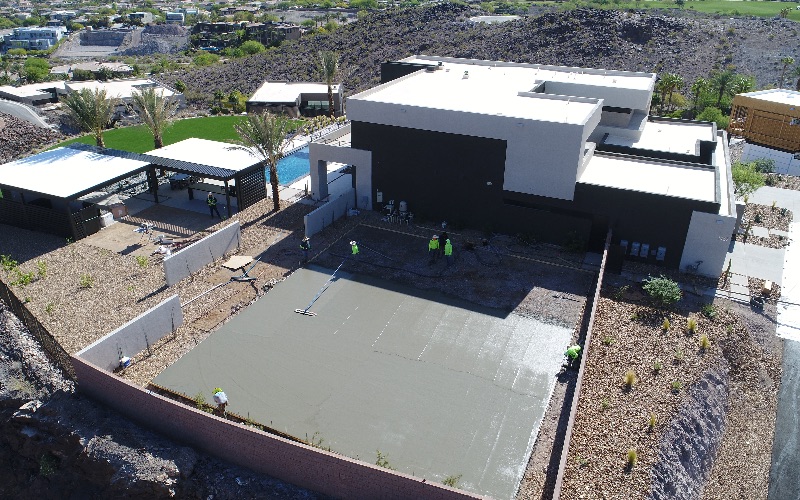
An expansive soil concrete slab in Las Vegas behaves differently from a slab poured on stable ground, and the difference does not show up on the day the concrete is finished. It shows up in year two, after the first full wet and dry cycle, as a crack that opens in one season and closes in the next.
Homeowners here have usually heard the phrase from a foundation contractor or a neighbor. Fewer people know what the soil is actually doing, why the desert of all places has this problem, or what a post-tension slab does about it.
What expansive soil does
Certain clay minerals take water into their structure. When they do, the soil swells. When the water leaves, it shrinks. The cycle repeats indefinitely and it can move a great deal of material.
The damaging part is that the movement is never uniform. Soil under the middle of a slab stays at a fairly constant moisture level because it is covered. Soil at the perimeter is exposed to rain, irrigation, evaporation and root uptake, so it swings. That difference produces differential movement, where one part of a slab rises or falls relative to another, and differential movement is what cracks concrete. Uniform movement would just lift the whole court and nobody would notice.
Two patterns get named. Edge lift is when the perimeter swells upward relative to the center, which typically happens when water gets in at the edges. Center lift is the reverse, when the interior gradually gains moisture and the perimeter dries out.
Why this happens in a desert
This is the part that catches people. Annual rainfall in the valley is low, so how does clay get wet enough to swell?
The answer is that the water almost never comes from the sky. It comes from irrigation systems running daily against a court perimeter. From a pool that leaks slowly. From a hose bib drip nobody noticed. From a downspout discharging in one place year after year. From a neighbor’s grading directing runoff into your side yard. Introducing consistent water into soil that has been dry for a very long time is exactly the condition that produces the biggest volume change.
The valley also has a second and less discussed problem: collapsible soils. Some soils here are stable while dry and lose volume abruptly when wetted, settling rather than swelling. The result looks similar from above, and the trigger is the same, which is water arriving where it historically did not.
And under both of those sits caliche, a cemented layer that resists infiltration and causes water to spread sideways instead of draining down. Get water into a caliche-bounded pocket and it stays there.
How to find out whether you have it
The reliable answer is a geotechnical investigation. Borings, sampling and laboratory testing establish the soil profile and its plasticity, and the report gives an engineer what they need to design a foundation for it. That is a real cost, and on a small residential court it is not always justified.
The practical signals are worth reading first. Does the house have foundation repair history? Do interior doors stick seasonally? Is the driveway or the pool deck cracked in a pattern that opens and closes through the year? Have neighbors had foundation work? Is the neighborhood built on an area known locally for problem soil? If several of those are true, get the report. It is far cheaper than rebuilding a court.
Three ways to engineer around it
There are three broad strategies and good projects often use more than one.
Remove and replace. Excavate the expansive material to a designed depth and replace it with an engineered, non-expansive fill. Straightforward, effective, and priced by the volume of dirt, which is why it gets less attractive as the clay gets deeper.
Control the moisture. If volume change is driven by moisture change, keeping moisture constant reduces the movement. This means perimeter drainage that moves water away decisively, irrigation kept off the court perimeter, no thirsty planting or trees near the edge, root barriers where needed, and leaks repaired immediately. Moisture control is the cheapest strategy and the one most often abandoned six months after handoff.
Stiffen the structure. Design the slab so it behaves as a single rigid plate and rides over the differential movement instead of fracturing. That is what a post-tension slab does.
What a post-tension slab is
A post-tension slab contains high strength steel strands inside plastic sheathing, laid out on a grid before the pour. After the concrete gains enough strength, the strands are tensioned with a hydraulic jack and anchored at the slab edges.
Tensioning the steel puts the concrete into compression. Concrete is strong in compression and weak in tension, and cracking is a tension failure, so pre-compressing the slab makes it far more resistant to the tensile stresses that differential soil movement produces. The tendon grid also ties the whole slab together into one stiff element rather than a collection of panels that can move independently.
This is not exotic. Post-tension foundations are standard practice for residential slabs across large parts of the Southwest and Texas precisely because of these soils. Applying the same approach to a court slab is a known solution.
Two conditions apply. It has to be engineered, with the tendon layout, spacing and stressing designed for the specific soil and slab geometry, not copied from another job. And the stressing has to be documented, with elongation measurements recorded and the as-built tendon layout kept.
What a post-tension slab means for you afterward
This section matters more than any other on this page.
Do not cut, core, drill or saw into a post-tension slab without locating the tendons first. The strands are under very high tension. Cutting one is dangerous to the person doing it and expensive to repair, and it compromises the slab in that zone.
The practical consequence is that everything requiring a penetration has to be planned before the pour. Volleyball and tennis net post sleeves. Basketball goal anchors. Fence post footings inside the slab edge. Drain inlets. Conduit for lighting. Anchors for a shade structure. All of it gets located, sleeved and blocked out in advance, because adding it later is a specialized operation involving tendon scanning rather than a guy with a hammer drill.
Keep the as-built tendon drawing with your property records and give it to any contractor who works on the court later. If the slab edges are stamped or tagged to identify it as post-tensioned, leave those markings visible.
When post-tension is not the answer
Not every site needs it. A court on stable, well drained granular soil with a properly built base does not benefit enough to justify the engineering and the operational constraints.
It is also not a fix for bad water management. A post-tension slab sitting on a saturated, poorly drained subgrade will hold together longer than a conventional slab, but the underlying condition is still there, and it will show up in the base and at the perimeter. Structure and drainage solve different problems, and choosing one to avoid paying for the other is the sort of decision covered in cutting corners on a sport court.
Living with it after construction
The owner’s job on an expansive site is moisture stability. Keep irrigation away from the court perimeter and fix broken heads promptly. Keep the perimeter grade sloping away and do not let it flatten out over the years as landscaping gets added. Avoid planting large water-seeking trees near the edge. Deal with pool leaks and hose bib drips as urgent rather than cosmetic. Watch for new cracking that opens and closes seasonally, and get it looked at early rather than after it has propagated.
Courts fail slowly on these soils, which means there is almost always time to intervene if somebody is paying attention. The failure patterns are catalogued in why sport courts crack, and the point at which repair stops making sense is covered in resurface versus replace.
We build on these soils across the valley, including Las Vegas and the surrounding communities, on both backyard courts and larger new court construction projects.
Frequently asked questions
Does Las Vegas have expansive soil?
Parts of the valley do, and the distribution is uneven from one area to another. The region also contains collapsible soils that lose volume when wetted and caliche layers that trap water. A geotechnical investigation is the only way to know what is under a specific lot.
How does expansive soil damage a sport court?
Through differential movement. Soil under the covered center of a slab holds a fairly steady moisture level while soil at the perimeter swings with irrigation, rain and evaporation. One part rises or falls relative to another, and the resulting tensile stress cracks the concrete.
What is a post-tension slab?
A concrete slab containing sheathed high strength steel strands that are tensioned after the concrete gains strength. Tensioning puts the slab into compression, which resists the tensile stresses that cause cracking, and ties the slab together into a single stiff plate that can ride over uneven soil movement.
Can you drill into a post-tension slab?
Not without locating the tendons first, which requires scanning by someone equipped to do it. Cutting a tensioned strand is dangerous and expensive to repair. Plan every penetration, including net post sleeves, goal anchors, conduit and drains, before the slab is poured.
Do I need a post-tension slab for a backyard court?
Only where the soil warrants it. On stable, well drained ground a conventionally reinforced slab on a properly built base performs well. Where expansive or collapsible soils are documented, an engineered post-tension design is a proven response. The soils report drives the decision, not a preference.
If you are building on ground you have doubts about, we would rather look at it before design than after the first crack. Call Nevada at (702) 883-8386 or Arizona at (480) 878-2292, or request a project quote.