
How Long Does It Take to Build a Sport Court?

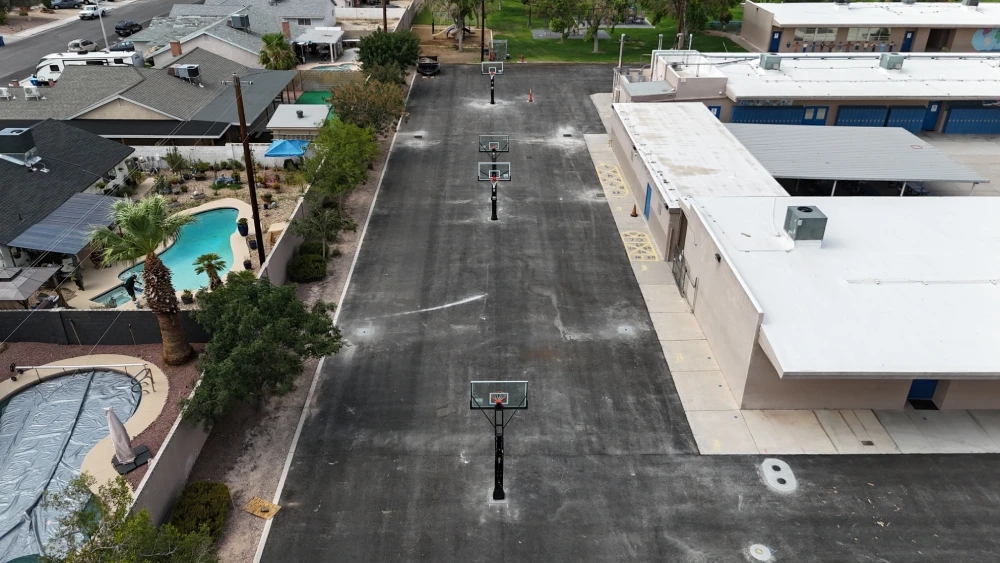
How long does it take to build a sport court? For a typical backyard court in Las Vegas or Phoenix, the honest answer has two parts. The construction work itself usually spans a few weeks. The full journey from first phone call to first game usually spans a few months, and most of that time is not spent building anything.
Owners who only hear the first number get frustrated. Owners who understand the whole sequence plan around it and are rarely surprised. This is the whole sequence, phase by phase, with the honest reasons each one takes the time it takes.
Phase one: design, site review and agreement
The first stretch is conversation and measurement. A serious builder walks the site, checks access for equipment, looks at slope and drainage, asks what sports the court needs to play, and turns that into a layout and a written scope. On a straightforward lot this can move quickly. On a tight lot, a sloped lot, or a lot where the court has to share space with a pool and landscaping, expect more back and forth before the drawing is right.
Rushing this phase is how projects go wrong later. The decisions made here determine the excavation, the slab and the drainage plan, and those are exactly the elements that cannot be cheaply revised once built. The thinking behind those choices is covered in our guide to installing a backyard court.
Phase two: permits and HOA approval
This is the phase owners underestimate most, and it is the one with the widest range. Jurisdiction review times in the valley vary with workload, and a submittal that needs corrections resets part of the clock. If your community has an architectural review committee, its meeting calendar adds its own cycle, and HOA approval and the permit are separate tracks that both have to clear. What each track involves is laid out in our article on court permits and HOA approval in Clark County.
The practical advice: start this phase before you emotionally commit to a play date. Nothing about the construction schedule matters until the paperwork clears, and no reputable contractor will break ground without it.
Phase three: excavation, grading and base
Once crews mobilize, the site work begins. The existing surface comes out, the pad is cut to grade, and the base is placed and compacted in lifts. On a clean, accessible site this measures in days. Limited access, rock, buried surprises, or soil that needs correction all extend it.
Southern Nevada adds its own variable here. Parts of the valley sit on expansive or poorly consolidated soils that demand extra preparation or a different slab design, which is why soil is a schedule question and not just an engineering one. The background is in our pieces on base construction and subgrade and expansive soil and post tension slabs.
Phase four: the slab, and the wait nobody can skip
The concrete pour is a short, intense day. What follows is the least negotiable stretch of the entire project: concrete cures on its own schedule. Industry practice treats roughly twenty eight days as the standard curing period before an acrylic sport surface should go down, because coating a slab that is still releasing moisture is how surfaces blister and peel later.
Owners regularly ask whether this can be compressed. A builder who says yes is volunteering your court for the failure cases described in why sport courts crack. The cure window is not padding in the schedule. It is the schedule.
Phase five: surfacing, lines and finish
The acrylic system goes on in multiple coats, each of which must dry before the next. Color coats, texture and line striping follow. This phase is weather dependent in both directions: coatings have minimum temperature requirements that limit winter work days, and desert summer surface temperatures can push application into early morning windows or off the calendar entirely. The background on what desert heat does to surfaces and work windows is in how Arizona heat impacts court performance.
Fencing, netting, hoops, lighting and shade go in around this phase. Each accessory is quick on its own, but lighting that needs electrical work or structures that need their own inspection add coordination time.
What actually delays court projects
Permit corrections. A submittal that bounces adds weeks. Complete drawings the first time are the cheapest schedule insurance there is.
Weather. Monsoon days stop surfacing in Phoenix. Summer surface heat shortens work windows in both markets. Winter cold snaps pause coating work. Builders plan around all of this, but planning around it is time.
Site surprises. Unmarked irrigation, old footings, rock and bad soil are found by excavators, not by estimators. Good site review reduces the odds without eliminating them.
Decision changes. A color change before surfacing costs nothing. A layout change after the pour costs a redesign. Locking decisions early keeps the schedule honest.
The builder’s backlog. A quality court crew has a queue. If you want to play in a specific season, the reservation matters more than the build duration, and a phased approach can sometimes get the slab in early while accessories follow. We describe that option in phased backyard court construction.
The small waits between phases add up too
The phases above are the ones owners see. Between them sit a set of short, mandatory pauses that rarely make it into anyone’s mental schedule, and together they explain why a project with three weeks of visible work occupies more calendar than that.
Utility locates come first. Before any excavation, the underground utilities on the property get marked, and that request has its own statutory waiting period measured in business days. It is short, it is non-negotiable, and it has saved more projects than any other phone call in construction.
Inspections come next. A permitted court is inspected at defined milestones, and each inspection is an appointment with the jurisdiction’s calendar, not yours. A passed inspection costs a day of waiting. A failed one costs the correction plus a re-inspection. Experienced builders pass these routinely, but the appointments themselves are still calendar entries between phases.
Then there are the material rhythms. Each acrylic coat must dry before the next goes on, and a day of wind or an unexpected shower resets that day. Fencing posts set in concrete need their own short cure before the fabric goes up. None of these waits is long. All of them are real, and a schedule that shows only the work days without them is the kind of schedule that disappoints.
The honest way to read any proposed timeline is to ask the builder which days are work and which days are waiting, and to be suspicious of a calendar that shows no waiting at all.
How to plan backwards from the day you want to play
Take the season you want to be playing in and walk backwards: surfacing needs a suitable weather window, the slab needs its cure before that, site work comes before the pour, and the permit and HOA cycle comes before anything. In practice, owners who want a court for a given season are best served starting the process at least a season ahead, and earlier if an architectural committee is involved.
If you want real dates instead of principles, that starts with a site visit and a scope. You can request a project quote and we will map your specific project, including the permit path for your jurisdiction, onto a calendar. Browse our new court construction services to see what the finished work looks like.
Frequently asked questions
How long does it take to build a sport court?
The construction work on a typical backyard court usually spans a few weeks of active effort, but the full process commonly runs a few months once design, permits, HOA approval, the concrete curing period and weather windows are counted. The paperwork and curing phases, not the labor, set the floor on the calendar.
Why does the concrete have to cure before surfacing?
New concrete releases moisture as it gains strength, and acrylic coatings applied over a slab that is still curing can blister, bubble or peel. Industry practice treats roughly twenty eight days as the standard wait before surfacing, and skipping it trades a few weeks now for surface failures later.
What is the slowest part of a court project?
Usually the parts with no crew on site: permit review, HOA architectural approval and the concrete cure. Construction phases are predictable by comparison. Starting the approval process early is the single most effective way to shorten the total calendar.
Can a court be built in the summer in Las Vegas or Phoenix?
Site work and concrete can proceed with heat precautions, but acrylic surfacing is constrained by surface temperature and, in Phoenix, by monsoon moisture. Summer projects often sequence the slab during the hot months so surfacing lands in a better window shortly after.
Does a multi-sport layout take longer to build than a single-sport court?
Not meaningfully. The pad, base and slab work are similar for comparable sizes. The additional time is in design and striping detail, which is measured in days rather than weeks, and the flexibility usually repays it.
Ready to put your project on a real calendar? Call Nevada at (702) 883-8386 or Arizona at (480) 878-2292, or request a project quote.