
Cushioned Court Surface Systems: Worth It or Not
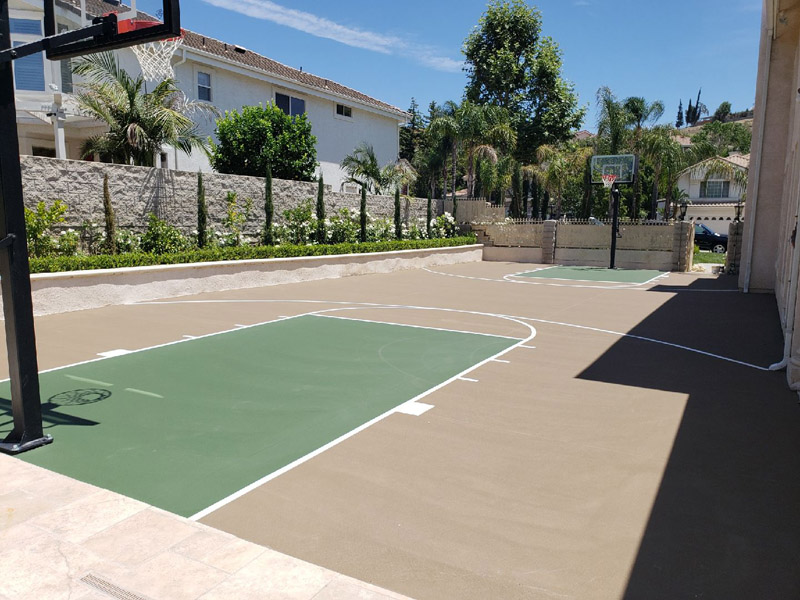
Most outdoor courts in this region are standard acrylic systems: a few thin coats over a base, hard underfoot and durable. A cushioned system adds layers between the base and the color coats, and it changes how the court feels to play on.
It also costs more, behaves differently over time and is not right for every project. The decision is worth making deliberately rather than by default in either direction.
What a cushioned system is
A conventional acrylic court is a patch and leveling course, resurfacer coats, color coats with graded sand, and line paint. Every layer is thin and the surface is hard, because the base beneath it is hard.
A cushioned system inserts resilient layers beneath the color coats. Those layers are typically rubber granules bound in an acrylic binder, built up in multiple passes, with the conventional color and line system over the top.
The result reads the same from a distance and feels different underfoot. The resilient layers absorb a proportion of each impact rather than transmitting all of it back.
The base and preparation requirements do not change, which is worth saying because a cushioned system over a poor base is still a court with a poor base. Those requirements are in sport court base construction and subgrade.
What it actually does
- Reduces impact on joints. This is the main reason people specify it. Running and stopping on a hard acrylic court transmits load through ankles, knees, hips and back, and a resilient layer absorbs part of it. For players with existing joint issues, or players who are on court for hours, the difference is noticeable.
- Slows the ball slightly, since the surface absorbs a small amount of energy from the bounce. Whether that is desirable depends on the sport and the player.
- Feels different underfoot, which some players prefer and some do not. It is not a universal improvement and anyone considering it should play on one first.
- Reduces fatigue over a long session, which follows from the impact reduction.
What it costs you
- More money, both in material and in the number of passes required.
- More installation time, since the resilient layers are built up over multiple applications with curing between them.
- A different repair proposition. A cushioned system is more involved to repair than a standard acrylic surface, because the repair has to reinstate the resilient layers rather than just the color coats.
- Potentially shorter resurfacing intervals in heavy use, depending on the system and the traffic.
- Sensitivity to the base, since a cushioned system over a base that is cracking will still crack. The resilient layers are not a crack bridging system, which is a common misunderstanding. Why courts crack is covered in why sport courts crack.
Who should specify one
- Players with joint concerns, which is the strongest single case and the reason most residential cushioned courts get built.
- Players who are on court for extended sessions, where cumulative impact matters.
- Older players, which in pickleball is a substantial share of the playing population.
- Facilities positioning themselves on player experience, where the surface is part of the offering. Commercial considerations are on the commercial courts page.
- Anyone who has played on one and prefers it, which is the honest test.
Who should not
- A court used casually by a family, where the premium buys something nobody will particularly notice.
- A heavy multi-sport court with hard wheeled traffic or equipment on it.
- A project where the budget would otherwise come out of the base, which is the important one. A standard acrylic system over an excellent base outperforms a cushioned system over a compromised one, every time. The argument against economizing in the wrong place is in cutting corners on a sport court.
- A project where nobody has played on one, since it is a feel preference and feel preferences should be tested.
Degrees of cushioning
This is not a binary choice. Systems are built to different thicknesses, which means different amounts of resilience.
A light cushion takes the edge off a hard court while keeping the ball speed close to standard. A heavier cushion gives more impact absorption and more effect on play.
For a residential court, a light to moderate cushion is frequently the right answer, since it addresses the joint concern without changing the game as much as the player expects. That is a conversation to have specifically rather than specifying a cushioned court and accepting whatever arrives. Surface options generally are on the sport court surface types and court surfaces pages.
The desert factor
Two local considerations. Heat. Surface temperature is affected by color far more than by the system beneath it, which is covered in how Arizona heat impacts court performance. A cushioned system does not make a dark court cooler.
Installation conditions. The additional layers mean more applications, each of which needs appropriate temperature and conditions to cure. In a summer build that affects scheduling, which is part of the argument in the best time of year to build a sport court.
Resurfacing an existing court
A cushioned system can be added when an existing court is resurfaced, provided the base is sound. That is a reasonable time to make the decision, since the court is already being worked on and the incremental cost of the resilient layers is smaller than the whole-court comparison suggests.
What it cannot do is fix an existing problem. A court with structural cracking, birdbaths or base movement needs those addressed first, and the decision between resurfacing and reconstruction is covered in resurface versus replace a sport court.
What to ask
Whether a cushioned system is being proposed and why. How many resilient layers and what the resulting cushion level is. Whether you can play on a court with that system before committing. What the repair process is if the surface is damaged. What the expected resurfacing interval is compared with a standard system. And whether the base specification is the same either way, which it should be. Our surfacing work is on the sport court resurfacing and maintenance page.
Frequently asked questions
What is a cushioned court surface?
An acrylic court system with resilient layers, typically rubber granules in an acrylic binder, built up between the base and the color coats. It looks the same from a distance and feels different underfoot, absorbing part of each impact rather than transmitting it all back. The base and preparation requirements are unchanged.
Does a cushioned court reduce joint pain?
It reduces the impact transmitted through ankles, knees, hips and back, which is the main reason people specify one, and players with existing joint issues or long sessions on court generally notice it. It is not a medical intervention and it is a meaningful difference in feel, which is why playing on one before committing is the sensible test.
Will it stop my court cracking?
No. The resilient layers are not a crack bridging system, which is a common misunderstanding. A cushioned surface over a base that is moving or cracking will crack along the same lines. Cracking is a base and subgrade problem, and it is addressed there rather than in the surface.
Is it worth the extra cost?
It depends on who is playing and for how long. For players with joint concerns, older players and anyone on court for extended sessions, frequently yes. For a family using the court casually, usually not. And never at the expense of the base, since a standard surface over an excellent base outperforms a cushioned one over a compromised base every time.
Can it be added to an existing court?
Yes, when the court is being resurfaced and the base is sound, which is the natural moment to decide since the incremental cost is smaller than the whole-court comparison implies. What it cannot do is fix existing problems. Structural cracking, low spots and base movement are addressed first or the new surface reproduces them.