
Court Edges, Curbs and Transitions
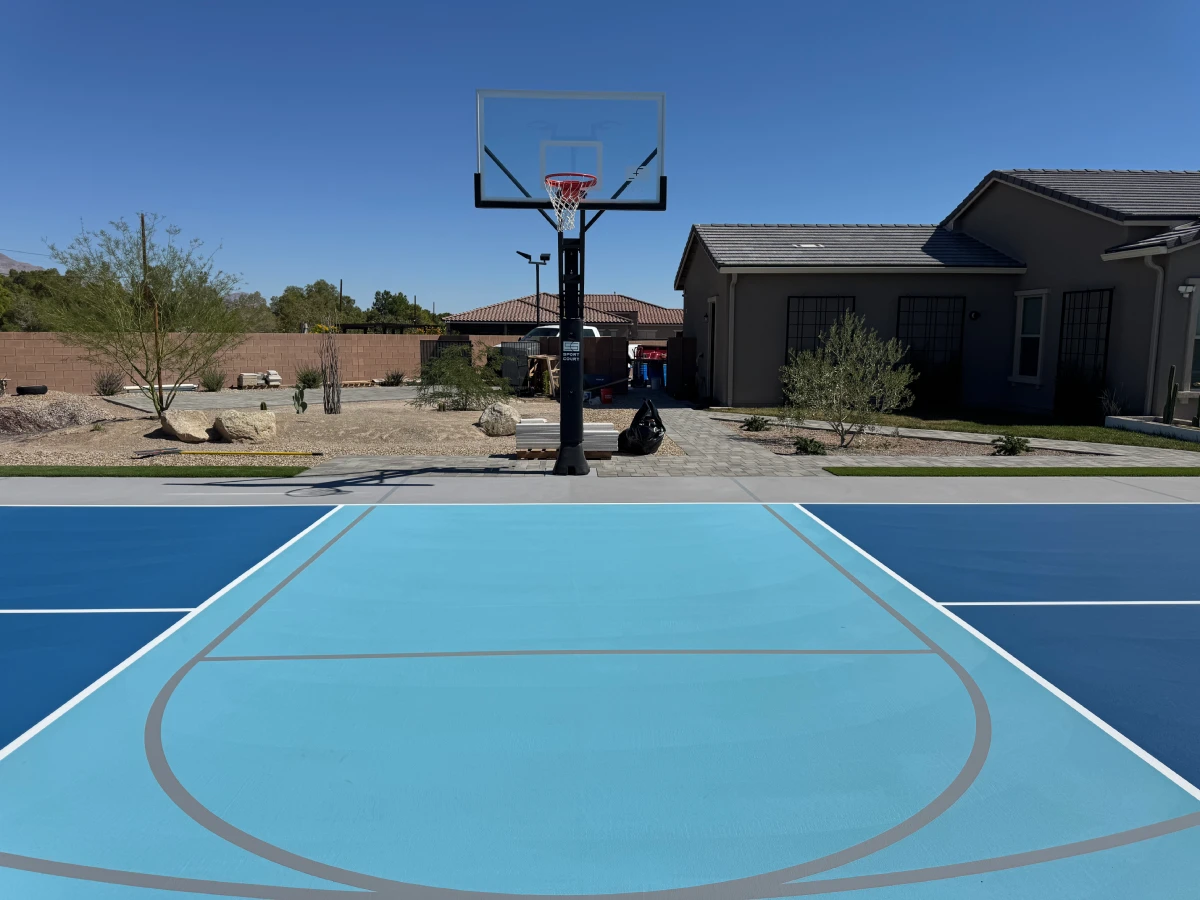
A court fails from its edges inward. Not from the middle, where the traffic is, but from the perimeter, where water leaves, where the base stops, where fence posts penetrate and where the surface meets something else. It is also the part of a court that is easiest to detail properly and cheapest to get wrong.
Why the perimeter is vulnerable
Four things happen at the edge of a court that do not happen anywhere else on it.
- The base stops. A compacted base has an edge, and unless that edge is confined, the material at it can move outward over time, taking support away from the surface above.
- Water leaves. Everything the court sheds crosses the perimeter, which means that is where water concentrates and where it either leaves cleanly or starts undermining.
- Soil meets court. On one side is engineered base, on the other is native soil that moves with moisture and is frequently irrigated.
- Things penetrate it. Fence posts, net post footings and any structure footing pass through the surface or sit immediately beside it.
Every one of those is a detail rather than a material, which is why two courts built with identical surfacing can behave very differently at ten years.
Edge confinement
The base needs to be held at its perimeter.
- A thickened edge on a concrete slab, which is a structural detail.
- A curb around an asphalt or base-built court, which confines the material and gives a clean line.
- Adjacent hardscape, where the court meets a patio or a path, which serves the same function if it is built to.
- A compacted shoulder, where the base extends past the surface and is itself confined by grade.
What does not work is a base that stops at the surface edge with native soil against it, since there is nothing holding the aggregate in place and the edge gradually loses material. The base itself is covered in sport court base construction and subgrade.
Water at the perimeter
The surface is sloped so water leaves, which is covered in sport court drainage and grading. What happens at the moment it leaves is the edge question.
- It has to go somewhere. Water running off the low side and then sitting against the court edge soaks the base from the side, which is the slowest and most damaging version of the problem because nobody sees it.
- Grade has to fall away from the court at the perimeter, or there has to be a drain.
- Sediment accumulates at the edge, since runoff here carries sand and silt, and an edge that silts up stops draining.
- Planting beds against the edge hold water there, which is one of the reasons for a hardscape band between the court and the landscape, covered in landscaping and irrigation around a sport court.
Fence posts
Fence posts are the most common penetration and the most common source of localized edge failure. Three considerations.
- Where they sit. A post set in the court surface means a footing through the surface and a detail around it. A post set outside the court, in the shoulder or beyond, keeps the surface continuous. Which is appropriate depends on the layout and on the fence design, covered in sport court fencing and netting systems.
- The footing. A fence post footing is a block of concrete in the base, and the interface between it and the surrounding aggregate is a discontinuity. Water follows discontinuities.
- Movement. A fence takes wind load and transmits it into the footing, and a footing that moves disturbs everything around it. In this region wind loading on a fence with windscreen on it is substantial.
Where the surface meets a fence post, the detail is sealed and maintained rather than left as a gap.
Net posts
Net post footings sit inside the court rather than at its edge, and they are the same kind of discontinuity. The important point is that they go in with the slab. Retrofitting a net post into a finished court means coring it, which is a repair as well as an installation, and on a post-tensioned slab it is a serious matter covered in expansive soil and post-tension slabs in Las Vegas. Where a court may later serve an additional sport at a different net position, installing the sleeves at construction is inexpensive insurance.
Transitions to other surfaces
Where a court meets a patio, a path, a turf area or a driveway, the two surfaces move independently and the joint between them has to allow for it.
- A defined joint rather than two surfaces butted together, which is what cracks.
- A level transition where people walk across it, since a lip is a trip hazard and on a court perimeter people move quickly.
- Material difference, meaning two surfaces that were installed by different trades at different times and that are expected to meet neatly. Agreeing who is responsible for the transition avoids the gap that neither one owns.
What this looks like on an existing court
Several signs tell you the perimeter is failing, and all of them appear before the court does.
- Cracking parallel to the edge, a short distance in from it, which is the surface losing support where the base has lost material.
- A visible lip where the surface edge has broken away.
- Vegetation growing at the edge, which indicates both a gap and moisture.
- Silt accumulation at the low side, which indicates the edge is not draining.
- A fence post that moves, or cracking radiating from a post.
- Settlement immediately outside the court, which indicates material migration from under the edge.
Catching any of these early turns a maintenance task into a maintenance task. Left alone, each becomes a reconstruction of that section. The decision framework is in resurface versus replace a sport court.
Maintaining the edge
- Keep it clear of silt, debris and vegetation, which is part of the routine in desert court maintenance schedule.
- Check drainage after storms, since that is when you can see whether the perimeter actually works.
- Watch the irrigation, since a head that was adjusted by a landscaper to throw a little further is how a dry edge becomes a wet one.
- Seal and maintain joints and penetrations rather than waiting for them to open.
- Address a lifting edge immediately, since it progresses inward and the repair grows with it.
What to ask when a court is quoted
How the base is confined at the perimeter. Whether there is a curb, a thickened edge or adjacent hardscape. Where water goes once it leaves the court. Whether fence posts sit inside or outside the surface and how the detail is made. Whether net post sleeves are included, and whether sleeves for any future sport are. And how transitions to other surfaces are detailed.
A quote that covers the surface and the fence and says nothing about any of this has specified a court and not its perimeter. The broader list is in court construction mistakes to avoid.
Frequently asked questions
Why do courts fail at the edges first?
Because four things happen there that happen nowhere else: the base stops and can lose material if it is not confined, water concentrates as it leaves, native soil meets engineered base, and fence and net posts penetrate the surface. Each is a detail rather than a material, which is why identically surfaced courts behave differently at ten years.
What holds the base in at the perimeter?
A thickened edge on a slab, a curb around an asphalt or base-built court, adjacent hardscape built to serve the purpose, or a compacted and confined shoulder. What does not work is a base that simply stops with native soil against it, because nothing holds the aggregate and the edge gradually loses material.
Should fence posts be inside or outside the court surface?
Outside where the layout allows, since that keeps the surface continuous and avoids a footing penetrating it. Where posts have to sit in the surface, the footing is a discontinuity in the base and the detail around it is sealed and maintained. Wind load on a fence with windscreen is substantial here, so footing movement is a real consideration.
Can net posts be added to a finished court?
Only by coring the surface, which is a repair as well as an installation, and on a post-tensioned slab it is a serious matter requiring tendon location first. Net post footings belong in the slab at construction, and sleeves for any sport the court might serve later are inexpensive insurance at that point.
How do I tell if my court’s perimeter is failing?
Look for cracking parallel to the edge a short distance in, a lip where the surface has broken away, vegetation at the edge, silt accumulating on the low side, a fence post that moves or cracks radiating from one, and settlement immediately outside the court. Each is cheap to address early and becomes a reconstruction if left.