
Landscaping and Irrigation Around a Sport Court
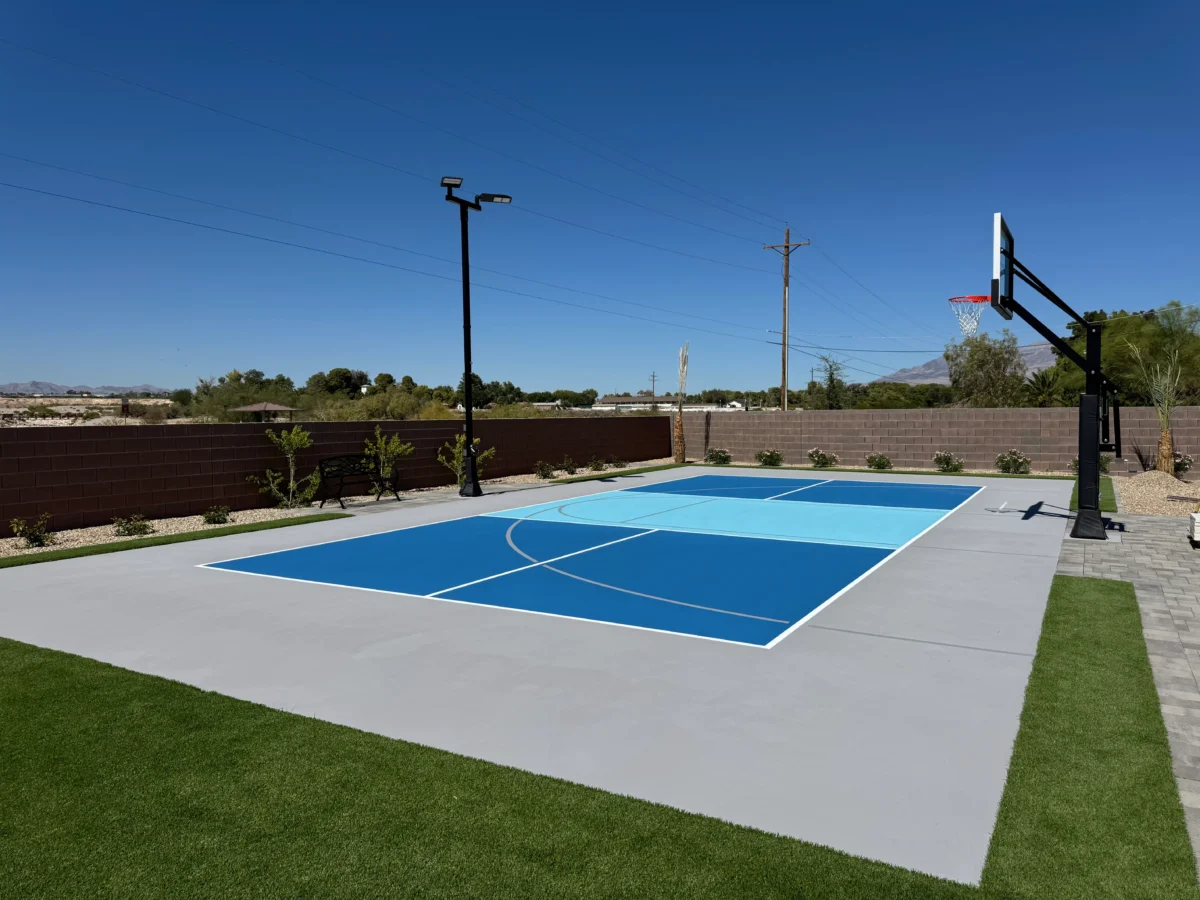
A court is built as an engineered flat plane over a compacted base. Nearly everything that threatens it from outside comes from the landscape around it, and specifically from roots and water. Both are entirely manageable, and both are easier to manage at design time than after a surface starts lifting.
Water is the main threat
A court base is designed to drain and to stay stable. Water arriving from outside the court undermines both.
- Irrigation beside the court puts water into the soil the base sits on, every day, regardless of rainfall. That is the single most common source of base problems on a residential court and it is invisible until the surface shows it.
- Overspray onto the court wets the surface, which is a slip matter, deposits minerals that stain, and in hard water areas leaves a film that affects traction.
- Drainage from the landscape routed across the court is a design error, and it brings sediment with it.
- Planting beds against the court edge hold water against the edge detail, which is where a surface is most vulnerable.
The principle is simple. Water is directed away from the court, and irrigation near the court is designed deliberately rather than inherited from what was there before. The court’s own drainage is covered in sport court drainage and grading.
Irrigation decisions
Several specific measures work.
- Keep irrigated planting back from the court edge. A band of decomposed granite, rock or hardscape between the court and the planting gives separation and reduces how much water reaches the base.
- Use drip rather than spray near the court, which puts water at the root zone instead of into the air where wind carries it onto the surface.
- Aim and adjust every head within range of the court, which is a five-minute task that is routinely skipped.
- Separate the zone nearest the court so its schedule can be managed independently.
- Fix leaks promptly, since a leaking line beside a court saturates the base continuously and the symptom appears on the surface long after the leak started.
- Check after any landscape work, because a head moved or added by a landscaper who was not thinking about the court is a common cause.
Trees and roots
A tree near a court is both the best and the worst thing in the yard. The best, because shade is the thing in shortest supply here and a court in afternoon shade is used far more than one in full sun.
The worst, because roots lift surfaces, and a root under a court is a repair that means removing and rebuilding that section. Three decisions manage it.
- Species. Root behavior varies enormously, and some trees are entirely unsuitable near hardscape.
- Distance. Mature canopy spread is a reasonable guide to root spread, and planting a tree at a distance that suits it today is how a court ends up with a root problem in year twelve.
- Root barriers, which redirect roots downward and away. They are installed at planting or during court construction and they are far cheaper than the repair.
Debris is the fourth consideration. A tree that drops heavily onto a court means constant sweeping, staining from organic material, and leaves in the drainage. The maintenance consequence is covered in desert court maintenance schedule.
Shade without trees
Where a tree is not the right answer, the structures do the same job without the roots. A shade structure over seating, a covered area at one end, or windscreen on the fence each provide shade without anything growing under the court. Those are covered in court shade structures and windscreens for the desert. For many courts the best answer is a structure over the seating and trees set well back for the wider yard, which gets the shade where it is needed without the roots where they are not.
Planting that works beside a court
The characteristics to look for are low debris, contained root systems, manageable mature size, and drought tolerance so the irrigation near the court can be minimal.
- Ornamental grasses give movement and softness with very little debris.
- Succulents and agave type plants need minimal water, which is the point, with the caveat that spiky forms belong away from where balls and players go.
- Structured evergreens provide screening and hold shape.
- Containers, which put planting exactly where you want it with no root system in the ground at all. Beside a court that is a genuine advantage rather than a compromise.
What to avoid beside a court is anything that drops heavily, anything with aggressive roots, anything with thorns within reach of a ball retrieval, and anything requiring frequent irrigation. Your designer or a local nursery is the right source for specific species, since exposure and soil differ by lot.
The edge detail
The transition between the court and the landscape is where the two interact, and it deserves a decision rather than a default.
- A hardscape band between the court and the planting, in decomposed granite, rock or pavers, keeps irrigation and organic material away from the edge, gives a clean line, and provides a walking surface for ball retrieval.
- A curb or edge at the court itself, which protects the surface edge and defines the boundary.
- Drainage along the edge, where the grading sends water that way.
An edge that runs straight from the court surface into a planting bed is the arrangement most likely to cause problems, and it is also the one that looks unfinished.
Lighting the surroundings
Court lighting is its own discipline, covered in sport court lighting, glare and shielding ordinances. Landscape lighting around the court does something different: it gives the eye something beyond the bright rectangle, makes the path to the court safe after dark, and makes the whole space read as designed rather than as a court dropped into a yard. Run the conduit while the court excavation is open.
Screening and neighbors
Planting is frequently used to screen a court, and it works at two levels. Visual screening softens the court from the house and from neighbors, which matters for a large fenced structure.
Sound, where planting does less than people hope. Dense planting absorbs some sound and does not block it, and anyone expecting a hedge to solve a noise concern will be disappointed. That subject is covered in pickleball noise mitigation. Where screening matters, combining planting with windscreen on the fence gives a far better result than either alone.
Sequencing
The order is the same as any outdoor project: the court first, the planting after. Equipment access during court construction damages anything planted beforehand, so planting first means paying for it twice. The irrigation mainlines and any root barriers go in with the court work, and the planting follows. Phasing generally is covered in phased backyard court construction.
Frequently asked questions
What damages a court from outside it?
Water and roots. Irrigation beside the court puts water into the base soil daily regardless of rainfall, which is the most common source of base problems and is invisible until the surface shows it. Tree roots lift surfaces, and a root under a court means removing and rebuilding that section rather than patching it.
How far from a court should I plant a tree?
Far enough that mature root spread, which roughly tracks mature canopy spread, does not reach the base. Species matters as much as distance, since root behavior varies enormously and some trees are unsuitable near hardscape at any reasonable distance. Root barriers installed at planting or during court construction redirect roots downward and cost far less than the repair.
How should irrigation near a court be set up?
Keep irrigated planting back from the court edge with a band of decomposed granite, rock or hardscape between. Use drip rather than spray nearby so wind does not carry water onto the surface. Aim and adjust every head within range. Put the nearest zone on its own valve so it can be managed independently, and fix leaks promptly.
Will planting block the noise from my court?
Not meaningfully. Dense planting absorbs some sound and does not block it, and anyone expecting a hedge to solve a noise concern will be disappointed. Planting is effective for visual screening, which matters for a large fenced structure. For sound, it is one element of an approach rather than the answer.
Should I landscape before or after the court is built?
After. Equipment access during court construction damages anything planted beforehand, so planting first means paying for it twice. What does go in during the court work is the irrigation mainlines, any root barriers and the lighting conduit, since all three are buried and the trench is already open.