
How to Choose a Sport Court Contractor in Nevada or Arizona

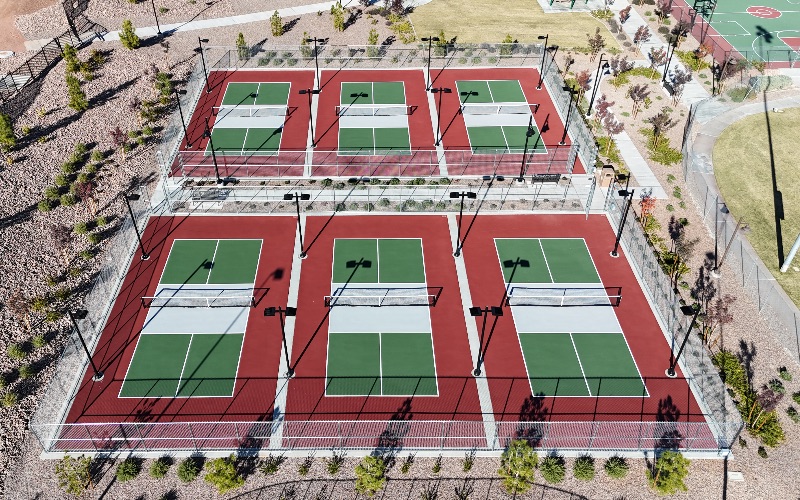
Knowing how to choose a sport court contractor matters more than any other decision on this project. Color, sport lines and fence height are preferences. The builder decides whether you own a court for twenty years or a slab with a crack running through the key by year three.
Most owners get three bids, compare the numbers and pick. That works for a patio. A court fails quietly and expensively. Here is the filter we use.
Court experience is not concrete experience
A licensed, insured, competent concrete contractor can pour a flawless driveway and still deliver a court that plays wrong.
A court has tolerances a driveway does not. It has to be flat enough that the ball bounces true everywhere, and sloped enough to shed water without the slope being felt underfoot. Add a base built for the soil you actually have, control joints placed out of the playing lanes, and an acrylic system applied inside its own temperature and moisture rules, and the job stops resembling flatwork.
When it goes wrong it stays wrong. We have covered why sport courts crack and the recurring court construction mistakes to avoid, and most items on those lists trace back to a crew building its first court.
So the first cut is simple. Ask how many courts the company has built, not how many years it has been in business.
Start with the license, and actually verify it
Both states run a public license lookup. In Nevada it is the Nevada State Contractors Board. In Arizona it is the Arizona Registrar of Contractors. Search the business name exactly as it appears on your proposal, then confirm four things.
- The license is active. Expired, suspended and revoked all show up in the record.
- The name matches. A proposal from one business and a license held by another entity is a problem, not a clerical detail.
- The classification covers the work. Confirm the license covers the kind of construction your project involves.
- The discipline history is clean. One old resolved complaint is context. A pattern is an answer.
Then ask for a certificate of insurance sent directly from the agent, listing general liability and workers compensation current for your build dates. If a crew member is hurt on an uninsured job in your backyard, the exposure lands on you.
Check references like you mean it
Every contractor has three happy customers from the last few months. Those tell you almost nothing, because a fresh court looks good no matter who built it.
Ask for the old ones. Request owners whose courts were finished several years ago, then go look at one. You are checking what time does to the work: whether the surface is still flat, whether cracks opened and how they were handled, whether the color held.
When you reach the owner, ask specific questions. Did the schedule hold, and if it slipped, were you told before or after? Did the company come back after final payment? That last one separates builders. Every job has a punch item, and the difference is whether the contractor returns for it.
Compare bids on scope, not on the bottom line
Three proposals for the same backyard arrive with three different numbers hiding three different jobs. Comparing totals without comparing scope is how owners end up feeling cheated by a contractor who did exactly what was written.
Line them up item by item. Excavation: is haul-off included, or is the dirt staying in your yard? Base: what material, what depth, compacted to what standard? Slab: what thickness, what reinforcement, what joint plan? Drainage: where does the water actually go? Surfacing: which named system, how many coats, applied by whom? Then permits, inspections and site restoration, with a responsible party named for each.
A proposal that cannot be broken down this way is not a bid. If the gap between two proposals turns out to be base depth and a reinforcement schedule, you know what the cheaper one is not doing.
The questions that separate builders
Five questions asked in person will sort a shortlist faster than any amount of website reading. You are listening for whether the person has thought about your specific lot.
What goes under my slab, and why that for my soil? A real answer references the site: the soil you have, whether the pad is cut or fill, what depth of base and why. Our explanation of base construction and subgrade shows what a substantive answer sounds like.
Where does the water go? The contractor should point at your yard and describe the path water takes off the court and off the property in a hard storm.
Who pulls the permit? The answer should be the contractor, by name, with the jurisdiction identified. Anyone suggesting you skip it, or pull it yourself as an owner-builder, has told you something important.
Which surfacing system, and who applies it? You want a named product line, not the word acrylic, and you want to know who coats the court: the company’s own crew or a subcontractor.
What does the warranty actually cover? Structure, surface and workmanship are three separate things, often with three different terms and three different parties behind them. We break the categories down in sport court warranty coverage.
Red flags
Any single item here is enough to drop a bidder.
- A license number that does not check out. Wrong entity, expired, or a classification that does not cover the work.
- Pressure to skip the permit. It transfers the risk to you and can surface at resale.
- A bid far below the others. Nobody finds savings the rest of the market missed. The gap is scope, usually in the base or the surfacing, which is what cutting corners on a sport court buys.
- A large deposit demanded up front, especially in cash. A deposit that funds most of the job before work starts is not normal.
- No local presence. A traveling crew has no reason to come back for warranty work and no relationship with the inspectors or the soil. That is why you need a local court builder.
- Reference projects that are all brand new.
- Nothing in writing. Verbal assurances about scope, schedule or warranty are worth what they cost.
Putting it together: how to choose a sport court contractor
Verify the license and insurance yourself. Count courts, not years. Walk an old court and call its owner. Compare written scopes line by line. Ask the five questions and listen for site-specific answers. Then drop anyone who trips a red flag.
What you are buying is not the court in the photos. It is the decisions made underneath it, where you will never see them. Our about us page covers the company, and new court construction covers how we scope and build.
Frequently asked questions
How do I choose a sport court contractor?
Verify the contractor’s license and history through the state board, confirm insurance, insist on court-specific experience with courts you can see several years after completion, and compare written scopes covering base, slab, drainage, surfacing system and warranty. Select on evidence in writing rather than on price or promises.
How do I verify a contractor’s license in Nevada or Arizona?
Nevada licenses are verified through the Nevada State Contractors Board lookup at nscb.nv.gov, and Arizona licenses through the Arizona Registrar of Contractors at roc.az.gov. Check that the license is active, matches the business name on your proposal, covers the classification of work, and carries a clean discipline history.
Can a regular concrete contractor build a sport court?
A general concrete contractor can pour a slab, but a playable court adds flatness and slope tolerances, court-specific base and subgrade requirements, and an acrylic surfacing system with strict preparation and weather rules. Builders without that specialty experience tend to produce courts that drain, bounce or wear poorly.
What questions should I ask a court builder before signing?
Ask what goes under the slab and why for your soil, how the court will drain on your lot, who pulls the permit, which named surfacing system will be used and who applies it, and exactly what the warranty covers for structure, surface and workmanship. Substantive, written answers are the qualifying standard.
What are the biggest red flags when hiring a court contractor?
An unverifiable or borrowed license number, pressure to skip permits, a bid far below every competitor, large cash deposits demanded up front, no local presence, and reference projects that are all brand new. Any one of these is sufficient reason to remove a bidder from consideration.
If we are on your shortlist, put us through the same filter. Call Nevada at (702) 883-8386 or Arizona at (480) 878-2292, or request a project quote.