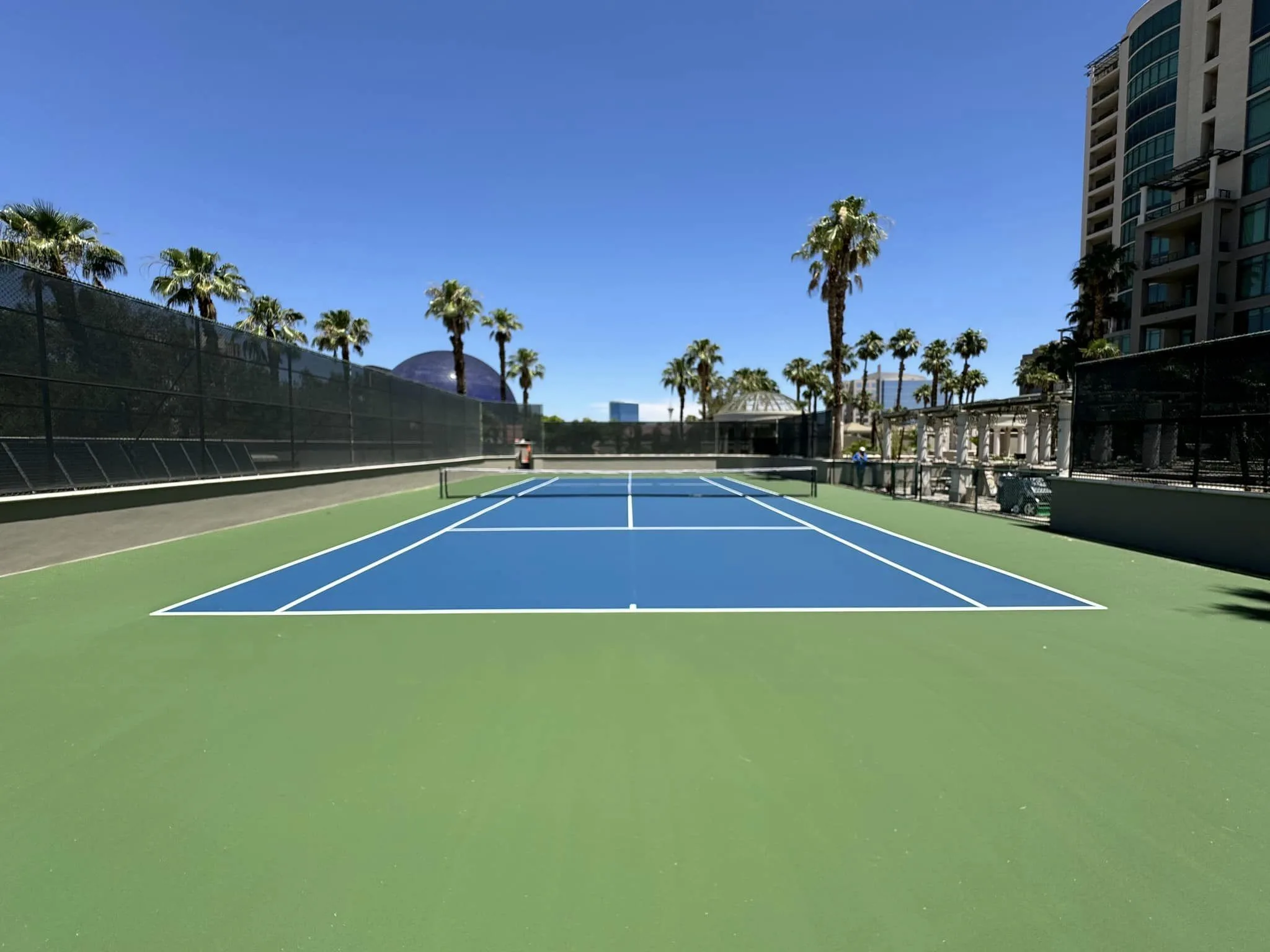
Cost to Build a Sport and Game Court: The Complete Pillar Guide

Cost to Build a Sport and Game Court: The Complete Pillar Guide

Cost to Build a Sport and Game Court: The Complete Pillar Guide

Building a sport and game court, basketball, pickleball, tennis, volleyball, or a multi-sport combination, is a significant investment, and getting a realistic budget picture up front prevents surprises later. This comprehensive guide breaks down every major cost factor across sport types so you can plan with confidence before requesting a quote.
 

The Core Cost Drivers Across All sport and game court

 
Regardless of which sport you’re building for, the same core variables drive total cost:
 
Court size. Larger courts require more base material, more surfacing, and more striping, scaling cost accordingly. A backyard basketball half-court costs meaningfully less than a full regulation court; a single pickleball or tennis court costs less than a multi-court facility.
 
Site conditions. Flat, accessible, well-draining lots cost less to prepare than sloped sites, sites with poor soil, or locations with difficult equipment access.
 
Base type. Concrete costs more upfront than asphalt but generally lasts longer and needs less frequent resurfacing. Post-tension concrete, increasingly popular for pickleball, costs more than standard slab but resists cracking better under heat stress.
 
Surface system. Standard acrylic coating is the most cost-effective way to achieve a professional playing surface. Cushioned acrylic and premium modular tile systems cost more but offer benefits in shock absorption or installation speed.
 
Accessories. Hoops, nets, fencing, and lighting are typically quoted separately from the base court construction and add up based on how many you include.
 

Cost by Sport Type

 
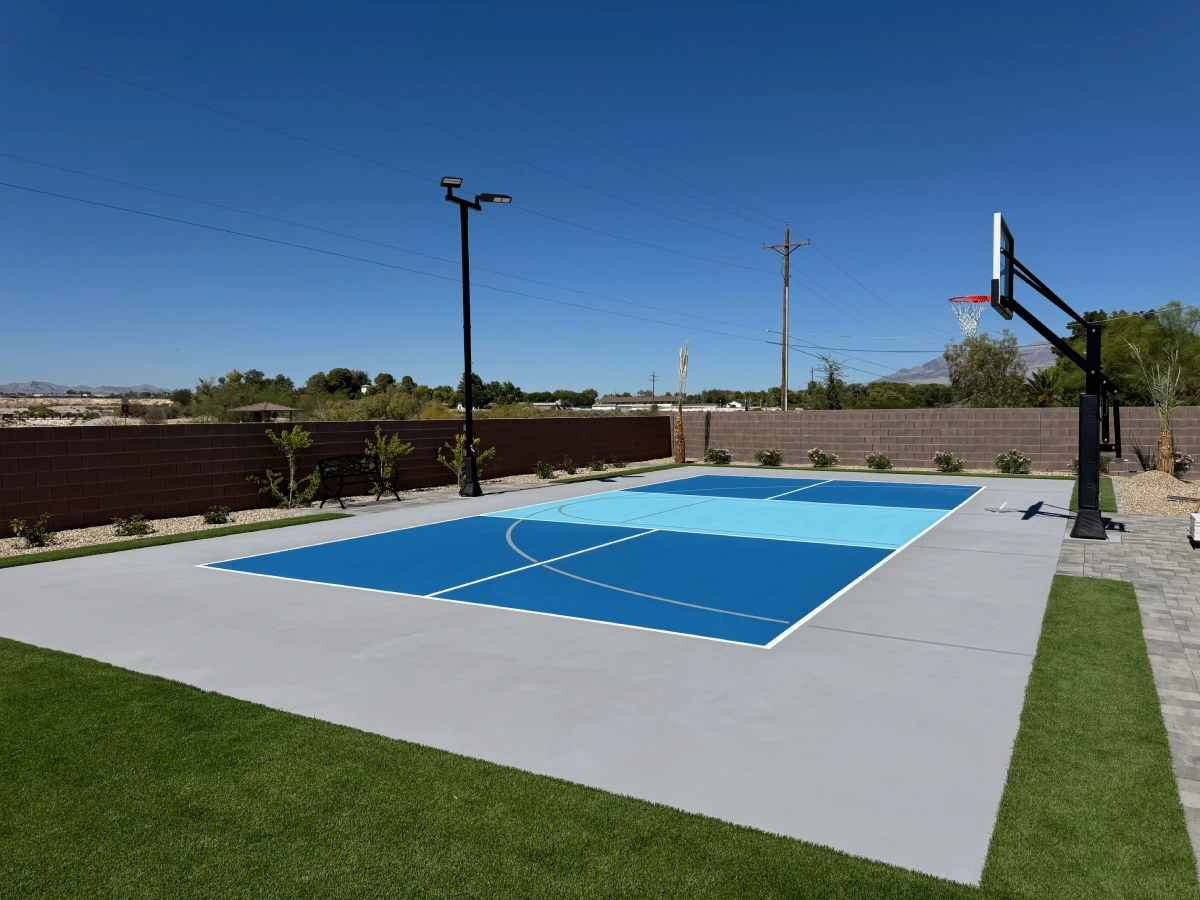
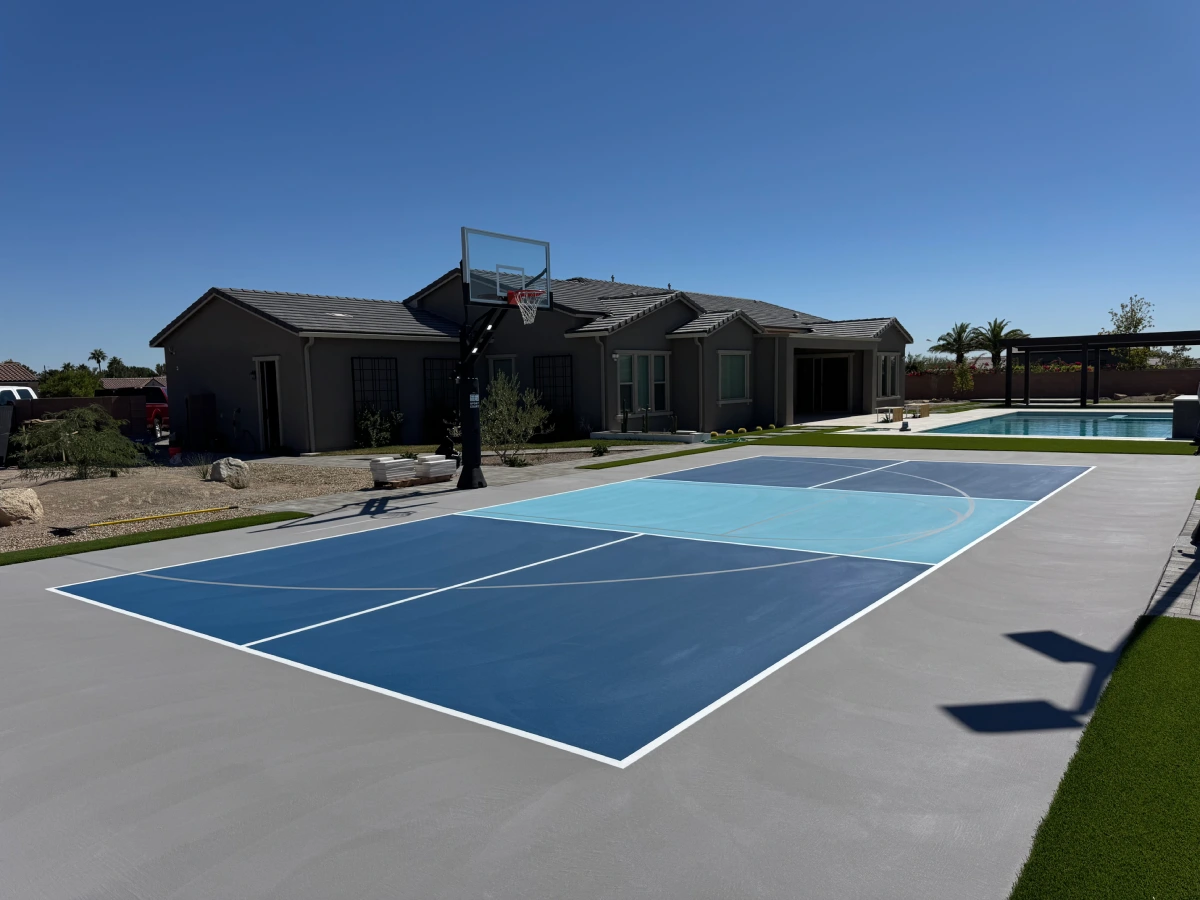
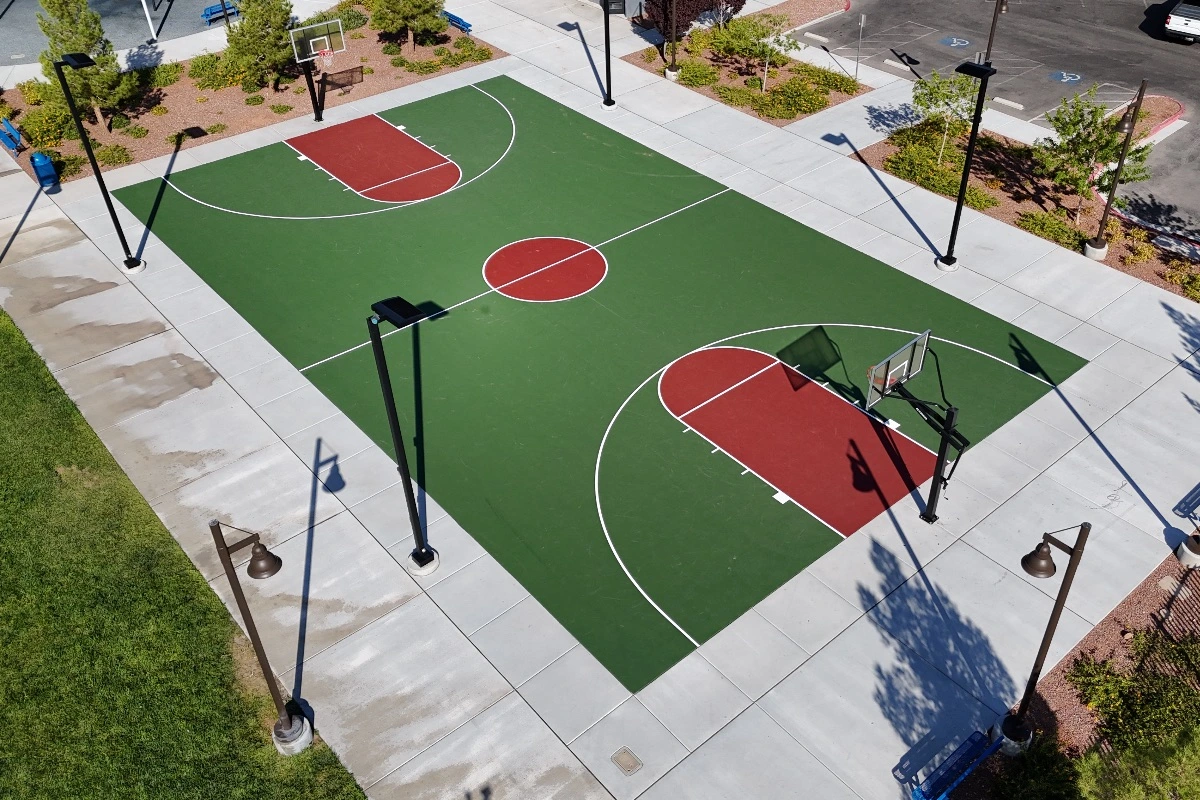
Basketball courts scale primarily with size (half-court vs. full court) and whether you add an adjustable hoop system, breakaway rim, or lighting package.
 
Pickleball courts are smaller in footprint than basketball or tennis but benefit from post-tension bases in our climate, which adds cost relative to standard concrete. Net systems and fencing are common add-ons.
 
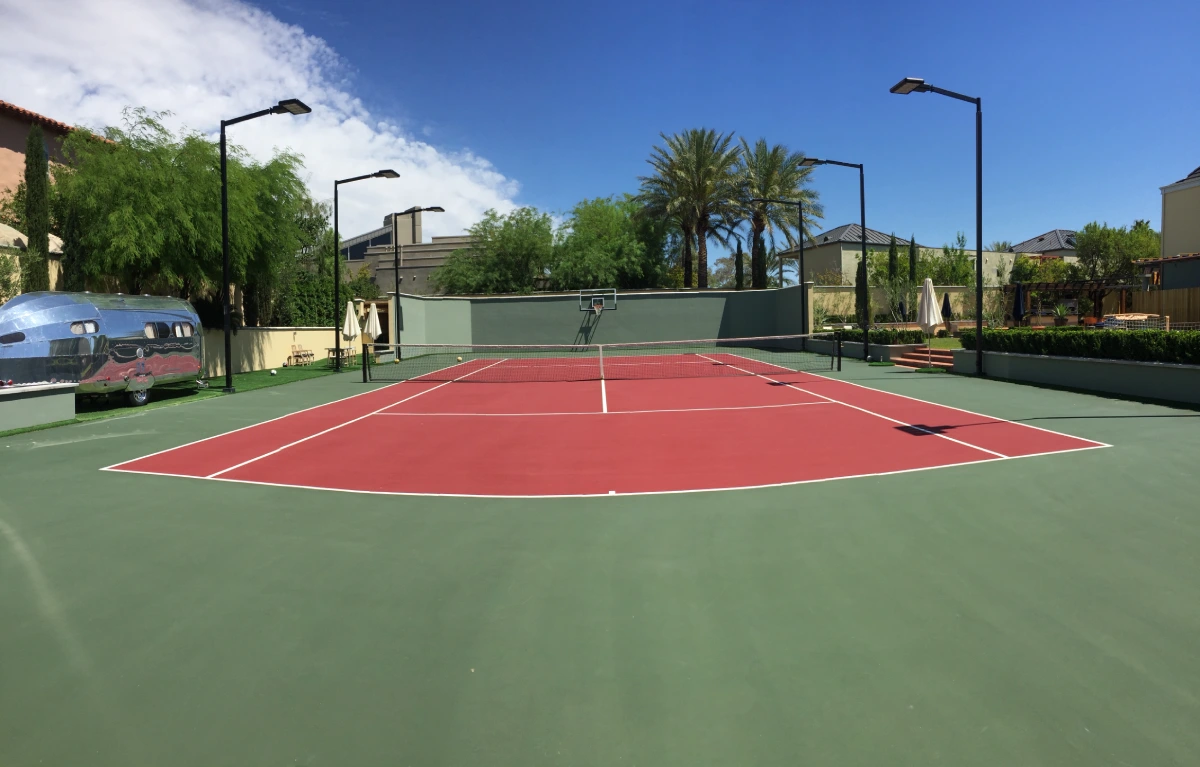
Tennis courts require the largest single-court footprint of the major racquet and ball sports, which drives up base material and surfacing costs relative to pickleball or basketball. Fencing is a near-universal addition for tennis courts.
 
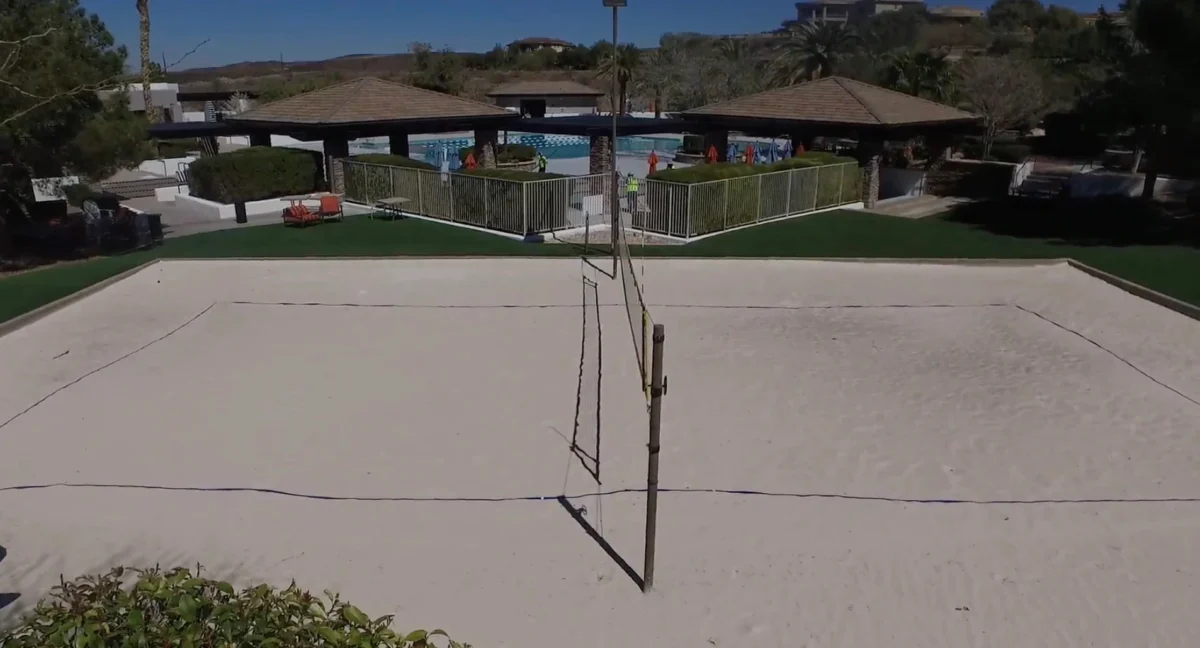
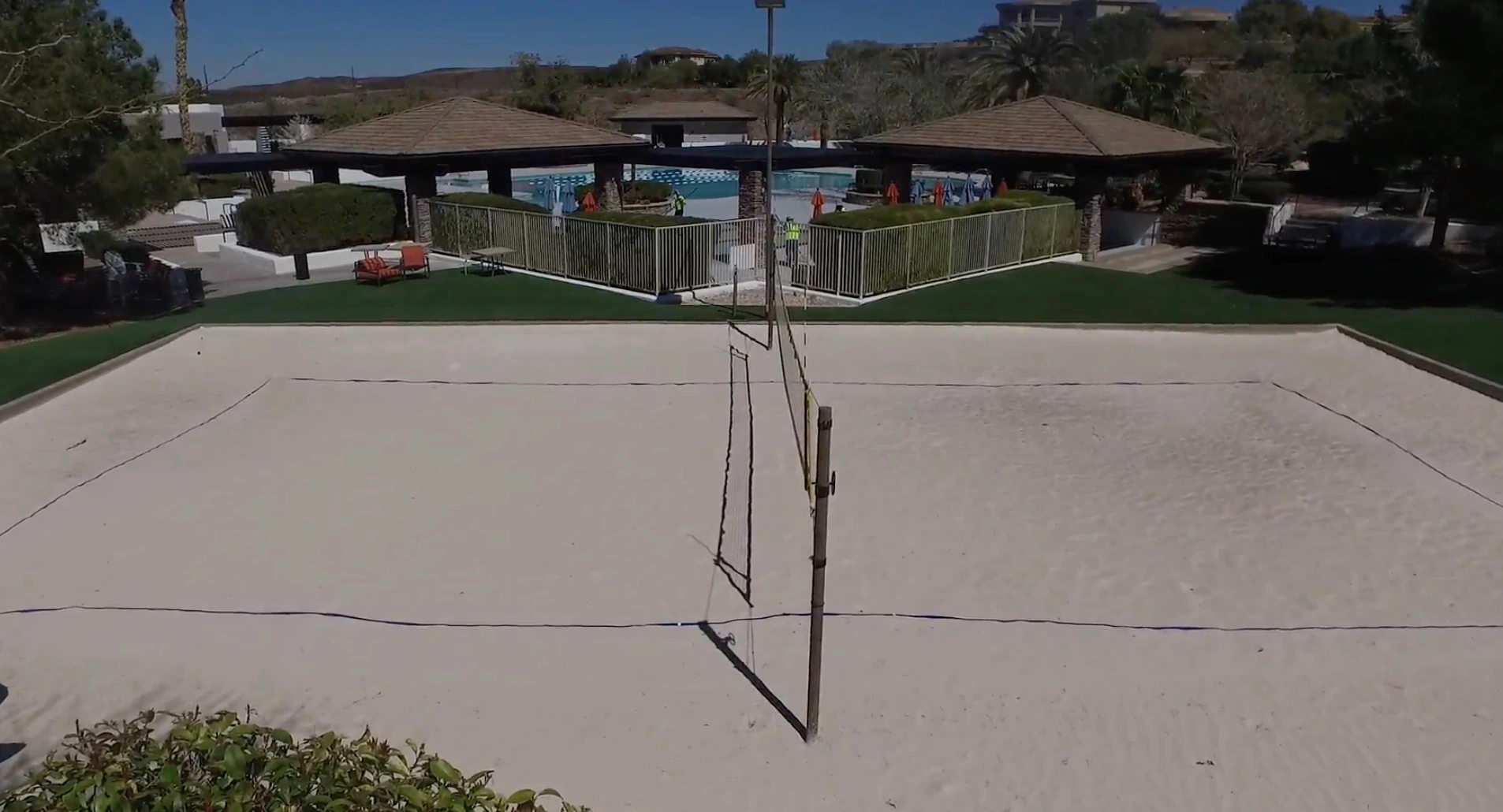
Volleyball courts vary significantly based on sand vs. hard-surface construction. Sand courts require contained borders and a drainage layer; hard-surface courts follow similar cost logic to basketball and pickleball.
 
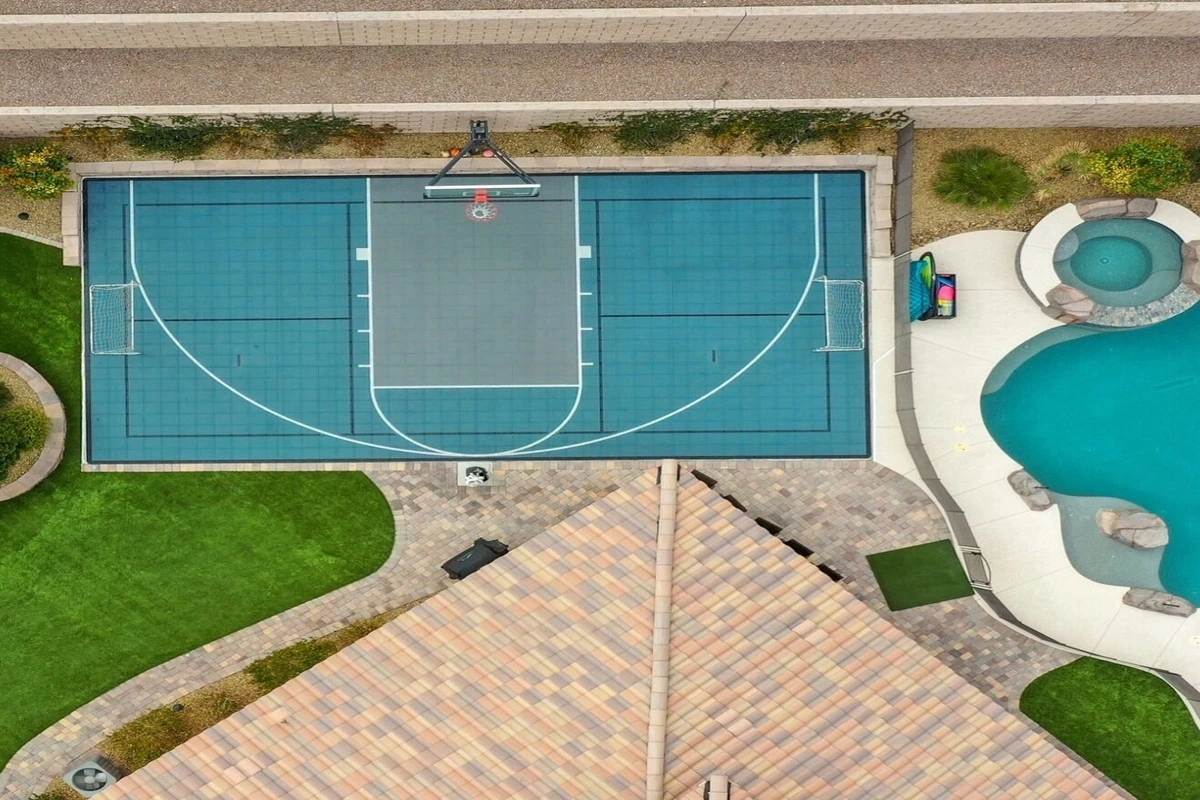
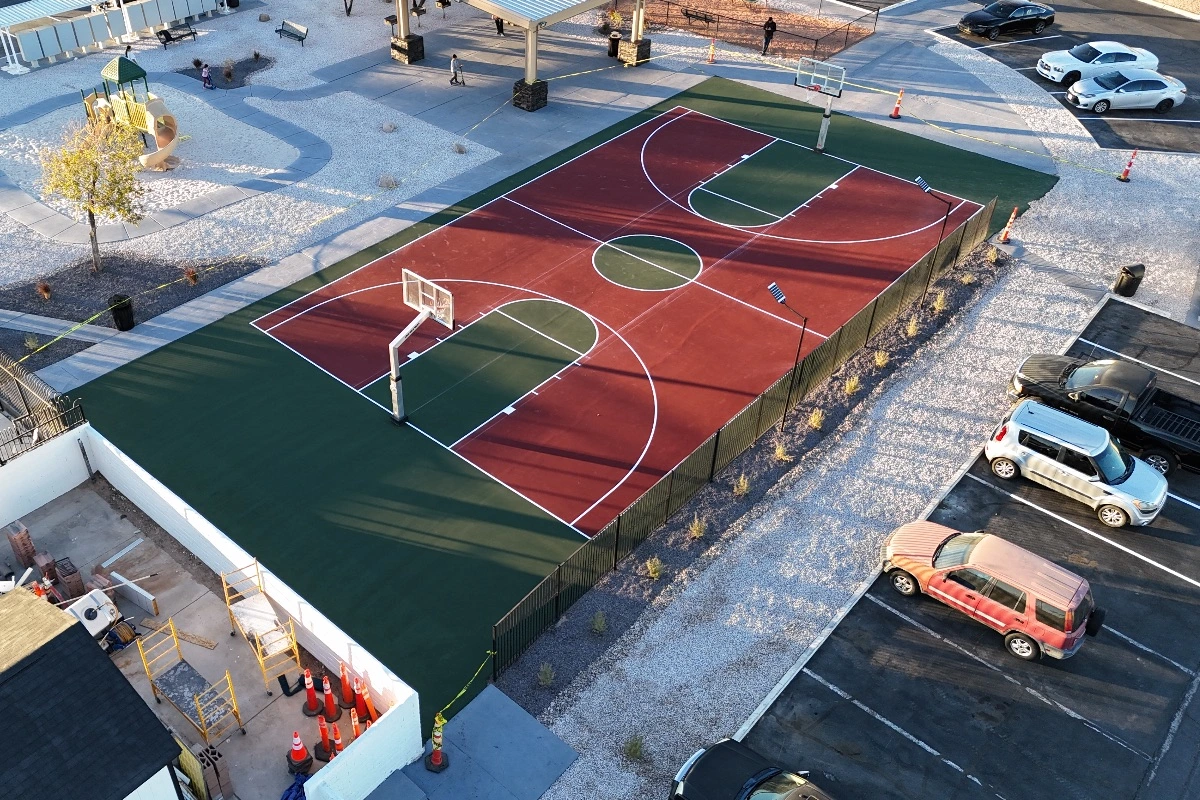
Multi-sport and game court cost more than a single-sport and game court due to larger pad size and more complex striping, but cost considerably less than building multiple standalone courts.
 

New Construction vs. Resurfacing

 
If you already have an existing court that’s aged, resurfacing costs substantially less than a full rebuild, provided the underlying base is still structurally sound. A full rebuild becomes necessary when the base itself has failed through significant cracking, heaving, or drainage breakdown.
 

Where Costs Commonly Go Wrong

 
The most expensive mistake in sport and game court construction is under-investing in the base to save money upfront. A cheaper, improperly compacted or sloped base leads to cracking and drainage failure that requires costly repair or a full redo within a few years, costing far more in the long run than paying appropriately for base work from the start.
 
The second most common issue is choosing a generic, non-climate-rated surface coating to save a small amount upfront, only to see it fade, chalk, or crack within a season or two under Las Vegas or Phoenix sun.
 

Getting an Accurate Quote

 
Because so many variables affect final pricing across sport types, sizes, and site conditions, the most reliable way to budget accurately is a site visit and itemized proposal. Legendary Sport Construction evaluates your specific property and goals, then provides a detailed quote breaking down base work, surfacing, and accessories separately.
 

FAQ

 
What is the biggest factor in sport and game court construction cost?
Court size and site conditions are typically the two biggest drivers, since they scale every downstream cost from base material to surfacing to striping.
 
Is it cheaper to build a basketball, pickleball, tennis, or volleyball court?
Pickleball courts generally have the smallest footprint and lowest base material cost, while tennis courts require the largest single-court footprint. Actual cost also depends heavily on surface system and site conditions.
 
Should I resurface my existing court instead of rebuilding?
If the base is structurally sound with functioning drainage, resurfacing is usually the more cost-effective choice. A rebuild becomes necessary when the base itself has failed.
 
Does adding lighting significantly increase project cost?
Lighting adds meaningful cost but delivers strong value in Las Vegas and Phoenix by extending usable court hours into cooler evening periods.
 
Can I build a multi-sport and gamecourt to save money over separate courts?
Yes, a well-designed multi-sport and game court costs more than a single court but considerably less than building multiple standalone courts.
 
How do I get an accurate cost estimate for my property?
Request a site visit and itemized quote from our team, since soil conditions, access, and layout all affect final pricing.
 
This pillar page links to our sport-specific cost guides, including basketball court construction cost and tennis court resurfacing cost, plus our surface types guide. Ready for real numbers on your project? Get a quote from Legendary Sport Construction today.

Tennis Court Construction Company in Las Vegas

Tennis Court Construction Company in Las Vegas

Tennis Court Construction Company in Las Vegas


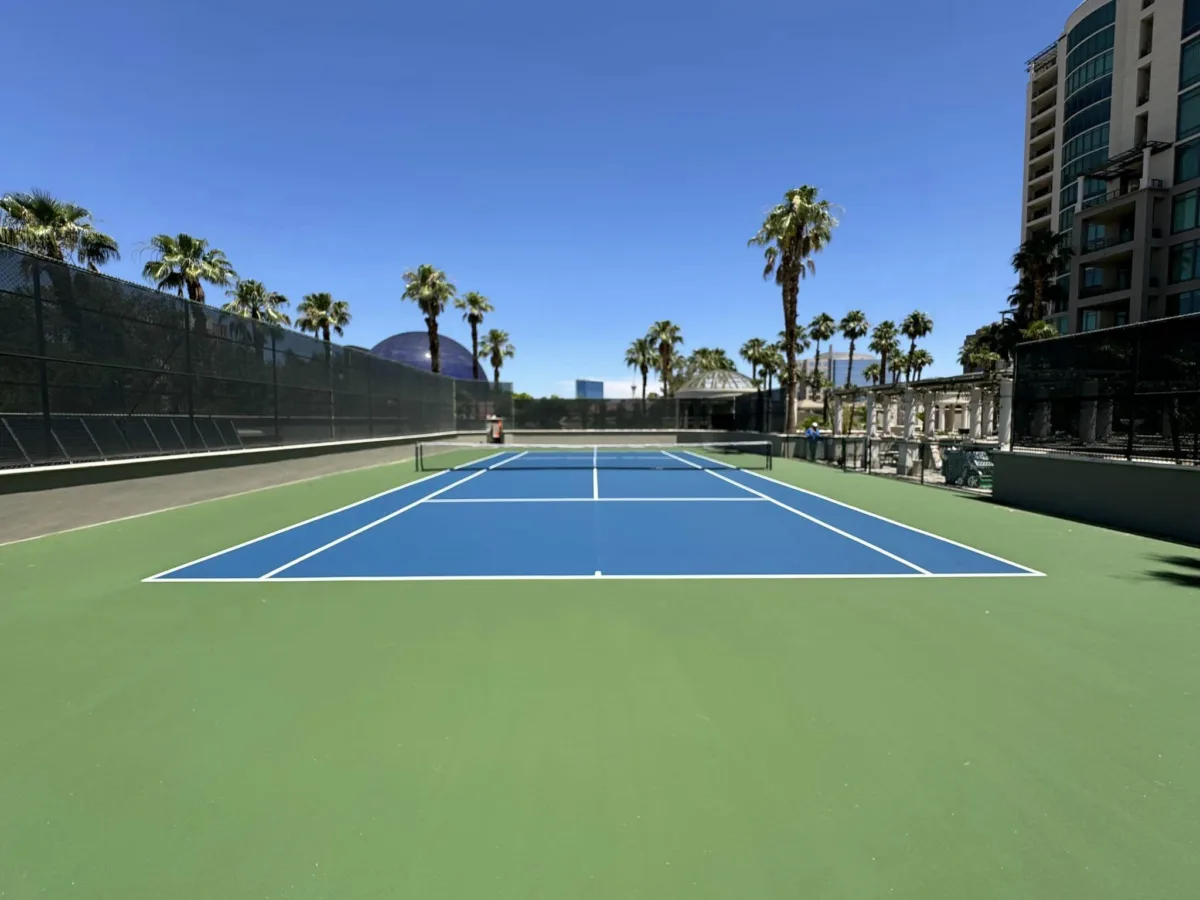
Legendary Sport Construction is a tennis court construction company serving Las Vegas homeowners, HOAs, schools, and commercial properties. We design and build regulation tennis courts engineered for desert conditions, and we resurface existing courts that need a second life without the cost of a full rebuild.
 

Why Las Vegas Chooses Legendary Sport Construction for Tennis

 
Tennis courts demand precision. Regulation dimensions, correct net height, consistent surface texture, and a base that holds its shape for decades, none of that happens by accident. Our approach:
 
  • Engineered bases designed to handle Las Vegas soil conditions and heat-cycling stress, reducing the cracking and heaving that shortens the life of poorly built courts.
  • UV-stable acrylic surfacing formulated for sustained high-heat, high-UV exposure, so color and texture hold up season after season.
  • Precise regulation striping for singles, doubles, and any multi-sport line overlays.
  • Full-service builds, meaning we manage excavation, base construction, surfacing, fencing, net systems, and lighting as one coordinated project.
 

Our Tennis Court Services

 
New court construction for backyards, HOA amenity spaces, schools, and commercial or club facilities, built to regulation dimensions (78 feet by 27 feet for singles, 36 feet for doubles) with correct net height and clearance.
 
Resurfacing and recoating for existing courts, restoring color, texture, and playability when the underlying base is still sound.
 
Fencing and net systems, properly installed and anchored for durability and safety.
 
Court lighting, extending usable hours into the evening, especially valuable during Las Vegas’s hottest months.
 
Multi-sport conversions, adding pickleball or other sport lines to an existing or new tennis court footprint.
 

Our Process

 
  1. Site visit and design — assessing your space, existing conditions (for resurfacing projects), and layout requirements.
  2. Proposal and scope — a detailed, itemized quote before any work begins.
  3. Base construction or crack repair — new excavation and paving for new builds, or targeted crack repair and base assessment for resurfacing.
  4. Surfacing and striping — acrylic color coat system and precise regulation lines.
  5. Fencing, nets, and lighting — final installation and testing.
 

Built for the Desert

 
Tennis courts in Las Vegas face the same climate stress every other outdoor court surface does: intense UV, extreme summer surface temperatures, and heat-cycling that stresses concrete and coatings over time. We select surface systems and base designs specifically suited to those conditions, which is why courts we build and resurface hold their integrity years longer than generic installations.
 

FAQ

 
What size is a regulation tennis court?
A regulation court measures 78 feet by 27 feet for singles or 36 feet for doubles, with additional clearance space required around the perimeter.
 
Do you build both new tennis courts and resurface existing ones?
Yes, we handle both new construction and resurfacing, and we’ll recommend honestly which one your court actually needs.
 
How much does it cost to build a tennis court in Las Vegas?
Cost depends on size, base type, site conditions, and any fencing or lighting add-ons. We provide a detailed quote after a site visit.
 
Can you add pickleball lines to my existing tennis court?
Yes, striping a tennis court for multi-sport use, including pickleball, is a common and cost-effective addition.
 
How long does new tennis court construction take?
Most single-court projects take two to four weeks from excavation through final striping, depending on site conditions.
 
Is court lighting worth adding for a Las Vegas tennis court?
Yes. Given the intensity of Las Vegas summer heat, lighting that enables comfortable evening play is one of the most valuable additions for both residential and commercial courts.
 
This page links to our tennis court resurfacing cost guide and our other sport-specific service pages. Ready to build or resurface your tennis court? Get a quote from Legendary Sport Construction today.
 

Basketball Hoop and Lighting Systems: What to Know Before You Buy

Basketball Hoop and Lighting Systems: What to Know Before You Buy

Basketball Hoop and Lighting Systems: What to Know Before You Buy

A basketball court is only as good as the hoop it’s built around, and in Las Vegas and Phoenix, that hoop often needs to work well after dark too. This guide covers the hoop systems and lighting options that turn a good court into a court that gets used every day, from casual backyard shooting to serious training sessions.
 

Basketball Hoop System Options

 
Fixed-height in-ground systems are anchored directly into a concrete footing and set at regulation height (10 feet). They’re the most affordable permanent option and the standard choice for most backyard and community courts where height adjustment isn’t needed.
 
Adjustable in-ground systems allow the rim height to be raised or lowered, which matters for households with younger kids who aren’t ready for a regulation hoop, or programs that train multiple age groups on the same court. These systems cost more but add flexibility that fixed hoops can’t match.
 
Breakaway rims are worth the upgrade for any court that will see real gameplay. A breakaway rim flexes under the weight of a hang or dunk and springs back, protecting both the rim and the backboard from the kind of damage that snaps a rigid rim clean off its mount.
 
Portable/wheeled systems are an option for temporary or multi-use spaces, but they trade stability and durability for mobility. For a permanent court, an anchored in-ground system is almost always the better long-term investment.
 
Backboard material matters too. Tempered glass backboards give the truest rebound and are standard for serious play. Acrylic and polycarbonate backboards are more affordable and more impact-resistant, which can make sense for high-traffic community courts.
 

Anchoring and Footing

 
Regardless of which hoop system you choose, the footing underneath it is what keeps it standing through wind, impact, and years of use. We pour dedicated concrete footings sized and reinforced for the specific hoop system being installed, not a generic post hole. Skipping proper anchoring is one of the most common (and most dangerous) shortcuts taken on budget installations.
 

Court Lighting Systems

 
Court lighting extends usable hours dramatically, which matters most in a region where daytime summer heat can make midday play uncomfortable and evening play the preferred time to use the court.
 
LED sports lighting is the standard today over older metal halide fixtures. LEDs use less energy, produce more consistent light without the flicker or warm-up delay of older bulbs, and last significantly longer before needing replacement.
 
Pole-mounted vs. wall-mounted fixtures. Pole-mounted lighting is typical for standalone courts and gives the most even coverage across the full playing surface. Wall-mounted fixtures can work for courts adjacent to a structure but may create more shadow and uneven lighting depending on placement.
 
Lumens and coverage. The number and placement of fixtures should be based on court size and desired brightness level, casual backyard play needs less intensity than a court intended for serious evening training or hosting games.
 
Glare control. Fixture angle and shielding matter, especially for residential courts near neighboring properties, to avoid light spilling where it isn’t wanted.
 

Putting It Together

 
The right hoop and lighting package depends on how the court will actually be used. A casual backyard half-court for family play doesn’t need the same specification as a court built for a training facility or HOA amenity space that sees daily, high-intensity use. We help clients match the hoop system, backboard type, and lighting package to actual usage and budget, rather than defaulting to either the cheapest or most expensive option available.
 

FAQ

 
Should I choose a fixed-height or adjustable basketball hoop?
Fixed-height regulation hoops are best for most serious play and cost less. Adjustable systems are worth the extra cost if younger players or mixed age groups will use the court.
 
Are breakaway rims worth the extra cost?
Yes, for any court that will see real gameplay including dunks or hangs. Breakaway rims protect the rim and backboard from damage that a rigid rim can’t absorb.
 
What type of backboard lasts longest outdoors?
Tempered glass gives the best rebound but is more exposed to impact damage. Acrylic and polycarbonate backboards are more impact-resistant and often preferred for high-traffic community courts.
 
Is LED lighting worth the upgrade over older lighting systems?
Yes. LED sports lighting uses less energy, lasts longer, and provides more consistent, flicker-free illumination than older metal halide systems.
 
How many light fixtures does a backyard court need?
It depends on court size and desired brightness. A half-court for casual evening play typically needs fewer fixtures than a full court intended for serious training or hosting games. We size lighting packages during your site visit.
 
Can hoop and lighting systems be added to an existing court?
Yes, both can be retrofitted onto an existing court as long as the base can support proper anchoring or fixture mounting.
 
  1. This page is part of our Basketball Court Construction hub. See our guides on basketball court installation and surface options, or find your local service-area page. Ready to plan your hoop and lighting setup? Get a quote from Legendary Sport Construction today.

Basketball Court Construction Cost: A Full Breakdown

Basketball Court Construction Cost: A Full Breakdown

Basketball Court Construction Cost: A Full Breakdown

One of the first questions every homeowner or property manager asks is simple: what does it actually cost to build a basketball court? The honest answer is that it depends on several variables, but they’re all knowable up front. This guide breaks down exactly where your money goes so you can budget accurately before requesting a quote from Legendary Sport Construction.
 

The Main Cost Factors

 
Court size. A half-court for casual backyard play costs significantly less than a full regulation court. Size is the single biggest driver of total price because it affects every downstream line item: base material, concrete or asphalt volume, surfacing gallons, and striping length.
 
Site conditions. A flat, accessible lot with stable soil and easy equipment access costs less to prepare than a sloped site, a lot with poor drainage, or a location requiring extensive excavation, retaining work, or tree/obstacle removal.
 
Base type. Concrete bases cost more upfront than asphalt but last longer and require less long-term maintenance. Asphalt is a lower initial-cost option that still performs well when installed correctly, though it typically needs resurfacing sooner.
 
Surface system. Standard acrylic color coating is the most cost-effective way to get a professional playing surface. Cushioned acrylic systems and premium modular tile systems cost more per square foot but add shock absorption or installation flexibility.
 
Accessories. In-ground adjustable hoop systems cost more than fixed-height systems. Add court lighting, fencing, windscreens, or shade structures, and the total moves up accordingly.
 
Access and logistics. Sites that require equipment to be brought in through tight spaces, over existing landscaping, or long distances from the street add labor cost.
 

Typical Cost Ranges

 
While every project gets a custom quote after a site visit, here’s how the major components generally break down:
 
  • Base preparation and paving (concrete or asphalt): This is usually the largest line item, driven by court size and site prep needs.
  • Acrylic surfacing system: Multiple coats (resurfacer, color coats, line striping) priced per square foot, with cushioned systems costing more than standard.
  • Hoop systems: Fixed-height systems are the most economical; in-ground adjustable systems with breakaway rims cost more.
  • Lighting: LED court lighting packages vary widely based on the number of fixtures and pole-mounted vs. wall-mounted setups.
  • Fencing and extras: Perimeter fencing, windscreens, benches, and shade structures are typically quoted separately.
 
Because soil conditions and site access vary so much across Las Vegas and Phoenix properties, we don’t publish a flat per-square-foot number that would be misleading for most sites. Instead, every project gets an itemized quote after we walk the property.
 

Where Homeowners Overspend (or Underspend)

 
The most common budget mistake isn’t overspending on the surface, it’s underspending on the base. A cheaper base that isn’t compacted or sloped correctly leads to cracking and standing water within a few years, which then requires costly repair or a full redo. Spending appropriately on excavation and base work up front is the single best way to protect your investment and avoid paying for the same court twice.
 
On the other end, some property owners over-invest in premium surface systems for a court that will see light, casual use, when a well-installed standard acrylic system would perform just as well for a fraction of the cost.
 

How to Get an Accurate Quote

 
Because so many variables affect final pricing, the fastest way to get real numbers is a site visit. Legendary Sport Construction evaluates your space, discusses your goals and budget, and provides an itemized proposal that breaks down base work, surfacing, and accessories separately, so you know exactly what you’re paying for and why.
 

FAQ

 
What is the average cost to build a basketball court?
Costs vary widely based on size, site conditions, base type, and surface system. We provide detailed, itemized quotes specific to your property rather than a generic average that may not apply to your situation.
 
Is asphalt or concrete cheaper for a basketball court base?
Asphalt generally has a lower upfront cost, while concrete costs more initially but lasts longer with less frequent resurfacing.
 
Does court size significantly affect the price?
Yes, size is the biggest single driver of cost since it scales base material, surfacing, and striping requirements.
 
What adds the most unexpected cost to a basketball court project?
Site conditions such as poor drainage, sloped terrain, or difficult equipment access are the most common source of costs that exceed initial expectations.
 
Should I choose a cheaper surface system to save money?
Not if it compromises the base. Cutting corners on excavation and base prep to afford a nicer coating almost always costs more in repairs later. We recommend prioritizing the base first.
 
How can I get an accurate price for my property?
Request a site visit and quote from our team. We’ll assess your specific site conditions and give you an itemized breakdown before any work begins.
 
This page is part of our Basketball Court Construction hub. See our full guide on basketball court installation and outdoor surface options, or contact your local service-area page. Ready for real numbers? Get a quote from Legendary Sport Construction today.
 

Outdoor Basketball Court Surface Options: A Complete Comparison

outdoor basketball court surface options

Outdoor Basketball Court Surface Options: A Complete Comparison

The surface system you choose for an outdoor basketball court affects everything from how the ball bounces to how long the court lasts before it needs major work. This guide walks through the main surface materials available for outdoor courts in Las Vegas and Phoenix, so you can choose the right one for your budget, usage, and site.
 

Acrylic Surfacing Systems

 
Acrylic is the most common surface for outdoor basketball courts, and for good reason. It’s applied as a multi-coat system directly over a properly prepared concrete or asphalt base:
 
  • Resurfacer coat — fills minor surface imperfections and hairline cracks, creating a uniform texture.
  • Color coats — typically two or more coats, applied in your chosen colors, giving the court its final look and playing texture.
  • Line striping — court lines and any logos or graphics painted with durable, UV-stable paint.
 
Acrylic systems are prized for their consistent ball bounce, textured non-slip surface, and nearly unlimited color and design options, including two-tone key areas, logos, and multi-sport line overlays. They are also the most economical way to achieve a professional, tournament-grade look.
 
The tradeoff: acrylic coatings sit on top of the base, so the base still has to be well-built. A great acrylic job over a poorly compacted base will still crack.
 

Cushioned Acrylic Systems

 
Cushioned (or “cushioned game court”) systems add a rubberized underlayment beneath the standard acrylic color coats. This layer absorbs impact, reducing stress on players’ joints during extended play, and it also helps bridge minor surface irregularities. Cushioned systems cost more than standard acrylic but are a smart upgrade for courts used for daily training, camps, or by younger players where impact reduction matters.
 

Modular Tile Systems

 
Modular sports tiles are interlocking polypropylene tiles that snap together over an existing hard surface, such as a driveway or existing concrete pad. Key advantages:
 
  • Fast installation with minimal curing time compared to poured surfacing systems.
  • Built-in drainage through perforated tile design, which helps in areas prone to standing water.
  • Flexibility — tiles can, in some cases, be removed and reinstalled elsewhere.
  • Forgiving over imperfect surfaces, since the tile system floats above minor unevenness.
 
The tradeoff: tile seams and edges require quality installation to avoid lifting, and the aesthetic is different from a smooth acrylic finish, some homeowners prefer one look over the other.
 

Which Surface Should You Choose?

 
Choose acrylic if you want the closest experience to a professional or tournament court, maximum color/design customization, and you’re building on a new or well-prepared concrete/asphalt pad.
 
Choose cushioned acrylic if the court will see heavy daily use or you want extra joint protection for younger or competitive players.
 
Choose modular tile if you want faster installation, need to work around drainage challenges, or are installing over an existing surface without extensive base rework.
 

Climate Considerations for Las Vegas and Phoenix

 
Outdoor courts in our region face extreme summer surface temperatures and intense, sustained UV exposure. Not every “outdoor-rated” coating on the market is actually formulated to hold color and texture under those conditions. We use acrylic systems specifically engineered for high-heat, high-UV climates, which is a major reason our courts don’t chalk, fade, or crack prematurely the way lower-grade coatings often do within a season or two.
 

FAQ

 
What’s the most durable surface for an outdoor basketball court?
A properly installed acrylic system over a well-built base is the most durable and cost-effective option for most outdoor courts. Cushioned acrylic adds even more longevity for high-use courts by reducing surface stress.
 
Can modular tile be installed over an old, cracked driveway?
In some cases yes, since tile systems are more forgiving of minor surface imperfections than poured coatings, but significant cracking or heaving still needs to be addressed first.
 
Does surface color affect court temperature or durability?
Lighter colors reflect more heat and stay cooler underfoot, which can matter in extreme summer heat. All colors in a quality acrylic system are UV-stable, but lighter palettes are often preferred for comfort in desert climates.
 
How long does acrylic surfacing last before it needs to be redone?
A well-installed acrylic system typically lasts four to seven years before a recoat is needed, depending on sun exposure and usage.
 
Is modular tile a good option for a multi-sport court?
Yes, tile systems handle striping for multiple sports well and their drainage properties make them a strong choice for courts that need to handle varied use.
 
This page is part of our Basketball Court Construction hub. Learn more about basketball court installation and typical construction costs, and check the service-area page for your city. Ready to choose your surface? Get a quote from Legendary Sport Construction today.
 

Acrylic Sports Court Surfaces: Why Acrylic, Maintenance & UV Durability

Acrylic Sports Court Surfaces: Why Acrylic, Maintenance & UV Durability

Acrylic Sports Court Surfaces: Why Acrylic, Maintenance & UV Durability

Acrylic is the most widely used surfacing system for outdoor sports courts, and understanding why it’s the standard, and how to maintain it, helps you get the most life and performance out of your investment.
 

Why Acrylic Is the Standard Court Surface

 
Consistent playing performance. Acrylic systems are engineered to provide a specific surface texture that delivers reliable ball bounce and player traction across the entire court, unlike raw concrete or asphalt, which can have inconsistent texture from panel to panel.
 
Design flexibility. Acrylic coatings come in virtually any color, allowing custom court designs, team colors, two-tone key areas, and multi-sport line overlays that would be difficult or impossible with other surface types.
 
Cost-effectiveness. Compared to specialty synthetic systems or premium modular tiles, acrylic surfacing delivers a professional-grade playing surface at a lower overall cost, especially when factoring in application over an existing, well-prepared concrete or asphalt base.
 
Reparability. Acrylic systems can be recoated rather than fully replaced, extending the usable life of a court for decades with periodic maintenance instead of expensive rebuilds.
 

How Acrylic Surfacing Is Applied

 
A proper acrylic system is built in layers:
 
  1. Crack repair and patching of the underlying base, if needed.
  2. Resurfacer coat, a textured layer that smooths minor surface imperfections and creates the base texture for ball bounce.
  3. Color coats, typically two or more coats applied for even color and durability.
  4. Line striping, using durable, UV-resistant paint for precise regulation markings.
 
Each layer needs proper cure time before the next is applied. Rushing this process is one of the most common reasons budget installations fail early, coats that haven’t cured properly don’t bond or wear correctly.
 

UV Durability: Why It Matters in Las Vegas and Phoenix

 
Not all acrylic coatings are created equal, and this matters enormously in a climate as demanding as ours. Generic or interior-grade coatings break down under sustained UV exposure and high surface temperatures, leading to:
 
  • Chalking, a powdery residue that forms as the coating’s binder degrades under UV exposure.
  • Fading, especially in darker colors that absorb more heat and UV energy.
  • Premature cracking, as the coating loses flexibility and can no longer move with the base beneath it.
 
We use acrylic systems specifically formulated for high-heat, high-UV climates. These systems hold color and texture significantly longer under desert sun than generic products, which is the difference between a court that looks great for two seasons and one that looks great for years.
 

Maintaining an Acrylic Court

 
Routine cleaning. Sweeping debris and rinsing the surface periodically prevents dirt and organic buildup from degrading the coating prematurely.
 
Prompt crack attention. Small cracks should be addressed quickly with flexible fillers before they widen and allow water intrusion, which can undermine the base beneath the coating.
 
Periodic recoating. Most acrylic courts benefit from a full recoat every four to seven years, depending on usage intensity and sun exposure. Recoating restores color, texture, and surface protection at a fraction of the cost of a full rebuild.
 
Avoiding harsh chemicals. Certain cleaning products and de-icers (in colder climates) can degrade acrylic coatings faster than normal wear. We can advise on safe maintenance practices specific to your court.
 

FAQ

 
Why is acrylic the most common surface for outdoor sports courts?
Acrylic offers a strong combination of performance, design flexibility, and cost-effectiveness, while also being straightforward to recoat and maintain over the court’s life.
 
How long does an acrylic court surface last?
With proper installation and periodic recoating every four to seven years, an acrylic surface system can support a court for well over a decade before major structural work is needed.
 
Does acrylic surfacing fade in Las Vegas or Phoenix heat?
Standard or generic coatings can fade and chalk under intense desert sun. UV-stable acrylic systems formulated specifically for high-heat climates resist this significantly better.
 
How often should an acrylic court be recoated?
Typically every four to seven years, depending on usage and sun exposure, though heavily used courts may need it sooner.
 
Can acrylic surfacing be applied over an existing asphalt or concrete pad?
Yes, as long as the existing base is structurally sound and properly sloped. We assess the base before recommending a resurfacing plan.
 
Is acrylic surfacing slippery when wet?
Properly textured acrylic coatings maintain reasonable traction even when damp, though like most outdoor court surfaces, play should generally pause during active rain.
 
This page connects to our surface options guide and our resurfacing and maintenance page. Ready to discuss your court’s surface system? Get a quote from Legendary Sport Construction today.

Multi-Sport Game Courts: Layout, Striping, Durability & Drainage

Multi-Sport Game Courts: Layout, Striping, Durability & Drainage

Multi-Sport Game Courts: Layout, Striping, Durability & Drainage

A multi-sport game court lets one pad serve basketball, pickleball, volleyball, and more, without building separate courts for each. For properties with limited space or families and communities that want variety, a well-designed multi-sport court is one of the smartest investments Legendary Sport Construction builds.
 

Planning a Multi-Sport Layout

 
The biggest challenge in a multi-sport court isn’t the surface, it’s the layout. Combining sports on one pad means fitting different dimensions and orientations onto a shared footprint without creating confusing or cramped lines:
 
  • Basketball requires the largest single footprint and typically anchors the overall court size.
  • Pickleball (20×44 feet) can often fit within or alongside a basketball court’s boundaries with careful planning.
  • Volleyball (60×30 feet) needs its own net anchoring points, which have to be planned so they don’t interfere with basketball hoop placement or pickleball run-off space.
  • Four-square, tetherball, or other casual games can sometimes be worked into corner space that wouldn’t otherwise be used efficiently.
 
We design layouts based on your actual space and priorities, deciding which sport gets primary emphasis and which get secondary striping, rather than trying to force every option onto a pad that’s too small for all of them to work well.
 

Line Striping for Multi-Sport Courts

 
Clarity matters more on a multi-sport court than a single-sport one. We use distinct, contrasting colors for each sport’s lines so players can visually separate a basketball three-point arc from a pickleball kitchen line at a glance. Poor color choices are one of the most common complaints about DIY or budget multi-sport court installations, lines that blend together make the court frustrating to use regardless of how well it’s built structurally.
 

Durability Considerations

 
Multi-sport courts see more total foot traffic than single-sport courts since they serve more use cases across more of the week. That makes base quality and surface durability even more important:
 
  • Reinforced base construction to handle sustained, varied traffic loads.
  • Cushioned acrylic surfacing is often a smart upgrade for multi-sport courts given the mixed movement patterns (basketball’s vertical impact, pickleball’s lateral quickness, volleyball’s diving and jumping).
  • High-traffic zone reinforcement in areas like the key or kitchen line where wear concentrates.
 

Drainage for Multi-Sport Courts

 
Because multi-sport courts are often larger than single-sport courts, drainage planning matters even more. We engineer slope and drainage paths across the full pad so water sheets off evenly regardless of which sport’s boundary it’s crossing, rather than pooling in low corners that a single-sport layout might not have created.
 

What’s Included in a Multi-Sport Court Build

 
  1. Layout consultation — determining which sports to include and how to prioritize the footprint.
  2. Base construction — excavation, compaction, and a concrete or asphalt pad sized for the full multi-sport layout.
  3. Surfacing — acrylic or cushioned acrylic system applied across the full court.
  4. Multi-color striping — precise, distinctly colored lines for each included sport.
  5. Accessories — hoops, nets, and lighting sized and positioned to avoid conflicts between sports.
 

FAQ

 
What sports can be combined on one multi-sport court?
Basketball, pickleball, and volleyball are the most common combination, though layouts can be customized to include other games depending on available space.
 
How do you keep multi-sport court lines from being confusing?
We use distinct, high-contrast colors for each sport’s lines, making it easy for players to visually separate boundaries at a glance.
 
Is a multi-sport court more expensive than a single-sport court?
Generally yes, since it requires a larger pad and more striping work, but it costs significantly less than building separate standalone courts for each sport.
 
Do multi-sport courts need special drainage planning?
Yes, larger multi-sport pads require more careful slope and drainage engineering to avoid pooling across the full surface.
 
Can hoop and net systems be removed for pickleball or volleyball play?
Yes, we typically use ground sleeve systems for net posts so they can be removed and stored when that sport isn’t in use.
 
How long does a multi-sport court take to build?
Most multi-sport court projects take two to four weeks depending on size and how many sports are included.
 
This page links to our basketball, pickleball, and volleyball construction pages. Ready to design your multi-sport court? Get a quote from Legendary Sport Construction today.
 

Backyard Volleyball Court Construction

Backyard Volleyball Court Construction

Backyard Volleyball Court Construction

A backyard volleyball court is one of the most flexible additions a property can add, sand or hard-surface, casual family use or serious training. Legendary Sport Construction builds backyard volleyball courts across Las Vegas and Phoenix designed around how you’ll actually use them, with the base, surface, and net system built to last.
 

Sand vs. Hard-Surface Volleyball Courts

 
Sand courts are the classic backyard volleyball setup, associated with beach-style recreational play. A properly built sand court isn’t just a pile of sand dumped in the yard, it requires:
 
  • Contained borders (typically timber, composite, or concrete edging) to keep sand from migrating into surrounding landscaping.
  • A drainage layer beneath the sand to prevent water pooling and sand compaction after rain.
  • Depth and sand type matched to actual play intensity, competitive sand courts need deeper, properly graded sand than casual backyard setups.
 
Hard-surface courts use an acrylic-coated concrete or asphalt pad, similar to a basketball or pickleball court base, with regulation volleyball court markings painted on. Hard-surface courts are lower maintenance than sand, drain faster, and are a natural fit for properties that also want to stripe the same pad for other sports.
 

Court Dimensions and Layout

 
A regulation volleyball court measures 60 feet by 30 feet, divided by a net set at 7 feet 11 5/8 inches for men’s play and 7 feet 4 1/8 inches for women’s play. Backyard courts don’t always need to hit full regulation size, we help you determine the right footprint for your space and how competitively the court will be used.
 

Net Systems and Anchoring

 
A volleyball net system needs sturdy, properly anchored posts capable of holding correct net tension without leaning or shifting over time. For hard-surface courts, we install ground sleeves set in dedicated concrete footings so posts can be removed when the court isn’t in use. For sand courts, posts are anchored into buried footings sized for sand court conditions.
 

What’s Included in a Backyard Volleyball Court Build

 
  1. Site evaluation and layout — assessing your yard, drainage, and desired court size.
  2. Border and base construction — timber or composite edging for sand courts, or a concrete/asphalt pad for hard-surface courts.
  3. Sand or surfacing installation — properly graded sand fill, or acrylic surface coating and line striping.
  4. Net system installation — anchored posts and a regulation net set to correct height.
  5. Optional add-ons — lighting for evening play, fencing, and surrounding landscaping integration.
 

Built for Las Vegas and Phoenix Conditions

 
Sand courts in our climate need drainage design that accounts for occasional intense rain events, and hard-surface courts need the same UV-stable acrylic systems we use across our basketball and pickleball builds. We design every backyard volleyball court with these desert-specific conditions in mind, so the court holds up rather than needing repair after its first summer.
 

FAQ

 
Is a sand or hard-surface volleyball court better for a backyard?
It depends on your goals. Sand courts offer the classic beach volleyball feel and are gentler on joints, while hard-surface courts are lower maintenance, drain faster, and can double for other sports.
 
How much space do I need for a backyard volleyball court?
A regulation court requires 60 by 30 feet of playing surface plus perimeter clearance, but smaller casual courts can be built to fit tighter yards.
 
How deep should the sand be for a volleyball court?
Depth depends on intended use, casual backyard courts typically need less depth than competitive courts, and we recommend the right specification based on how the court will be used.
 
Can a volleyball court share space with a basketball or pickleball court?
Yes, on hard-surface pads, volleyball lines can be striped alongside other sports for multi-use functionality.
 
How do you keep sand from spreading into the yard?
Contained borders, typically timber or composite edging, keep sand within the court area and out of surrounding landscaping.
 
How long does a backyard volleyball court take to build?
Most backyard volleyball court projects take one to two weeks, depending on court type and site conditions.
 
This page links to our multi-sport game court page and the service-area page for your city. Ready to build your backyard volleyball court? Get a quote from Legendary Sport Construction today.
 

Backyard Sport Court Ideas: Design Inspiration for Your Space

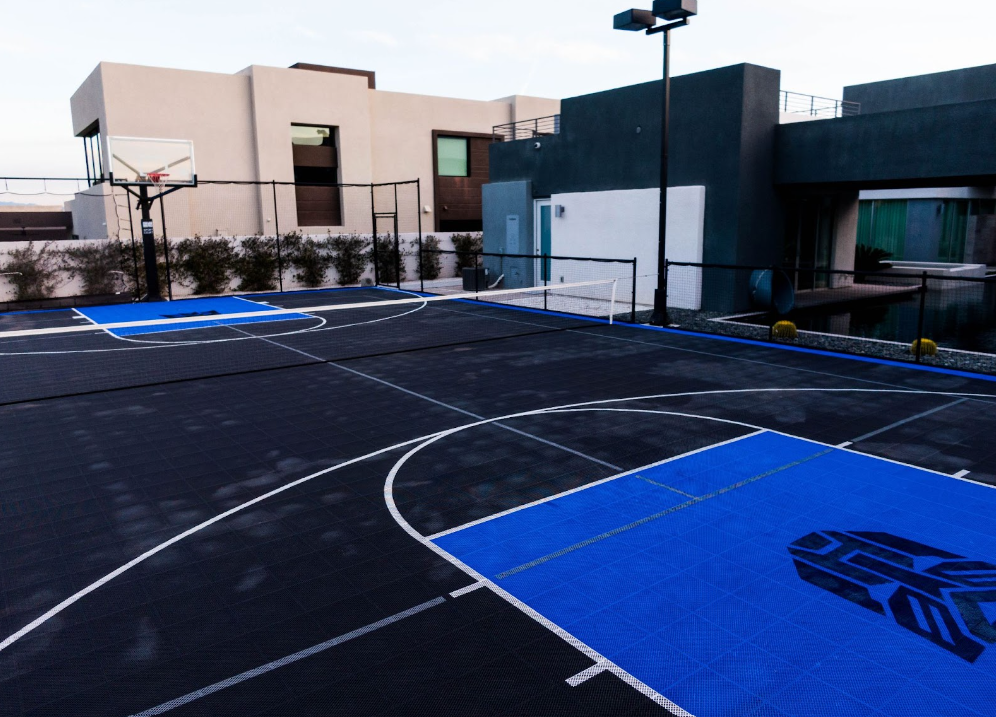
Backyard court in Las Vegas, Nevada done by Legendary Sports Construction

Backyard Sport Court Ideas: Design Inspiration for Your Space

A backyard sport court doesn’t have to look like a generic slab with painted lines. With the right layout, color palette, and accessories, a court can become one of the most-used and best-looking features on a property. Here are design ideas worth considering before you build.
 

Color and Design Choices

 
Acrylic surfacing systems open up color options that go well beyond the standard blue-and-green combination seen on many public courts. Popular directions include:
 
  • Matching your home’s exterior palette, using complementary or accent colors that tie the court visually into the rest of the property.
  • Two-tone key and boundary areas, a classic look that adds visual interest without overwhelming the space.
  • Custom logos or monograms, painted into the key or center circle for a personalized touch, popular for family courts and HOA amenity spaces alike.
  • Lighter color palettes, which not only look clean but also stay cooler underfoot during Las Vegas and Phoenix summers.
 

Sizing to Fit Your Yard, Not the Other Way Around

 
One of the most common mistakes in backyard court planning is trying to force a full regulation court onto a lot that’s better suited to a half-court or a smaller multi-sport layout. A well-proportioned half-court that fits comfortably in your space, with room to move around it, plays and looks better than a cramped full court squeezed in at the expense of landscaping or safety clearance.
 

Multi-Sport Flexibility

 
If your household or neighborhood enjoys more than one sport, striping a single pad for basketball, pickleball, and even four-square play maximizes the return on your investment. Multi-sport courts are especially popular for HOA common areas and families with a range of ages and interests.
 

Lighting for Evening Use

 
Court lighting isn’t just functional, it transforms how a court is used and looked at after dark. LED sports lighting extends play into the cooler evening hours (a big deal during Las Vegas and Phoenix summers) and, with thoughtful fixture placement, can make the court an attractive feature of the property at night rather than a dark, unused slab.
 

Fencing, Shade, and Seating

 
Perimeter fencing keeps balls contained and adds a finished look to the space. Shade structures, pergolas, or shade sails near the court make it far more comfortable to use, and hang out around, during peak sun hours. Simple bench seating along one edge turns the court into a gathering space, not just a playing surface.
 

Landscaping Integration

 
Courts don’t have to sit as an isolated slab in the middle of a yard. Thoughtful landscaping, decorative gravel borders, low retaining walls, or planted buffers between the court and the rest of the yard, helps the court feel like an intentional part of the property design rather than an afterthought.
 

Practical Ideas Worth Considering

 
  • Half-court with adjustable hoop for households with kids at different ages and skill levels.
  • Pickleball court with a shade structure for comfortable daytime play in hot months.
  • Multi-sport court with distinct line colors for basketball and pickleball on the same pad.
  • Cushioned acrylic surface for households prioritizing comfort for frequent, high-impact play.
  • Sand volleyball corner paired with a hard-surface court elsewhere on the property for variety.
 

FAQ

 
What colors work best for a backyard basketball or pickleball court?
Popular choices include colors that complement the home’s exterior, along with lighter palettes that stay cooler underfoot in desert heat.
 
Should I build a full court or a half-court in my backyard?
For most residential lots, a well-proportioned half-court fits more comfortably and gets just as much use as a cramped full court.
 
Can I add a custom logo or design to my court?
Yes, acrylic surfacing systems support custom logos, monograms, and multi-color designs painted directly into the court surface.
 
Is a multi-sport court a good idea for a family backyard?
Yes, especially for households or neighborhoods with a range of ages and sport interests, since it maximizes use of the available space.
 
Does lighting really make a difference for backyard courts?
Yes, particularly in Las Vegas and Phoenix, where lighting extends comfortable play into the evening during the hottest months.
 
How do I make my court fit naturally into my yard’s design?
Thoughtful landscaping, borders, and shade elements help integrate the court visually rather than leaving it as an isolated slab.
 
This page links to our basketball, pickleball, and volleyball construction pages, and our surface types guide. Ready to design your backyard court? Get a quote from Legendary Sport Construction today.

The Growth of Pickleball and Its Future

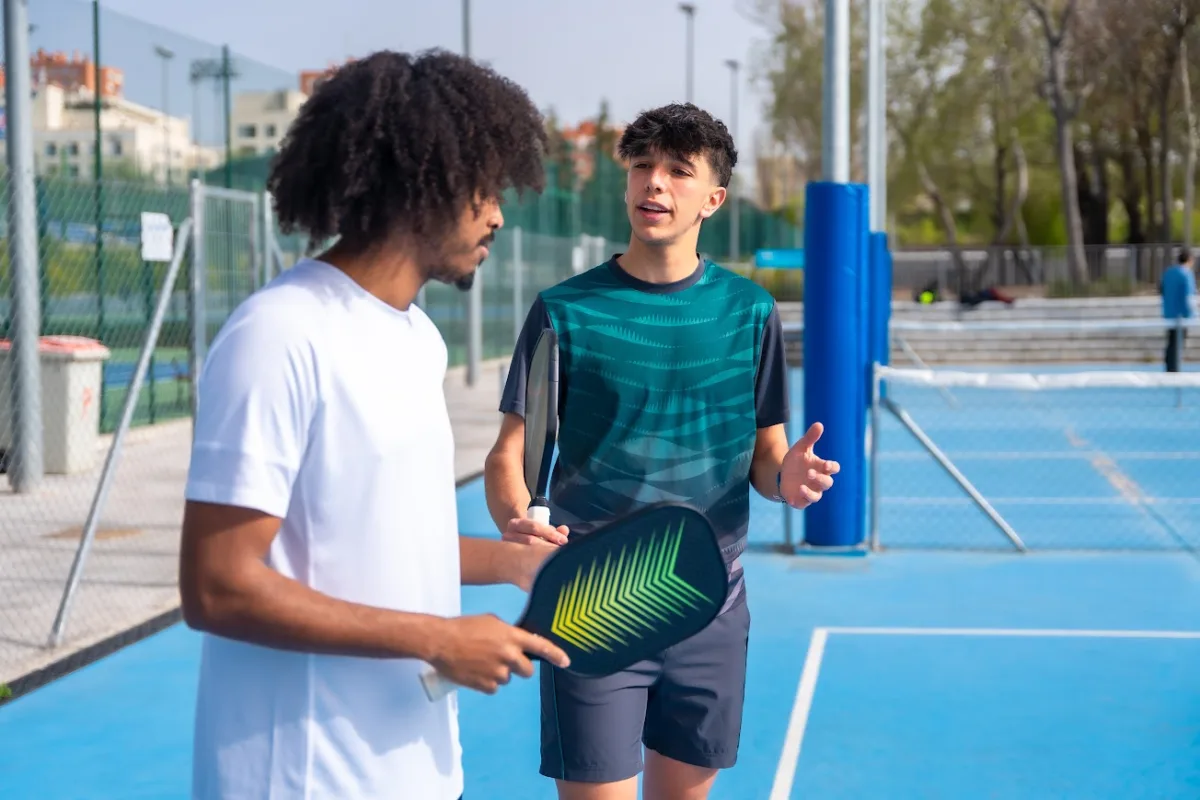
Pickleball instructor teaching someone how to play

The Growth of Pickleball and Its Future

In recent years, pickleball has seen a meteoric rise in popularity, evolving from an improvised backyard game into an international phenomenon. From community centers to exclusive sports clubs, the sport has attracted players of all ages and skill levels. What started as a quirky little game played by a small in-crowd has quickly become one of the fastest-growing sports in America. The reason for this surge? Pickleball’s unique blend of accessibility, social interaction, and fun. With courts popping up everywhere and participation skyrocketing, it’s clear that pickleball isn’t just a fad.

The Rise of Pickleball

A Brief History

Pickleball was invented in 1965 by Joel Pritchard, Bill Bell, and Barney McCallum on Bainbridge Island, Washington. They combined elements of badminton, tennis, and table tennis, using a wiffle ball and ping-pong paddles to create a fun, accessible sport. Originally popular in retirement communities, pickleball has since grown into a sport enjoyed by millions worldwide.

Factors Fueling Its Rapid Growth

Pickleball’s widespread appeal comes from its ease of learning, inclusive environment, and social nature. Its simple rules and low barrier to entry make it accessible to people of all ages and skill levels, while its smaller court size encourages social interaction and allows for more courts in a given space. This combination of factors has helped pickleball gain traction in communities, schools, and recreational centers across the country.

For a deeper dive into how these factors are driving pickleball’s growth, read our detailed blog post here.

Court Design, Installation, and Technological Advancements in Pickleball

As pickleball’s growth continues, the expansion of courts across the country has followed suit. From residential backyards to commercial venues, the demand for dedicated pickleball courts is transforming spaces, often converting tennis courts to accommodate the sport’s growing playerbase. Cities like Las Vegas are seeing five tennis courts repurposed into 16 pickleball courts, a trend that highlights the efficiency of smaller, more social playing areas.

Customization and Flexibility

Pickleball courts are highly customizable, with designs that can fit a variety of spaces and player needs. Whether adjusting dimensions to fit a smaller backyard or incorporating personalized colors and logos, courts are tailored to match their environments. Different surface options, from standard acrylic to cushioned materials, allow for enhanced comfort and reduced player fatigue—particularly important for those looking to avoid the wear and tear of traditional hard courts.

Technological Innovations

Technological advancements have improved both the playing experience and the sustainability of court installations. Noise reduction has been a significant focus, with innovations like glass walls that reduce sound by 50% while maintaining visibility. Some courts also feature eco-friendly LED lighting, reducing energy consumption and light pollution.

Upgrades in Equipment

Equipment has evolved alongside courts. Quieter paddles and enhanced surface materials provide a better playing experience, addressing concerns around noise and durability. These developments ensure pickleball is not just fun but also more accessible to communities concerned about noise or environmental impact.

By incorporating smart court designs and advanced technologies, pickleball is adapting to meet growing demand, ensuring the sport’s continued expansion and success.

Community Engagement and Events

Pickleball’s popularity is bringing communities together, with venues like Chicken N Pickle serving as hubs for casual players and families. These facilities, which combine pickleball courts with dining, entertainment, and social spaces, offer an inviting atmosphere for those looking to enjoy the game without the intensity of competitive play. They’ve become places where people can connect, engage in friendly matches, and spend time with family and friends. With activities ranging from pickleball to life-sized games like Connect Four, these venues are creating spaces where the community can come together, making the sport accessible and fun for all.

Growth of Pickleball Tournaments and Leagues

For players seeking a more competitive environment, pickleball’s rapid growth has also sparked an increase in local and national tournaments. From weekend competitions to USA Pickleball-sanctioned events, there are numerous opportunities for players to showcase their skills. Schools are also helping to drive the sport’s expansion, incorporating pickleball into their physical education programs and establishing youth leagues. These initiatives are introducing younger generations to the sport, ensuring its continued development for years to come.

Inclusivity and Accessibility

One of pickleball’s most appealing features is its inclusivity. The sport is welcoming to players of all ages and abilities, with clubs and social groups popping up across the country to foster a sense of community. Programs for beginners make it easy for newcomers to learn the game, while local clubs provide opportunities for casual players to join in, socialize, and bond over their shared love of pickleball.

Celebrity Influence on Pickleball

Pickleball’s rise has attracted high-profile endorsements from celebrities, with athletes like LeBron James and Tom Brady investing in professional pickleball teams. Reese Witherspoon and George Clooney are among the growing list of famous pickleballers who have been spotted playing, adding to the sport’s visibility. This celebrity involvement has helped pickleball trend further into the mainstream, contributing to its ongoing growth.

The Future Outlook of Pickleball

The future of pickleball looks bright, with the sport continuing to gain momentum. One of the most exciting prospects is its potential inclusion in the Olympics. While the 2028 Summer Olympics in Los Angeles have a finalized roster of events, pickleball could potentially make its Olympic debut in 2032 in Brisbane, Australia. As global interest in the sport grows, its consideration for the Olympics showcases how far pickleball has come since its humble beginnings.

Continued Expansion of Facilities and Global Reach

Pickleball courts are rapidly expanding across the U.S., and the sport’s global reach is growing as well. More communities are integrating courts into public parks, schools, and sports clubs, while commercial facilities are transforming existing spaces to meet the increasing demand. This expansion is not limited to the U.S.—pickleball is gaining traction internationally, with more countries recognizing its appeal. As the sport spreads worldwide, the infrastructure to support it will only continue to improve.

Legendary Sports Construction’s Role in Shaping the Future

Legendary Sports Construction plays a key role in the growth of pickleball by providing expert pickleball court design and customization. Whether adapting to unique spaces or integrating the latest materials and technologies, our courts are built to enhance the playing experience.

Beyond construction, we are committed to community development. We donate resources to schools, help launch youth pickleball clubs, and educate teachers about the sport. By building both residential and commercial courts, our team ensures that more people have access to pickleball as demand continues to rise.

How to Get Involved and Promote Pickleball

Advocating for more pickleball courts in your local community can start with engaging schools, parks, and recreational centers to add courts. Fundraising and volunteer efforts are great ways to support these initiatives.

Spreading awareness is also key—use social media, attend local events, and offer mentorship or beginner classes to introduce new players to the sport. Supporting youth programs and promoting inclusive participation will ensure pickleball remains accessible and continues to grow.

Conclusion

Pickleball’s future is undeniably bright, with its widespread appeal and rapid growth showing no signs of slowing down. The sport’s accessibility and community-driven nature make it a favorite for players of all ages and skill levels. Now is the perfect time to get involved—whether by playing, advocating for more courts, or supporting local programs.

For those looking to bring pickleball into their own communities, Legendary Sports Construction is ready to assist with expert court design and installation. Together, we can continue to grow the sport and ensure that the growth of pickleball continues through the years.

Contact Us

Sign up for our Newsletter

GET A QUOTE

Please Provide Your Contact Information and Project Details