What Really Happens When a Sport Court Is Built to Cut Corners

What Really Happens When a Sport Court Is Built to Cut Corners

What Really Happens When a Sport Court Is Built to Cut Corners

A new court almost never looks like the shortcut it was. On day one, a corner-cut court and a properly engineered one can sit side by side and look identical: fresh acrylic, crisp lines, a hoop that still swings true. That is exactly why poorly built sport court problems catch so many families off guard. The trouble doesn’t announce itself at the ribbon-cutting. It waits.
We’ve built courts across Las Vegas, Henderson, and the Phoenix valley for more than 20 years, and some of the ones we poured early on are still going strong three decades later. We’ve also been called out to look at courts we didn’t build, the ones that started lifting, cracking, or holding water somewhere in year three. Almost every time, the story is the same. The corner that got cut was underground, in the part nobody sees once the surface goes down.

Where corner-cutting actually happens (it’s the base)

Here’s the uncomfortable truth about shortcuts: they don’t come out of the color coat or the striping. They come out of the base.
The base and sub-base are the parts of the job that take the most time, the most equipment, and the most discipline, and they are also the parts a homeowner can’t inspect after the fact. Excavation depth, soil evaluation, compaction, the crushed stone layer that distributes load and breaks the path moisture takes up into the slab, the reinforcement inside the concrete itself. Skip or shrink any of those and the court will still look finished. It just won’t behave finished for long.
That’s what makes base corner-cutting different from every other shortcut. A faded surface can be recoated. Worn lines can be restriped. A failing base can’t be repaired from the top down. You fix it by tearing the court out and starting over, which is the one outcome we build specifically to help you never face.

The failures that show up in years 2 through 10

Base problems keep a schedule. They tend to surface slowly, and here in the desert the clock runs a little differently than it does in cooler, wetter climates.

Cracking and settling from a weak sub-base

Expansive desert soils move. They shrink as they dry out in summer and swell when they finally take on water, and that constant push-and-pull is one of the leading causes of long, diagonal cracks running through a slab. When the sub-base underneath wasn’t properly evaluated and compacted, the ground opens small voids, the slab loses its uniform support, and it starts to settle unevenly. You’ll see it as a ridge through the key, a low spot that never quite drains, or a crack that keeps coming back no matter how many times it’s patched.

Premature surface breakdown

Year-round UV is relentless out here. A surface coating that was under-spec’d or applied too thin can chalk out, fade, and lose its grip after just a season or two of desert sun, while a properly built UV-stable acrylic system holds its color and traction for years. When the coating goes early, the court gets slick, the lines wash out, and what should be a straightforward recoat turns into a bigger conversation because the layers underneath were compromised too.

Drainage and water damage

Water is patient, and it does its damage from the edges inward. When slope and drainage get estimated instead of engineered, puddles form, the perimeter softens, and moisture works its way under the surface. It rarely fails the court overnight. Instead you get algae, slick patches, surface breakdown, and a base that stays wet long enough to lose strength. Poor drainage is probably the most underestimated of all the poorly built sport court problems, precisely because it looks fine right up until it doesn’t.

The tear-out-and-redo outcome

This is the one we most want families to avoid. When the base fails structurally, there is no patch, no overlay, no coat that makes it right. The court has to come out and go back in. Everything that was saved in effort up front gets spent, and then some, on doing the whole thing twice.

DIY and rushed builds: what actually goes wrong

We hear it a lot: how hard can a slab and a couple of hoops really be? The honest answer is that the pouring isn’t the hard part. The engineering under it is.
Most DIY and rushed low-effort builds go sideways in the same predictable places. The site never gets a real soil and topography evaluation, so nobody knows what the ground underneath is going to do. The sub-base gets compacted by eye rather than to spec. Drainage gets set by a rough slope guess. Reinforcement gets thinned or skipped. None of that shows on day one. All of it shows up later, usually as some combination of cracking, settling, and standing water that arrives right around the time the court should have been hitting its stride.

Where more isn’t better

Now the honest counterpoint, because building it right is not the same as building it heavy everywhere.
We don’t believe in over-building a court for how it will actually be used. A light-use backyard hoop for weekend shooting doesn’t need every premium system a tournament-grade multi-sport facility calls for, and we’ll tell you that on the site visit rather than talk you into it. There’s a difference between the things that must never be compromised and the things that are genuinely optional. The base, the compaction, the drainage, the reinforcement, the surface’s UV protection: non-negotiable, because they decide whether the court lasts. Cushioned layers, competition-grade lighting, fencing, extra square footage: real options, matched to how you play, not padded on for the sake of it. Cutting a corner on the base is a mistake. So is spending effort where it won’t change how long you enjoy the court.

How we build for longevity, not shortcuts

Everything we do follows the same order for a reason: Design, Build, Play, Maintain. It starts with understanding your yard and your soil before a single form goes in, engineering the base to hold up to desert heat and movement, and finishing with a UV-stable surface built to take the sun.
That base-first philosophy is why we lean on reinforced and post-tension concrete for the courts that need to last. A post-tensioned slab is held together under tension, which lets it flex with temperature swings and resist the cracking that flexible pavement gives in to over time. It’s the difference between a court that’s still true after 25 or 30 years and one that’s fighting itself by year five. If you want to go deeper on why courts fail in this climate specifically, our guide on why sport courts crack in the desert breaks it down, and the most common court-building mistakes we get called to fix covers the rest of the pattern. You can also read up on our UV-stable acrylic surfacing and how it holds up here.
We pride ourselves on the relationship, and we’re there for the life of your court. That’s not a slogan. It’s the whole reason we refuse to cut the corners that would end the relationship early.
If you’re weighing a court and want to know it’ll be built right, book a site visit and we’ll walk your space with you and lay out an honest plan.

FAQ

Is asphalt or post-tension concrete more durable long-term? For longevity in the desert, post-tension concrete is the stronger choice. It’s engineered to flex with heat and resist cracking, and a well-built post-tension court can stay true for 25 to 30 years and beyond. Asphalt is a flexible pavement, which means cracking tends to arrive sooner and resurfacing comes around more often, especially under year-round sun and moving soils.
Can a poorly built court be fixed later? It depends entirely on whether the base is sound. Surface and cosmetic problems (faded color, worn lines, a slick coat) can be resurfaced. A failing base can’t be patched from the top. If the sub-base is settling or the slab is cracking structurally, the honest fix is a rebuild, which is exactly why the base is the one place you never want a shortcut.
What should never be compromised on a sport court? The parts you can’t see and can’t fix later: soil evaluation, sub-base compaction, drainage and slope, the reinforcement in the slab, and UV protection on the surface. Those decide whether the court lasts. Everything else is a matter of matching the build to how you’ll actually play.
Is a Backyard Sport Court Right for You? An Honest Look at Fit

Is a Backyard Sport Court Right for You? An Honest Look at Fit

Is a Backyard Sport Court Right for You? An Honest Look at Fit

Most people who ask us “is a backyard sport court a good idea?” already want one. What they’re really asking is quieter than that. Will our family actually use it? Does our yard fit? Are we the kind of household this makes sense for, or are we about to build something that sits empty by the second summer?
Fair questions. We’ve built courts across Las Vegas, Henderson, and out into the Phoenix and Scottsdale suburbs for over 20 years, and we’ve learned that the happiest court owners aren’t the ones with the biggest yards or the fanciest surface. They’re the ones who matched the court to how their family really lives. So instead of a sales pitch, here’s an honest look at fit.

The two questions that really decide it

Everything comes down to two things: how you’ll use it, and whether your space can hold it well.
Use is the one people skip. It’s easy to picture weekend games with the kids and harder to be honest about whether that picture lasts. A court that gets played on three or four times a week is a completely different decision than one built for a maybe. Neither is wrong. But knowing which one you are changes what you should build, and whether you should build at all.
Space is the more concrete question, and we’ll get into real numbers below. The short version: a court needs room not just for the lines, but for the run-off around them, the fence clearance, and the space behind the hoop where half the rebounds actually go.
Answer those two honestly and the rest of this article mostly sorts itself out.

Who a backyard court is genuinely right for

There’s a type of household that gets tremendous mileage out of a court, and after thousands of projects the pattern is pretty clear.
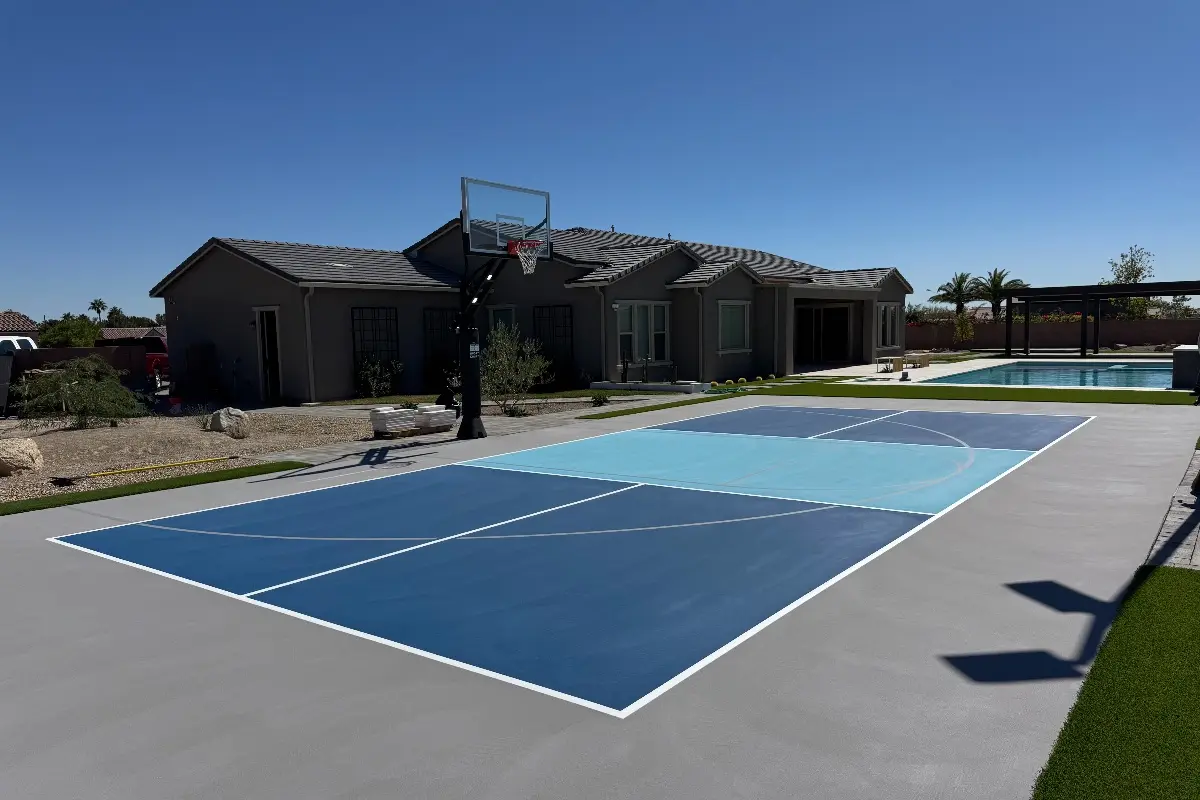
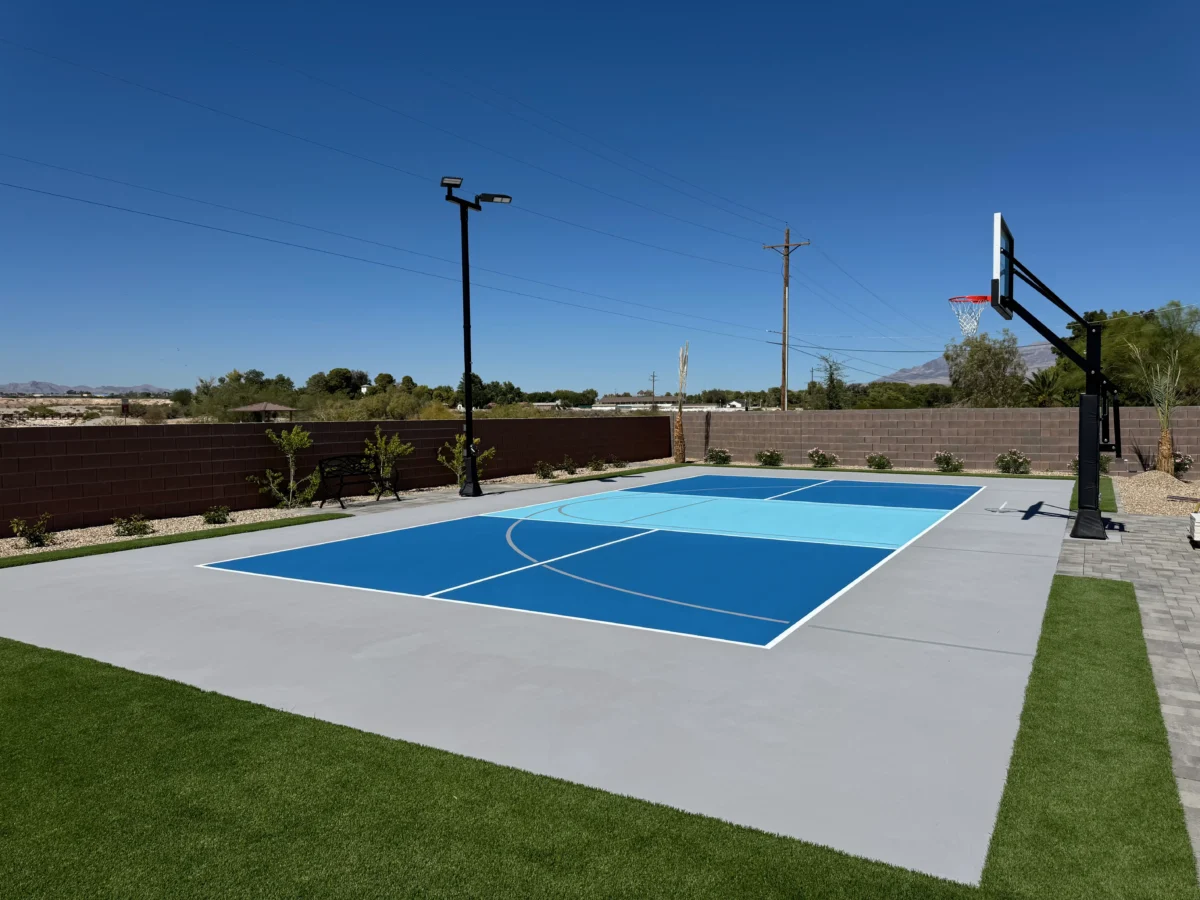
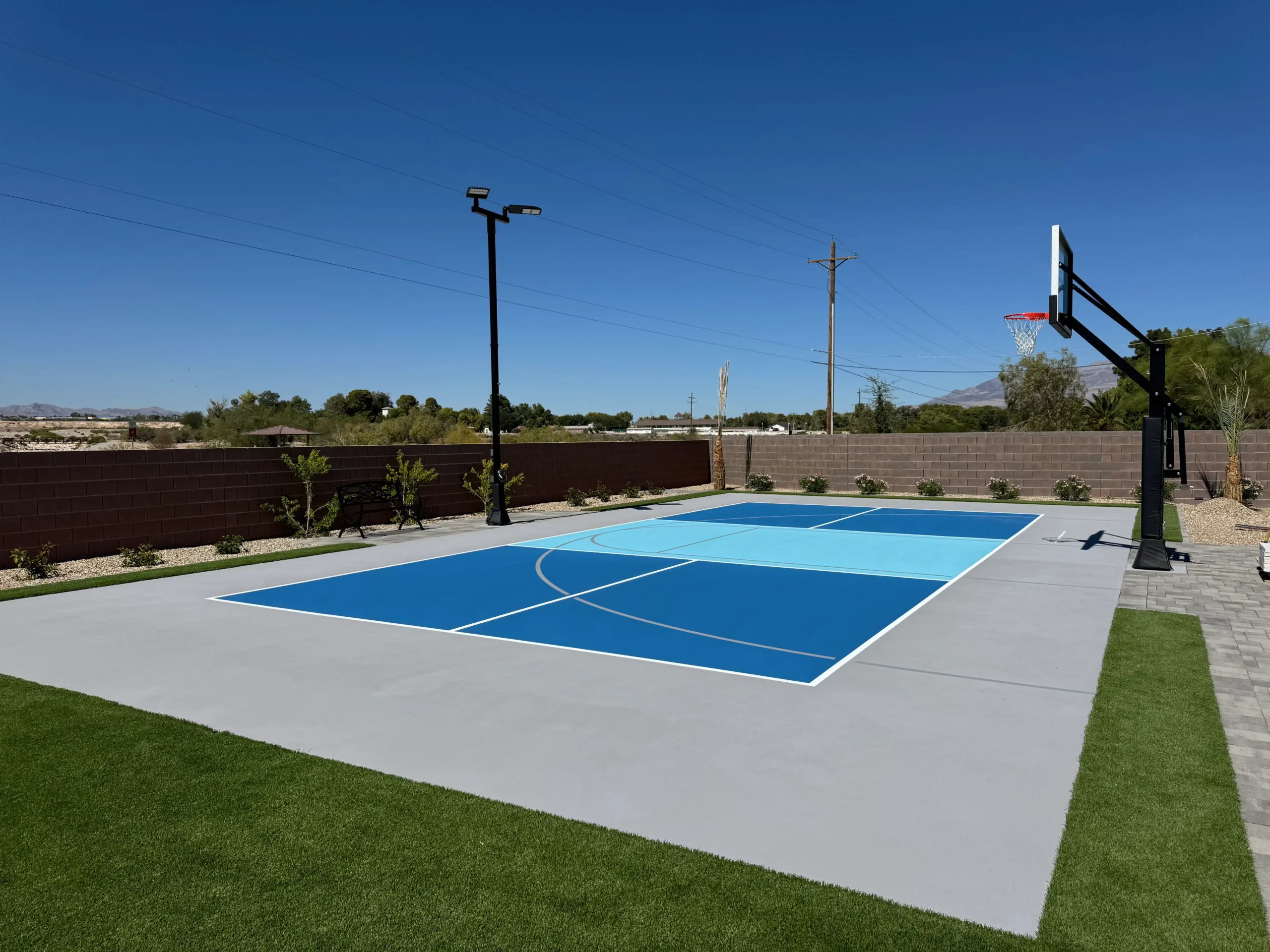
Multi-sport families. If your kids rotate through basketball, pickleball, and whatever their friends brought over that afternoon, a single well-designed surface gives all of it a home. A multi-sport game court can carry basketball keys, pickleball kitchen lines, and more inside the same footprint, which is why it’s our most-requested build for growing families.
Households with kids still at home. This is the big one. A court in the backyard is the difference between “go outside” being a suggestion and being the obvious thing to do. Our founder, Miles Reynolds, grew up playing on his driveway court every day with three brothers, and that’s genuinely the origin of this company. Courts are where athletes grow, families connect, and neighbors end up staying for dinner.
Entertainers. If your yard is already the gathering spot, a court extends it. Game nights, birthday parties, the neighborhood kids who somehow always know where the good hoop is.
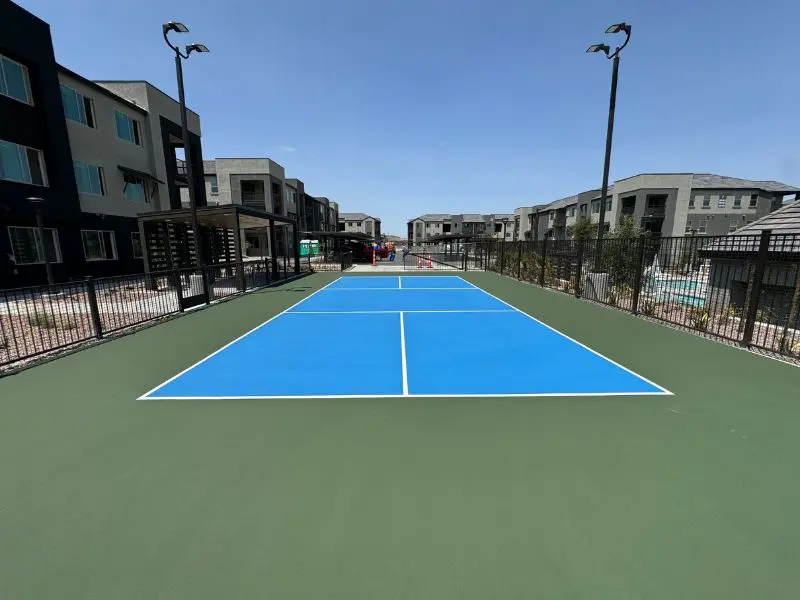
Pickleball converts. We’ve watched this one accelerate. People pick it up at a rec center, get hooked, and want a court steps from the kitchen. Pickleball’s low barrier and cross-generational appeal (grandparents and grandkids on the same court, genuinely) make it one of the strongest fits we see.

Who should think twice

We’d rather tell you now than have you regret it later, so here’s the honest counterpoint.
If your available space is genuinely tight, forcing a court into it usually means cramped run-off and a surface that never feels quite right to play on. Sometimes the better call is to wait until you can do it properly, or to choose a smaller single-sport layout instead of squeezing a full multi-sport court where it doesn’t belong.
If the use is rare (a court you’ll touch a handful of times a year), be honest about that before you build. And if nobody in the household is willing to give it the light upkeep it needs, that’s worth naming too. A court isn’t demanding, but it isn’t zero. We’d rather you know that going in.
None of these are permanent no’s. They’re “not yet,” or “not this version.” That distinction matters.

How much space do you actually need?

Here are the numbers people ask us for most, in real feet, so you can walk your yard this weekend.
  • Pickleball: the playing area is 20 by 44 feet, but you want closer to 30 by 60 feet once you add safe run-off on the sides and behind each baseline. Players chase lobs well past the line, so that buffer isn’t optional if you actually want to play.
  • Half-court basketball: plan for roughly 2,350 square feet to have comfortable room around the key and behind the hoop.
  • Multi-sport: a 30 by 60 foot area is the sweet spot, and it’s enough to combine a half-court with pickleball on one surface.
If your yard clears those comfortably, you’re in great shape. If it’s close, that’s exactly the kind of thing we sort out on a site visit before anyone commits to a layout. For more layout inspiration once you know your dimensions, our backyard sport court ideas gallery is a good next stop.

Matching the court to how you actually play

The right court is the one built around your real weekends, not a spec sheet.
A family that lives and breathes basketball might want a proper half-court with a regulation-height, breakaway rim and room to run a real game. A pickleball-first household wants accurate kitchen lines and a surface that plays true. Most people, though, land somewhere in the middle and are best served by a multi-sport layout that does several things well rather than one thing perfectly. Surface choice follows the same logic: cushioned acrylic feels different underfoot than a modular tile system, and what’s right depends on who’s playing and how hard.
There’s no single best answer here, and anyone who gives you one without seeing your yard is guessing.

Desert considerations before you build

Building here isn’t like building in a mild climate, and a few things deserve a look before you fall in love with a layout.
Space and run-off we’ve covered. Beyond that, sun and shade matter more than people expect, because a west-facing court with zero shade turns into an oven by mid-afternoon in a Vegas or Scottsdale summer. Orientation, and sometimes a shade structure, can change how many months a year the court actually gets used. Then there’s HOA design review, which is a real step across much of Southern Nevada and Arizona and worth starting early. And drainage: our monsoon bursts are short but serious, so slope and water handling get engineered in from the start, not patched on later.

Why quality decides whether you love it in ten years

Here’s the part that separates a court you’re glad you built from one you quietly wish you hadn’t.
You can’t see the base once the court is finished, which is exactly why it’s the thing that decides everything. We engineer the base first, on properly compacted sub-base with correct slope, then surface it with UV-stable acrylic that won’t chalk out after one desert summer. That’s the difference between a court that looks great on day one and one that’s still going strong decades later. We have courts in Vegas that families have played on for over 30 years. The reason isn’t the color they picked. It’s what went in underneath. If you want to understand what goes wrong when that base gets rushed, why cutting corners on a sport court backfires walks through it.
Follow our Design, Build, Play, Maintain process and the court earns its keep in family time, not regret.

Keeping it great for the life of your court

Upkeep is lighter than most people fear. Sweep it, rinse it, keep an eye on the surface, and plan on a periodic resurface down the road to refresh the color and the lines. That’s most of it. The specifics live in our guide to keeping it in shape, and we stay in the picture for the life of your court, not just the day we hand you the keys. Want to see how these hold up over the years? Take a look at real courts we’ve built.

FAQ

What’s the best court type for my family? It depends on how you play. Basketball-first households lean toward a half-court, pickleball converts want accurate lines and a true surface, and most families are happiest on a multi-sport layout that handles several games well. A quick look at your yard and your weekends usually makes the answer obvious.
How much space do I really need? Plan for about 30 by 60 feet for pickleball with proper run-off, roughly 2,350 square feet for a comfortable half-court, and 30 by 60 feet for a multi-sport court. If your yard is close but not certain, that’s what a site visit is for.
Does a backyard court need maintenance to stay good? Yes, but not much. Regular cleaning, keeping the surface clear, and a periodic resurface down the line keep it playing and looking right. A well-built court asks very little to stay great for decades.
Still weighing it? The honest way to know if a court fits your family and your yard is to have someone stand in the space with you. Book a site visit and we’ll walk it together, no pressure to build.

Why Sport Courts Crack in the Desert (and How to Stop It Before It Starts)

Sport Courts

Why Sport Courts Crack in the Desert (and How to Stop It Before It Starts)

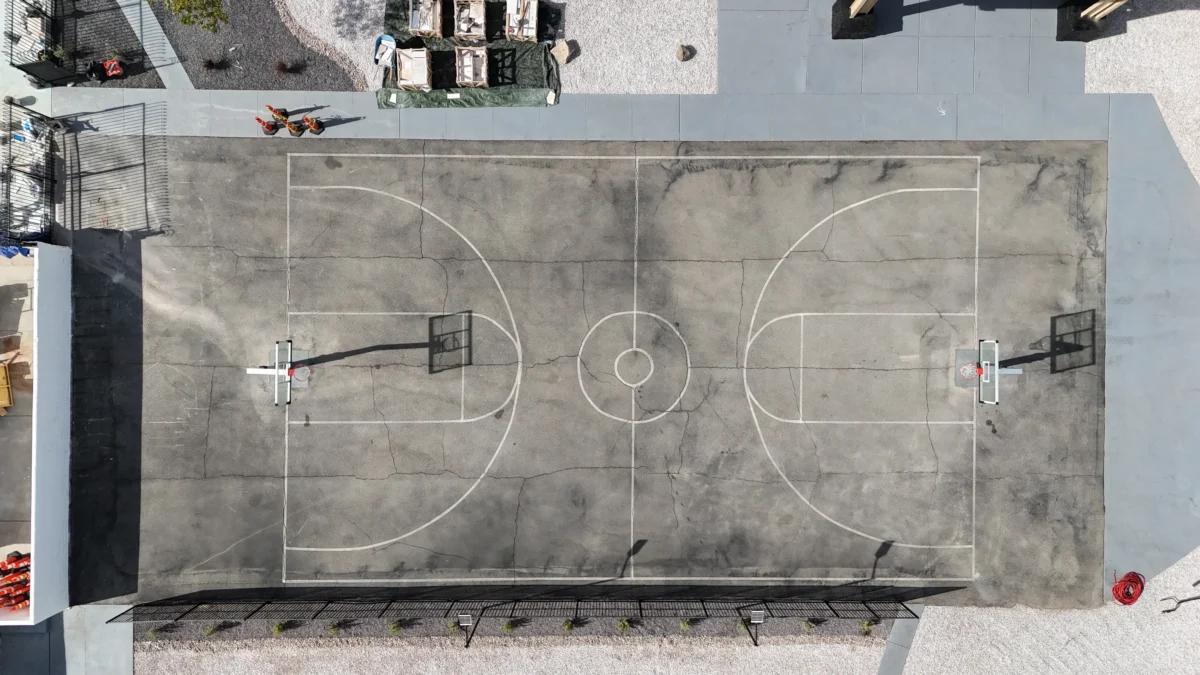
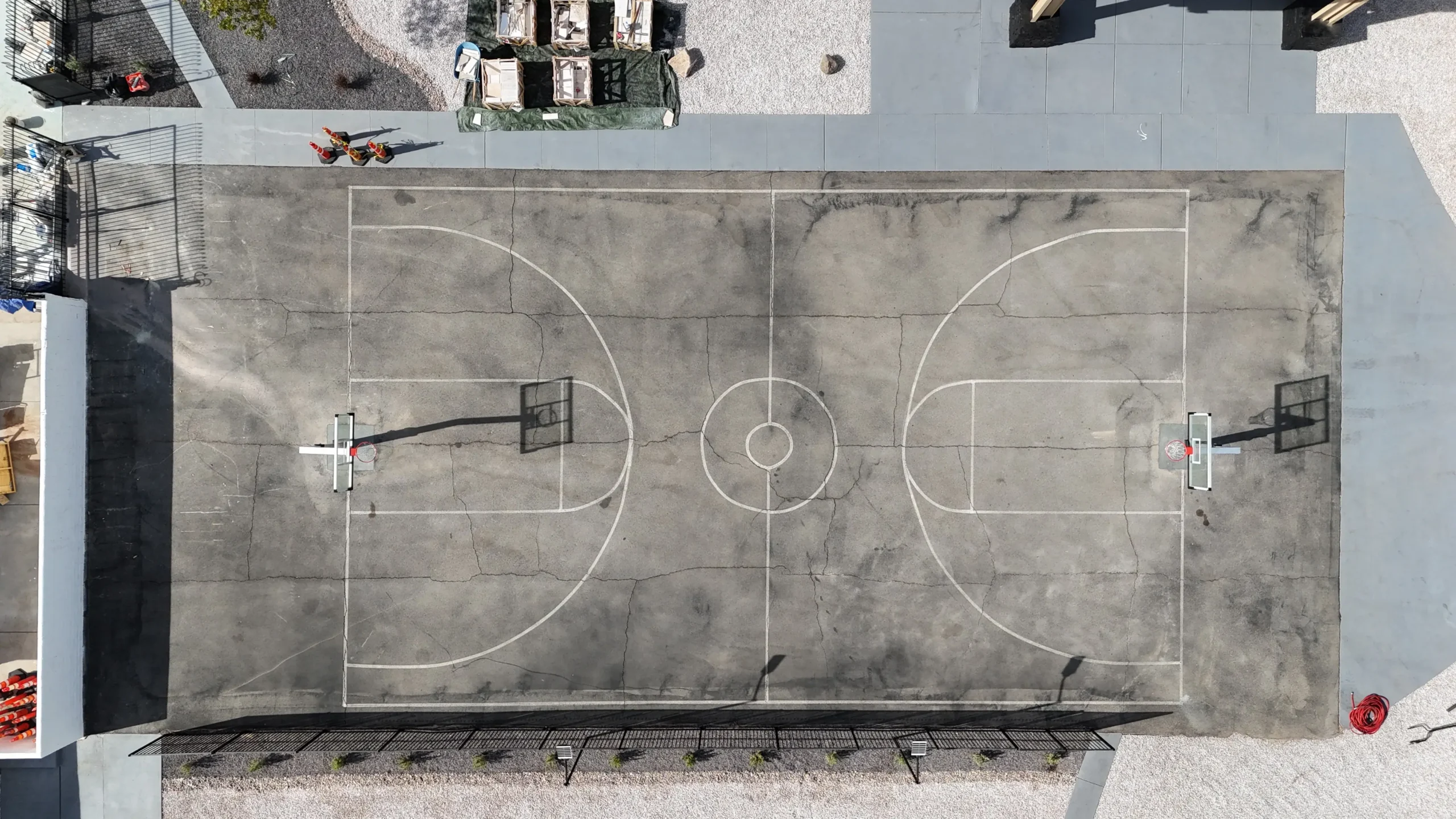
You noticed the first line one morning, running along the baseline, thin as a hair. A year later it’s wider, a little raised at the edges, and now you’re wondering whether the whole court is going bad. It’s the question we hear most often out here: why do sport courts crack, and did something go wrong? Here’s the honest answer, and it’s the one almost nobody leads with. Most of the “why courts crack” advice online was written for cold, wet climates where ice is the villain. Water gets into the surface, freezes, expands, and pries the court apart over a few winters. That story is real. It’s just not our story. In Las Vegas and Phoenix, courts almost never crack from ice. They crack for reasons that are specific to the desert, and once you understand them, most of the damage is preventable.


The short answer: most cracks start under the surface

 
A cracked court looks like a surface problem. It usually isn’t. The color coat and the acrylic on top are only a few millimeters thick, and they crack because something moved underneath them. In our experience across more than 10,000 projects, the crack you can see is almost always reporting news from below, from the base and the soil the court is sitting on. That’s why patching the surface without understanding the base is like painting over a wall that keeps cracking because the foundation is settling. It buys you a season, maybe two, and then the line comes right back through your fresh coating.
 
So the real question isn’t “how do I fill this crack.” It’s “what moved, and why.”


What actually causes court cracks in Las Vegas and Phoenix


Soil movement and expansive desert soils

 
This is the big one, and it’s the one people don’t expect in a place this dry. A lot of Southern Nevada and Arizona sits on expansive clay soils. When those clays take on water, during monsoon storms or from a leaking irrigation line or bad drainage, they swell and push up. When they dry back out over a long hot stretch, they shrink and pull away. Engineers call that cycle heave, and it happens under slabs, footings, and yes, sport courts. When one part of a court’s soil moves more than another, the slab flexes, and something has to give. Usually it’s the surface, in the form of a crack. The American Sports Builders Association and the USTA construction manuals both treat unstable subgrade as a leading cause of court failure, and in the desert that instability is driven by these wet-dry clay swings rather than frost.


Extreme heat and daily temperature swings

 
A court in Henderson can hit surface temperatures well over 140 degrees on a July afternoon and then drop 30 or 40 degrees by early morning. Concrete and acrylic expand in that heat and contract when it cools, every single day, all summer long. Do that thousands of times and the material fatigues. Coatings that were never rated for that kind of thermal cycling lose their elasticity and start to fracture, which is why so many hairline cracks show up on the sunniest, most exposed part of the court first.


Year-round UV breaking down cheap coatings

 
We get roughly 300 sunny days a year, and UV is relentless on a surface with no shade. Bargain coatings chalk out, get brittle, and lose the flexibility they need to move with the court. A UV-stable acrylic surfacing system is built to take that punishment. A cheap one isn’t, and after one or two desert summers you can usually tell which one you got.


Water and poor drainage

 
Dry climate, still a water problem. When a court isn’t sloped correctly or the surrounding grading sends runoff toward the slab instead of away from it, water pools and finds its way into the soil underneath. That’s the fuel for the expansive-clay cycle above. A flat-looking court that holds a puddle after a storm is quietly feeding the exact movement that cracks it.


A weak or rushed base, the real culprit

 
Here’s where all of it comes together. Soil moves, heat cycles, water intrudes. A court engineered to handle those forces stays put. A court built on a thin, poorly compacted, or under-reinforced base doesn’t have the strength to resist them, so it cracks early and keeps cracking. Nine times out of ten, when we’re called to look at a badly cracked court, the base is where the corner was cut.


Structural cracks vs. surface cracks: how to tell them apart

 
Not every crack means the same thing, and knowing the difference saves you a lot of worry.
 
Surface, or hairline, cracks are thin, usually less than an eighth of an inch, and shallow. They live in the coating and the top of the slab. They often come from coating age and everyday thermal stress, and they’re frequently manageable with proper repair and resurfacing. Alligator cracking (a scaly, interlocking pattern) and fine shrinkage cracks fall in this family too.
 
Structural cracks are a different animal. They’re wider, often a quarter inch or more, and they run down through the surface into the base itself. These are the ones that tell you the slab or the soil beneath it has moved. A good rule of thumb: if a crack is wide enough to catch your fingernail, changes elevation from one side to the other, or keeps coming back through every repair, treat it as structural until a professional says otherwise.


Can you repair a cracked court, or does it come back?

 
Both, and which one you get depends entirely on the base.
 
If the base is sound and you’re dealing with surface cracks, a proper crack repair followed by resurfacing and maintenance can give you many more good years of play. That’s the whole point of a resurfacing cycle, which most court bodies put in the range of every five to seven years depending on use and sun exposure.
 
If the base is failing, though, a surface repair is a delay, not a fix. The soil is still moving, the slab is still flexing, and the crack will telegraph right back through your new coating within a season or two. We’d rather tell you that up front than take you through a resurface we know won’t hold. Sorting out which situation you’re in is exactly the decision we walk through in resurface vs. replace.


How we prevent cracks: base-first engineering

 
We’ve built courts in this valley for over 20 years, and some of the ones we poured decades ago are still going strong after 30-plus years of daily play. That doesn’t happen by accident, and it doesn’t happen because of the color coat. It happens because we engineer from the ground up, in that order: Design, Build, Play, Maintain.


Post-tension and reinforced concrete bases

 
For desert soils, this is the difference-maker. A post-tension slab has steel cables run through it that get tensioned after the concrete cures, holding the whole slab in constant compression. When the expansive soil underneath swells or shrinks, the slab essentially floats and moves as one stable piece instead of cracking apart. Regions with difficult soils have leaned on post-tension for decades for exactly this reason, and the Post-Tensioning Institute documents the crack-resistance benefit in detail. It’s the single best insurance against the soil movement we described up top.


Proper sub-base prep, compaction, and slope

 
Before any concrete is placed, the ground has to be right: excavated to the correct depth, compacted properly so it won’t settle unevenly, and graded so water runs away from the court instead of pooling under it. This is the unglamorous work that never shows up in a photo, and it’s the work that decides whether your court is still flat in ten years.


UV-stable acrylic surfacing

 
Once the base is doing its job, the surface can do its job. We finish with UV-stable acrylic built to flex through the heat cycles and hold its color and grip through our summers, not chalk out after one. You can read more about the different surface types and which one fits how you actually play.


When a crack means it’s time to resurface or replace

 
A few faded lines, minor hairlines, a slick spot where the texture has worn down? That’s a resurface conversation. Widening structural cracks, a section that has visibly settled, chronic puddling, or damage that keeps returning after repair? That’s a sign the base needs a real look, and it may be time to rebuild rather than recoat. If you’re not sure which camp your court is in, that’s exactly what a site visit is for.


FAQ

 
Do all courts crack eventually? Every outdoor court lives with movement, so hairline surface cracks over many years aren’t unusual and are normal wear. What isn’t inevitable is early structural cracking. A court engineered base-first for desert soil can go decades without a structural crack, which is why we treat the base as the thing that determines a court’s real lifespan.
 
Do concrete courts crack more than asphalt? It’s less about concrete versus asphalt and more about how the base is engineered. Plain slabs and asphalt can both crack when the soil moves under them. A properly reinforced post-tension concrete base is specifically designed to resist that movement in expansive desert soils, which is why we recommend it for courts built to last out here.
 
Is a cracked court covered under warranty? That depends on the cause and the builder, so the honest answer is that it varies. What we can tell you is how we approach it: we build to prevent the structural cracks in the first place, and we stay in the relationship for the life of your court so there’s someone to call when a question comes up.
 
If your court is starting to show its first cracks, don’t wait for the line to widen before you find out what’s really going on underneath it. Book a site visit and we’ll tell you honestly whether you’re looking at a simple resurface or something the base is trying to warn you about.
 

Basketball Court Construction Company Serving Las Vegas & Phoenix

Basketball Court Construction Company Serving Las Vegas & Phoenix - Legendary Sports

Basketball Court Construction Company Serving Las Vegas & Phoenix

Legendary Sport Construction is a basketball court construction company built around one standard: courts that are engineered correctly from the ground up and finished to play true for decades. We design and build backyard courts, HOA and community courts, school and athletic facility courts, and commercial basketball installations across Las Vegas, Nevada and the Phoenix, Arizona metro.
 
If you’re comparing basketball court construction companies, the difference that matters most isn’t the color of the paint. It’s what’s under it: the base, the drainage, the surface system, and the crew installing it.
 

Why Property Owners Choose Legendary Sport Construction

 
Engineering-first approach. Every project starts with a site evaluation covering soil conditions, drainage, slope, and orientation. In the desert Southwest, courts that aren’t graded and based correctly fail early, regardless of how good the paint job looks on day one.
 
Full-service builds. We handle excavation, base preparation, concrete or asphalt paving, acrylic surfacing, line striping, hoop systems, fencing, and court lighting as one coordinated project, not a string of subcontractors you have to manage yourself.
 
Regional experience. Building a basketball court in a high-UV, high-heat climate requires different surface specifications than building one in a milder region. We use coating systems and base designs proven to hold up against Las Vegas and Phoenix conditions specifically.
 
Transparent scope and pricing. You get a defined scope, a realistic timeline, and a quote that reflects the actual work, not a lowball number that turns into change orders once the project starts.
 

Our Basketball Court Construction Services

 
New court construction for backyards, HOAs, churches, schools, and commercial properties, sized and laid out to regulation dimensions or customized to your space.
 
Court resurfacing and recoating for existing courts showing cracking, fading, or surface breakdown, extending the life of the court without a full rebuild.
 
Surface system selection, matching acrylic, cushioned acrylic, or modular tile systems to your usage, budget, and site conditions.
 
Accessories and lighting, including in-ground and portable hoop systems, court fencing, and LED lighting packages for evening play.
 
Multi-sport conversions, striping courts for basketball alongside pickleball or volleyball lines on the same pad.
 

Our Process

 
  1. Consultation and site visit — we assess your space, discuss your goals, and talk through surface and layout options.
  2. Design and proposal — you get a detailed scope, material specifications, and pricing before any work begins.
  3. Base construction — excavation, compaction, and concrete or asphalt installation to the correct slope and thickness.
  4. Surfacing and striping — acrylic color coats or modular tile installation, followed by precise court line painting.
  5. Accessories and final walkthrough — hoops, lighting, and fencing installed and tested, with a final walkthrough before we call the project complete.
 

Built for the Desert Southwest

 
Las Vegas and Phoenix present some of the toughest conditions in the country for outdoor sports surfaces: intense UV, surface temperatures that can exceed 140°F, and wide seasonal temperature swings that stress concrete and coatings. Our surface systems and base designs are chosen specifically to handle that environment, which is why courts we build hold their color and structural integrity for years longer than generic installations.
 

FAQ

 
What does a basketball court construction company actually do?
A full-service company like Legendary Sport Construction handles the entire build: site evaluation, excavation, base construction, surfacing, striping, hoop and lighting installation, and any fencing or accessories, coordinated as a single project.
 
How much does it cost to build a basketball court?
Costs vary based on size, surface system, site conditions, and accessories. Our team provides a detailed, itemized quote after a site visit so you know exactly what you’re paying for. See our full basketball court construction cost breakdown for typical ranges.
 
Do you build both residential and commercial basketball courts?
Yes. We build backyard courts, HOA and community courts, church and school courts, and commercial or municipal installations.
 
Can you convert an existing concrete pad or driveway into a basketball court?
In many cases, yes, provided the existing slab is structurally sound and properly sloped. We evaluate the pad during our site visit.
 
Do you serve areas outside Las Vegas and Phoenix?
We primarily serve the Las Vegas metro and are expanding service into the Phoenix, AZ metro. Contact us to confirm coverage for your location.
 
How long will a new basketball court last?
With proper installation and periodic recoating, a well-built acrylic basketball court typically lasts 15-20+ years before major structural work is needed.
 
This hub page links to our supporting basketball guides (cost, surface options, hoops and lighting) and to the relevant service-area page for your city. Ready to start your project? Get a quote from Legendary Sport Construction today.
 

Tennis Court Resurfacing Cost: Process, Pricing & Resurfacing vs. Rebuild

Tennis courts age visibly: fading color, hairline cracking, low spots where water pools, and a surface that no longer grips the way it used to. Before assuming a full rebuild is necessary, it's worth understanding what resurfacing actually involves, what drives its cost, and when a rebuild is genuinely the better call.   What Tennis Court Resurfacing Involves   Resurfacing is not just a fresh coat of paint. A proper resurfacing project includes:   Surface assessment — checking for structural cracking, drainage issues, and base integrity before any coating is applied. Crack repair — filling and treating cracks with flexible fillers designed to move with the surface rather than re-crack immediately. Resurfacer application — a textured coat that fills minor surface irregularities and creates a uniform base for color coats. Color coating — typically two coats of acrylic color, applied evenly across the full court. Line striping — precise regulation lines repainted in durable, UV-resistant paint.   Done correctly, resurfacing restores both the appearance and playability of a court that has aged but still has a structurally sound base underneath.   What Drives Resurfacing Cost   Court condition. A court with only cosmetic fading and minor cracking costs less to resurface than one with extensive cracking that requires significant crack repair before coating can even begin.   Court size. Standard singles/doubles courts have a fixed footprint, but multi-court facilities scale cost accordingly.   Number of coats and system type. Standard acrylic resurfacing costs less than cushioned acrylic systems, which add a rubberized layer for extra shock absorption.   Access and site conditions. Courts with easy equipment access cost less to resurface than those requiring extensive material transport or site prep.   Line striping complexity. Standard tennis lines cost less than multi-sport overlays combining tennis with pickleball or other sport lines on the same court.   Resurfacing vs. Rebuild: How to Decide   Resurfacing makes sense when: The base (concrete or asphalt) is structurally sound with no major settling or heaving. Cracking is limited to surface-level or minor structural cracks that can be properly treated. Drainage and slope are still functioning correctly, water isn't pooling on the court.   A rebuild is the better call when: The base shows significant heaving, settling, or structural failure that resurfacing can't fix. Drainage problems are severe enough that water regularly pools, indicating the underlying slope is wrong. Extensive, widespread cracking suggests the base itself has failed rather than just the surface coating.   Resurfacing costs meaningfully less than a full rebuild, but only delivers lasting results when the base underneath is actually sound. A resurfacing job over a failing base is a short-term fix that will need to be redone within a couple of years.   Why Professional Assessment Matters   The biggest cost mistake we see is property owners resurfacing a court that actually needed a rebuild, spending money on a coating system that fails again within a season or two because the underlying problem was never addressed. Our team assesses the base and drainage first, then recommends resurfacing or rebuild honestly, even when resurfacing would be the easier sale.   FAQ   How much does it typically cost to resurface a tennis court? Cost depends on court condition, size, and the surface system chosen. We provide a detailed, itemized quote after assessing your court in person.   How often should a tennis court be resurfaced? Most tennis courts benefit from resurfacing every four to eight years, depending on usage intensity and sun exposure.   Can cracks be fixed without a full rebuild? Yes, in many cases. Surface-level and minor structural cracks can be treated with flexible crack fillers as part of a resurfacing project, provided the underlying base is still sound.   How do I know if I need resurfacing or a full rebuild? The deciding factor is base condition. If the concrete or asphalt base is structurally sound with functioning drainage, resurfacing is usually sufficient. Significant heaving, settling, or drainage failure points to a rebuild.   How long does a tennis court resurfacing project take? Most resurfacing projects take about one to two weeks, including crack repair, coating, curing time, and striping.   Does resurfacing include new line striping? Yes, standard resurfacing packages include fresh, precise line striping as part of the process.   This page is part of our tennis services alongside our tennis court construction company page. Ready to assess your court? Get a quote from Legendary Sport Construction today.

Tennis Court Resurfacing Cost: Process, Pricing & Resurfacing vs. Rebuild

Tennis courts age visibly: fading color, hairline cracking, low spots where water pools, and a surface that no longer grips the way it used to. Before assuming a full rebuild is necessary, it’s worth understanding what resurfacing actually involves, what drives its cost, and when a rebuild is genuinely the better call.
 

What Tennis Court Resurfacing Involves

 
Resurfacing is not just a fresh coat of paint. A proper resurfacing project includes:
 
  1. Surface assessment — checking for structural cracking, drainage issues, and base integrity before any coating is applied.
  2. Crack repair — filling and treating cracks with flexible fillers designed to move with the surface rather than re-crack immediately.
  3. Resurfacer application — a textured coat that fills minor surface irregularities and creates a uniform base for color coats.
  4. Color coating — typically two coats of acrylic color, applied evenly across the full court.
  5. Line striping — precise regulation lines repainted in durable, UV-resistant paint.
 
Done correctly, resurfacing restores both the appearance and playability of a court that has aged but still has a structurally sound base underneath.
 

What Drives Resurfacing Cost

 
Court condition. A court with only cosmetic fading and minor cracking costs less to resurface than one with extensive cracking that requires significant crack repair before coating can even begin.
 
Court size. Standard singles/doubles courts have a fixed footprint, but multi-court facilities scale cost accordingly.
 
Number of coats and system type. Standard acrylic resurfacing costs less than cushioned acrylic systems, which add a rubberized layer for extra shock absorption.
 
Access and site conditions. Courts with easy equipment access cost less to resurface than those requiring extensive material transport or site prep.
 
Line striping complexity. Standard tennis lines cost less than multi-sport overlays combining tennis with pickleball or other sport lines on the same court.
 

Resurfacing vs. Rebuild: How to Decide

 
Resurfacing makes sense when:
  • The base (concrete or asphalt) is structurally sound with no major settling or heaving.
  • Cracking is limited to surface-level or minor structural cracks that can be properly treated.
  • Drainage and slope are still functioning correctly, water isn’t pooling on the court.
 
A rebuild is the better call when:
  • The base shows significant heaving, settling, or structural failure that resurfacing can’t fix.
  • Drainage problems are severe enough that water regularly pools, indicating the underlying slope is wrong.
  • Extensive, widespread cracking suggests the base itself has failed rather than just the surface coating.
 
Resurfacing costs meaningfully less than a full rebuild, but only delivers lasting results when the base underneath is actually sound. A resurfacing job over a failing base is a short-term fix that will need to be redone within a couple of years.
 

Why Professional Assessment Matters

 
The biggest cost mistake we see is property owners resurfacing a court that actually needed a rebuild, spending money on a coating system that fails again within a season or two because the underlying problem was never addressed. Our team assesses the base and drainage first, then recommends resurfacing or rebuild honestly, even when resurfacing would be the easier sale.
 

FAQ

 
How much does it typically cost to resurface a tennis court?
Cost depends on court condition, size, and the surface system chosen. We provide a detailed, itemized quote after assessing your court in person.
 
How often should a tennis court be resurfaced?
Most tennis courts benefit from resurfacing every four to eight years, depending on usage intensity and sun exposure.
 
Can cracks be fixed without a full rebuild?
Yes, in many cases. Surface-level and minor structural cracks can be treated with flexible crack fillers as part of a resurfacing project, provided the underlying base is still sound.
 
How do I know if I need resurfacing or a full rebuild?
The deciding factor is base condition. If the concrete or asphalt base is structurally sound with functioning drainage, resurfacing is usually sufficient. Significant heaving, settling, or drainage failure points to a rebuild.
 
How long does a tennis court resurfacing project take?
Most resurfacing projects take about one to two weeks, including crack repair, coating, curing time, and striping.
 
Does resurfacing include new line striping?
Yes, standard resurfacing packages include fresh, precise line striping as part of the process.
 
This page is part of our tennis services alongside our tennis court construction company page. Ready to assess your court? Get a quote from Legendary Sport Construction today.

Basketball, Pickleball & Tennis Court Dimensions Guide

Basketball, Pickleball & Tennis

Basketball, Pickleball & Tennis Court Dimensions Guide

Getting court dimensions right is the foundation of a court that plays correctly and looks professional. Whether you’re planning a backyard build or a commercial installation, this guide covers the regulation dimensions for basketball, pickleball, and tennis courts, plus the extra space you actually need around each one.
 

Basketball Court Dimensions

 
A regulation full basketball court measures 94 feet by 50 feet (NBA/college) or 84 feet by 50 feet (high school). For backyard installations, a half-court, roughly 47 feet by 50 feet, is far more common and gives most households and neighborhoods plenty of room for real games.
 
Key measurements within the court:
 
  • Free-throw line: 15 feet from the backboard.
  • Three-point line: varies by level, from about 19.75 feet (high school) to 23.75 feet (NBA) at the top of the arc.
  • Hoop height: 10 feet, regulation for all standard adult play.
 
Beyond the painted lines, plan for at least 5-10 feet of clear run-off space around the perimeter so players aren’t at risk running out of bounds into a fence or landscaping.
 

Pickleball Court Dimensions

 
A regulation pickleball court measures 20 feet by 44 feet for the playing surface, the same size for both singles and doubles play. Key measurements:
 
  • Net height: 34 inches at the center, 36 inches at the posts.
  • Non-volley zone (“the kitchen”): extends 7 feet from the net on both sides.
 
Run-off space matters more for pickleball than most sports because of the sport’s fast lateral movement. Plan for a minimum of 10 feet behind each baseline and 5 feet along each sideline where space allows, meaning a comfortable pickleball court footprint is closer to 30 feet by 60 feet including clearance.
 

Tennis Court Dimensions

 
A regulation tennis court measures 78 feet by 27 feet for singles play, or 78 feet by 36 feet for doubles. Net height is 3 feet at the center, rising to 3.5 feet at the posts.
 
Additional clearance space is needed around the court, typically at least 12 feet behind each baseline and 6 feet along each sideline for proper play, bringing the total footprint closer to 120 feet by 60 feet for a fully clear regulation court.
 

Comparing the Three at a Glance

 
Sport
Playing Surface
Net/Rim Height
Recommended Total Footprint
Basketball (half-court)
~47 x 50 ft
10 ft rim
~55 x 60 ft with clearance
Pickleball
20 x 44 ft
34-36 in net
~30 x 60 ft with clearance
Tennis (singles)
78 x 27 ft
3-3.5 ft net
~90 x 40+ ft with clearance
 

Why Getting Dimensions Right Matters

 
Undersized courts don’t just look off, they change how the sport actually plays. A pickleball court without adequate kitchen clearance or a basketball court without enough run-off space creates real safety and playability issues. We lay out every court to regulation spec (or a clearly communicated, intentional modification for tight lots) so the finished product plays the way it’s supposed to.
 

FAQ

What is the standard size of a backyard basketball half-court?

A backyard half-court usually plans around a 47 by 50 foot playing surface with a 10-foot rim, then adds 5 to 10 feet of clearance for a total footprint near 55 by 60 feet. It can be scaled down for smaller yards while keeping safe clearance and true play.

How much space do I need for a pickleball court including clearance?

The court itself is 20 by 44 feet, and with about 10 feet behind each baseline and 5 feet along the sidelines the total footprint is roughly 30 by 60 feet. Its compact size is why pickleball fits so many yards and community spaces.

What is the difference between singles and doubles tennis court dimensions?

Both are 78 feet long. Singles is 27 feet wide and doubles is 36 feet wide. With recommended run-off of about 12 feet behind the baselines and 6 feet along the sidelines, a full tennis court plans to a total footprint near 120 by 60 feet.

Can court dimensions be adjusted for a smaller yard?

Yes. Courts can be scaled to fit your space. We shrink the surface or prioritize certain sports on a multi-sport layout while protecting safety clearance and playability, so the court still plays true. A site visit shows you the largest, best-playing court your yard can hold.

Do multi-sport courts have to compromise on dimensions?

Not in the ways that matter. A multi-sport court overlaps several sports on one surface with color-coded striping, laid out so each game plays well. It is our favorite way to fit more play into less space.

Which sport needs the most space, and which needs the least?

Tennis needs the most room, pickleball needs the least, and a basketball half-court sits in between. Multi-sport courts are the space-saving option when you want several games on one footprint.

How do I plan the right court size for my specific property?

The numbers here are the starting point, but your yard’s shape, slope, setbacks, and access decide what actually fits. Our site visit sorts all of that out. Call us at 702-883-8386 and we will help you plan the right footprint.

Cost to Build a Sport and Game Court: The Complete Pillar Guide

Cost to Build a Sport and Game Court: The Complete Pillar Guide

Cost to Build a Sport and Game Court: The Complete Pillar Guide

Building a sport and game court, basketball, pickleball, tennis, volleyball, or a multi-sport combination, is a significant investment, and getting a realistic budget picture up front prevents surprises later. This comprehensive guide breaks down every major cost factor across sport types so you can plan with confidence before requesting a quote.
 

The Core Cost Drivers Across All sport and game court

 
Regardless of which sport you’re building for, the same core variables drive total cost:
 
Court size. Larger courts require more base material, more surfacing, and more striping, scaling cost accordingly. A backyard basketball half-court costs meaningfully less than a full regulation court; a single pickleball or tennis court costs less than a multi-court facility.
 
Site conditions. Flat, accessible, well-draining lots cost less to prepare than sloped sites, sites with poor soil, or locations with difficult equipment access.
 
Base type. Concrete costs more upfront than asphalt but generally lasts longer and needs less frequent resurfacing. Post-tension concrete, increasingly popular for pickleball, costs more than standard slab but resists cracking better under heat stress.
 
Surface system. Standard acrylic coating is the most cost-effective way to achieve a professional playing surface. Cushioned acrylic and premium modular tile systems cost more but offer benefits in shock absorption or installation speed.
 
Accessories. Hoops, nets, fencing, and lighting are typically quoted separately from the base court construction and add up based on how many you include.
 

Cost by Sport Type

 
Basketball courts scale primarily with size (half-court vs. full court) and whether you add an adjustable hoop system, breakaway rim, or lighting package.
 
Pickleball courts are smaller in footprint than basketball or tennis but benefit from post-tension bases in our climate, which adds cost relative to standard concrete. Net systems and fencing are common add-ons.
 
Tennis courts require the largest single-court footprint of the major racquet and ball sports, which drives up base material and surfacing costs relative to pickleball or basketball. Fencing is a near-universal addition for tennis courts.
 
Volleyball courts vary significantly based on sand vs. hard-surface construction. Sand courts require contained borders and a drainage layer; hard-surface courts follow similar cost logic to basketball and pickleball.
 
Multi-sport and game court cost more than a single-sport and game court due to larger pad size and more complex striping, but cost considerably less than building multiple standalone courts.
 

New Construction vs. Resurfacing

 
If you already have an existing court that’s aged, resurfacing costs substantially less than a full rebuild, provided the underlying base is still structurally sound. A full rebuild becomes necessary when the base itself has failed through significant cracking, heaving, or drainage breakdown.
 

Where Costs Commonly Go Wrong

 
The most expensive mistake in sport and game court construction is under-investing in the base to save money upfront. A cheaper, improperly compacted or sloped base leads to cracking and drainage failure that requires costly repair or a full redo within a few years, costing far more in the long run than paying appropriately for base work from the start.
 
The second most common issue is choosing a generic, non-climate-rated surface coating to save a small amount upfront, only to see it fade, chalk, or crack within a season or two under Las Vegas or Phoenix sun.
 

Getting an Accurate Quote

 
Because so many variables affect final pricing across sport types, sizes, and site conditions, the most reliable way to budget accurately is a site visit and itemized proposal. Legendary Sport Construction evaluates your specific property and goals, then provides a detailed quote breaking down base work, surfacing, and accessories separately.
 

FAQ

 
What is the biggest factor in sport and game court construction cost?
Court size and site conditions are typically the two biggest drivers, since they scale every downstream cost from base material to surfacing to striping.
 
Is it cheaper to build a basketball, pickleball, tennis, or volleyball court?
Pickleball courts generally have the smallest footprint and lowest base material cost, while tennis courts require the largest single-court footprint. Actual cost also depends heavily on surface system and site conditions.
 
Should I resurface my existing court instead of rebuilding?
If the base is structurally sound with functioning drainage, resurfacing is usually the more cost-effective choice. A rebuild becomes necessary when the base itself has failed.
 
Does adding lighting significantly increase project cost?
Lighting adds meaningful cost but delivers strong value in Las Vegas and Phoenix by extending usable court hours into cooler evening periods.
 
Can I build a multi-sport and gamecourt to save money over separate courts?
Yes, a well-designed multi-sport and game court costs more than a single court but considerably less than building multiple standalone courts.
 
How do I get an accurate cost estimate for my property?
Request a site visit and itemized quote from our team, since soil conditions, access, and layout all affect final pricing.
 
This pillar page links to our sport-specific cost guides, including basketball court construction cost and tennis court resurfacing cost, plus our surface types guide. Ready for real numbers on your project? Get a quote from Legendary Sport Construction today.

GET A QUOTE

Please Provide Your Contact Information and Project Details