What Is Under a Court: Subgrade, Base and Why They Decide the Lifespan

Sport court base construction is the part of the job nobody photographs and everybody pays for twice when it is done badly. Buyers choose a color. They compare surface systems. Then the court is finished, the pretty layer is on top, and every question about how long it lasts has already been answered by material nobody will ever see again.

Some of the courts we built decades ago are still flat and still in service. The surface on those has been redone more than once, which is normal. The structure under them has never been touched, which is the entire point.

The stack, bottom to top

A hard court is a layered system. Each layer has one job and depends completely on the one below it.

  • Native subgrade. The existing soil, cut or filled to a designed elevation, moisture conditioned and compacted.
  • Aggregate base. A graded crushed rock layer that spreads load and provides a working platform.
  • The slab. Concrete in most of the Southwest, reinforced and jointed.
  • Surface system. Acrylic color coatings, or a modular tile system, or synthetic turf depending on the sport.

The failure mode people expect is the top layer wearing out. That does happen, and it is normal maintenance. The failure that ends a court’s life starts at the bottom.

Subgrade: the layer nobody photographs

Subgrade work is unglamorous and it is where the lifespan is decided.

First, strip everything that is not soil. Topsoil, roots, buried irrigation, old landscape fabric, construction debris. Organic material decomposes and leaves a void. Anything that can rot or settle has to leave the site.

Second, get the moisture right. This is the step most often skipped in the desert. Soil compacts properly only within a narrow band around its optimum moisture content, and native soil here is usually far drier than that. Running a roller over dry soil produces a surface that looks compacted and is not. Water has to be added, mixed in, and given time to distribute through the lift before compaction means anything.

Third, compact in controlled lifts and verify. Compaction is specified as a percentage of maximum dry density determined by a Proctor test, and it is verified in the field with a density gauge or sand cone. Ask whether your project has a compaction specification and whether anyone is testing to it. On a residential job the honest answer is frequently no, and that is a choice worth making deliberately rather than by default.

Fourth, proof roll. Drive a loaded vehicle across the finished subgrade and watch. Anything that pumps, ruts or springs under the tire is a soft spot, and it needs to be over-excavated and replaced with compacted material rather than bridged over and hoped about.

A geotechnical report is not required on most residential courts, but it earns its keep on sites with known expansive clay, deep uncontrolled fill, a high water table, or a history of movement in nearby structures. If your house has foundation history, your court will have foundation history.

The aggregate base

The base layer spreads concentrated load across the subgrade and gives the crew a stable platform to build on. Two things matter: the material and the compaction.

Material means a graded crushed aggregate with a specified gradation, not whatever the nearest yard is selling as fill. A well graded base has a distribution of particle sizes that lock together under compaction. Uniform round material does not lock, and material with too many fines holds water and behaves like soil.

Thickness is a design decision driven by subgrade strength, expected loading and the slab above. There is no single correct number, and anyone who quotes one without asking about your soil is reciting rather than designing.

A geotextile separation fabric between subgrade and base costs very little and does something specific: it stops fine soil particles from migrating up into the base under repeated wetting and loading. Without it, the base slowly becomes contaminated, loses its drainage capacity and stops behaving like a base. This is one of the first line items to disappear when a bid is being sharpened, and it is one of the reasons we wrote about cutting corners on a sport court.

The slab

Most courts in Southern Nevada and Arizona are concrete. Concrete tolerates heat better than asphalt, holds its plane longer, and is a better substrate for acrylic surfacing over the long run.

Reinforcement. Rebar, welded wire mesh or fiber, and the choice matters less than the placement. Steel does nothing sitting on the ground. It has to be supported on chairs at the specified height within the slab and stay there through the pour. Pulling mesh up with a hook while the concrete goes down is a technique that exists and it does not work reliably. Walk the pad before the pour and look at whether the steel is supported.

Joints. Concrete shrinks as it cures and it will crack. Control joints decide where. Sawcuts have to be made within a specific window after the pour, deep enough to create a real plane of weakness, and laid out in panels that avoid long thin rectangles and re-entrant corners. Late sawcutting is a common cause of random cracking that gets blamed on soil, and shallow sawcutting simply does not control anything.

Curing. This is where the desert punishes shortcuts. High temperature, low humidity and wind together drive surface evaporation faster than bleed water can reach the top, and the result is plastic shrinkage cracking that appears within hours of placement. The countermeasures are known: schedule the pour for the cooler part of the day, use windbreaks, apply an evaporation retarder, and cure properly with a curing compound or wet cure. Summer pours in Las Vegas and Phoenix demand this attention. Winter pours are easier and are one reason scheduling matters.

Finish. The finish has to suit what goes on top. A hard steel-troweled surface is dense and slick, and acrylic coatings do not bond to it well without preparation. Court slabs are typically finished to a texture appropriate for coating, and the surface is then prepped and profiled before the system goes down.

Where the surface system fits

The surface is a wear layer and a playing characteristic, not a structural component. Acrylic systems bond to the slab and take on its geometry and its cracks. Modular tile spans small imperfections and drains, but tile does not repair a slab that is moving, and a failing base will telegraph through any product on top of it. Our overview of court surface options and the detail on court flooring tiles cover those choices.

Concrete needs to cure before it gets coated. Coating too early traps moisture and produces blistering and delamination that is not the coating manufacturer’s fault. Where moisture is a question, a moisture test before surfacing is cheap insurance.

How to tell whether it was done right

You mostly cannot, after the fact. So ask before.

Ask for the base section: subgrade preparation, base material and thickness, slab thickness, reinforcement type and placement, and joint layout. Ask whether compaction will be tested and by whom. Ask for concrete delivery tickets and the mix design. Ask what the curing method will be and what the plan is if the pour lands on a very hot day. Ask to see the joint layout drawing before the pour rather than after.

A builder who does this work properly will answer those questions immediately, because they already made those decisions. A builder who gets vague is telling you something useful.

What base failure actually looks like

Random cracking that does not follow the joint pattern. Cracks that open and close with the seasons. Panels that have moved relative to each other so one edge sits proud of the next. Depressions that hold water where none existed at handoff. Coating that fails repeatedly in the same location after being repaired.

Those symptoms are structural, and resurfacing does not fix any of them. It covers them for a season or two. The full diagnostic breakdown lives in why sport courts crack, and the decision framework for what to do about it is in resurface versus replace.

We build to the section, not to the bid, on every new court construction project in Nevada and Arizona.

Frequently asked questions

How thick should a sport court slab be?

There is no universal thickness. It is a design decision based on subgrade strength, aggregate base thickness, soil behavior, reinforcement and expected use. A builder should tell you the specified thickness for your project and why. Be skeptical of anyone who quotes a number before asking about your soil.

What is the base under a sport court made of?

Typically a graded crushed aggregate placed and compacted over a prepared subgrade, often with a geotextile separation fabric between the two. The gradation matters as much as the depth, since well graded material locks together under compaction while uniform or fines-heavy material does not.

Can a good surface make up for a bad base?

No. Acrylic coatings take on the geometry of the slab, and while modular tile spans minor irregularities, neither product stops a moving slab. A base problem shows through whatever is installed above it, usually within a few seasons.

Why do courts crack when the concrete is new?

Cracking within hours or days of placement is usually plastic shrinkage caused by rapid surface evaporation, which desert heat, low humidity and wind all accelerate. It is controlled through pour timing, windbreaks, evaporation retarders and proper curing. Cracking that appears later and ignores the joint pattern generally points to subgrade or base problems.

Do I need a soils report for a backyard court?

Not on most residential projects. It becomes worth the cost on sites with expansive clay, deep or uncontrolled fill, prior settlement in nearby structures, or unusual grading. If the house has a foundation history, get the report.

If you want the section specified in writing before you sign anything, call Nevada at (702) 883-8386 or Arizona at (480) 878-2292, or request a project quote.
Setbacks, Easements and Property Lines: Siting a Court Legally

Court setback requirements are the reason a project that looked fine on a napkin suddenly does not fit. A homeowner measures the flat part of the yard, gets a number that clears the court dimensions with room to spare, and then a surveyor shows up and the usable envelope shrinks by six feet on two sides.

This is fixable. It is only expensive when it gets discovered late, after the fence posts are set or the concrete is down. Everything below is the general framework. Zoning is local, it varies between unincorporated county and incorporated cities, and it changes. Confirm your specific numbers with your own planning or building department before you commit to a layout.

The three lines that constrain your court

Three different limits control where a court can sit, and people routinely confuse them.

The property line is the legal boundary of your parcel. It is defined by the recorded plat and located on the ground by a licensed surveyor. It is not the fence. Fences get built to convenience, to old agreements, and to whatever the previous owner assumed, and it is common for a block wall to sit a foot or more off the actual line in either direction.

The setback is a zoning-imposed buffer measured inward from the property line. Front, side and rear setbacks are usually different numbers, and corner lots carry a second front setback on the street side. Some zoning districts also apply a separate accessory structure setback that is different from the setback for the house.

The easement is a recorded right that somebody else holds across part of your land. You still own the ground. You cannot obstruct it. Utility easements, drainage easements, access easements and public utility easements along rear and side lot lines are all common in valley subdivisions, and they are frequently wider than owners expect.

These stack. A court has to clear the setback and stay out of the easement, and where the two overlap the more restrictive one controls.

Why a survey is not optional on a tight lot

If your court fits with several feet of slack on every side, a careful measurement from a recorded plat may be enough. If it fits by inches, get a survey.

A boundary survey locates your actual corners, sets stakes, and gives you a document you can put in a permit package. It also flags the surprises: a wall built over the line by a previous owner, an easement that is wider than the plat suggested, a utility box sitting where you wanted the fence post.

We have walked jobs where the owner was certain of the boundary because a fence had been there for twenty years. Adverse possession arguments are messy, slow, and not something you want to discover mid-build. Locate the line, then design to it.

What actually counts as encroachment

The slab is only one part of the footprint. Reviewers look at the whole assembly.

  • Fence posts and footings. The post footing extends beyond the post. A fence line drawn exactly at the setback can put concrete into the buffer.
  • Fence height in the setback. Many zoning codes allow a low fence in a setback and require a taller one to sit further in. Court fencing is tall by definition.
  • Overhang. A basketball backboard cantilevers. A shade sail extends past its posts. Roof overhangs on a cover project past the columns.
  • Light poles. Poles are structures, and they have footings and a fall radius that some jurisdictions consider.
  • Retaining walls. A wall built to create a level pad has a footing that extends toward the downhill side, sometimes well past the face of the wall.
  • Drainage discharge. Concentrating runoff into an easement or across a boundary is its own problem even when nothing physical crosses the line.

Design from the outside in. Start with the property line, subtract the setback, subtract the easement, subtract the footing and overhang allowances, and whatever rectangle is left is your buildable envelope. Then see what fits inside it.

When the court does not fit

This is where good design earns its keep, because there is almost always a version that works.

Reduce the dimension that matters least. A full regulation footprint is not the only option, and out-of-bounds run-off space can be trimmed on one end more comfortably than on the other depending on the sport. Our court dimensions guide covers the playing areas and the surrounding clearances for each sport, and the clearance numbers are usually where the flexibility lives.

Rotate the layout. Turning a court a few degrees off parallel with the house frequently recovers the needed clearance on a wedge-shaped or pie lot. It looks unusual on paper and plays fine.

Change the configuration. A half court, a shortened multi-use layout, or a shared-line arrangement that overlays two sports on one slab all reduce the required envelope. A multi-game court is often the answer on a lot that cannot hold a single-sport regulation footprint, and we cover the tradeoffs in multi-purpose court design for Nevada and Arizona.

Reconsider the location. The flattest part of the yard is not always the most permissive part. Moving the court toward the interior of the lot costs more in grading and gains you clearance on every side.

Variances and encroachment permits

Where the numbers cannot be made to work, there are formal remedies. A zoning variance is a request for relief from a specific setback requirement, decided by a hearing body, usually with notice to neighbors and a demonstration of hardship that is specific to the property rather than to your preferences. An encroachment permit or easement encroachment agreement is a separate instrument that allows a defined improvement within an easement, subject to the easement holder’s conditions, which typically include your obligation to remove it at your own cost if they need access.


Both take time. Both can be denied. Neither is a formality. Treat them as a fallback, not a plan, and get an honest read from your planning department before you spend money designing around an approval you may not get.

Neighbors, walls and the shared-boundary problem

Most valley backyards are bounded by a shared block wall. That wall belongs to someone, or to both parties, depending on how the subdivision was recorded. Attaching a court fence to it, mounting lights on it, or excavating close enough to undermine its footing are all things that generate disputes.

Do not attach to a shared wall without knowing who owns it and having something in writing. Do not excavate against its footing without understanding how deep that footing goes. A court cut that undermines a neighbor’s wall is a fast route to a claim, and it is entirely avoidable with a hand-dug test hole before the excavator arrives.

Talking to the neighbor early also costs nothing and prevents a surprising amount of trouble. People object to what appears without warning far more than to what they were told about.

Get this in writing before you sign

A competent proposal for a new court should reference a specific layout on a specific plan, with the property lines, setbacks and easements shown. If the proposal you are holding shows a court floating on a satellite image with no boundary information, you do not have a plan. You have a sketch.

Ask for the buildable envelope in writing. Ask what the layout assumes about the property line and whether that assumption came from a survey or from a fence. Ask who is responsible if the layout turns out to encroach. Those three questions separate builders quickly, which is one more reason choosing a local court builder tends to save money on the back end.

We size and site courts around real boundary constraints on backyard court projects and on new court construction throughout Southern Nevada and Arizona.

Frequently asked questions

How far from the property line does a sport court have to be?

There is no universal number. Setbacks are set by your zoning district and differ for front, side and rear lines, and corner lots carry additional requirements. Some jurisdictions treat a court and its fencing as accessory structures with their own setbacks. Ask your planning or building department for the setbacks that apply to your parcel.

Can I build a sport court over a utility easement?

Generally no, not without written permission from the easement holder. Even where an encroachment agreement is possible, it usually obligates you to remove the improvement at your own expense if access is needed. Locate every recorded easement before you design the layout.

Do I need a survey before building a court?

If the court fits comfortably within the buildable area, a careful layout from the recorded plat may be sufficient. If it fits by a small margin, or if the existing fence is your only reference for the boundary, get a boundary survey. Fences are frequently not on the property line.

Does the fence count toward the setback or just the slab?

In most jurisdictions the fence, its footings, light poles and any overhanging equipment are all evaluated, not just the concrete. Tall fencing is often subject to stricter placement rules than low fencing. Confirm how your jurisdiction measures it before finalizing the fence line.

What if my court will not fit within the setbacks?

Usually the layout can be adjusted: reduce non-essential clearance, rotate the court, switch to a half court or a multi-sport configuration, or relocate to a different part of the lot. A variance is a last resort, requires a hearing, and is not guaranteed.

If you want the buildable envelope worked out before you spend anything on design, call us in Nevada at (702) 883-8386 or in Arizona at (480) 878-2292, or request a project quote.
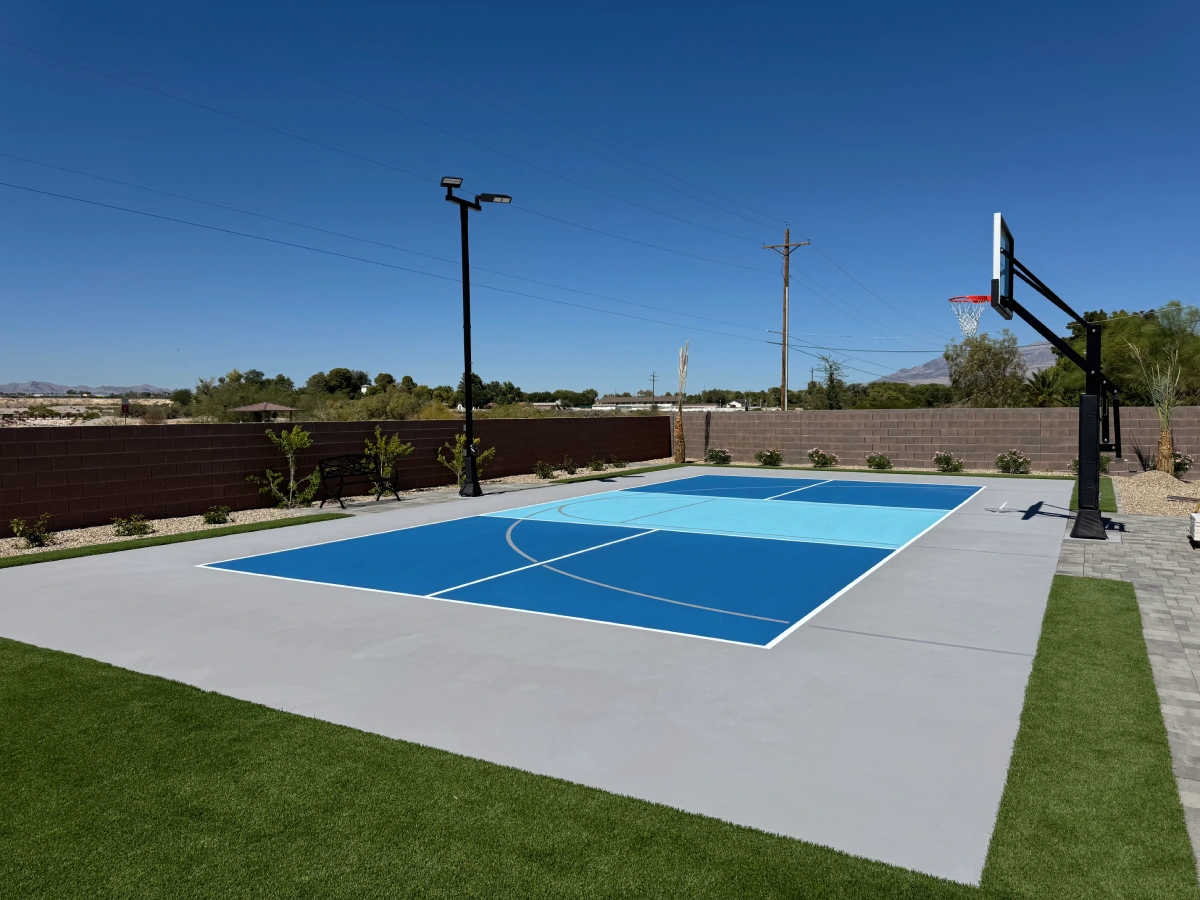
Court Fencing and Netting: Systems, Heights and What Drives the Spec

Sport court fencing is usually the second largest line item on a court project and the one people think about least until they are looking at bids that differ wildly. Two proposals can both say “chain link enclosure” and describe completely different products with completely different service lives.

Understanding what actually drives the specification makes those bids comparable. It also stops you from buying more fence than you need, which happens as often as the opposite.

What the fence is for

Start here, because the answer changes the design.

On most residential courts the fence exists for ball containment. It is not a security barrier and it is not primarily a boundary marker. The design question is where balls go when players miss, and how far they travel before they stop. Everything about height and placement follows from that.

Secondary purposes matter too. A fence keeps small children and dogs out of an active court. It gives windscreen something to attach to. On a court near a pool it becomes part of the barrier conversation, which carries its own code requirements. And on a sloped lot it prevents a rolling ball from ending up two properties away.

Height is geometry, not preference

There is no single correct fence height, and paying for a uniformly tall enclosure all the way around is usually wasted money.

Height follows ball behavior by sport. On a basketball court the balls that escape mostly go long, off the rim and behind the goal, so the tallest fence belongs behind the backboard while the sides can be much lower. On tennis and pickleball courts the escapes go long as well, so the baseline ends carry the height and the sidelines are reduced. Volleyball generates less containment demand than either. A multi-sport court has to satisfy whichever sport in the mix is most demanding at each end.

Site geometry modifies all of it. A downhill side needs more height than an uphill side, because a ball clearing a fence on a slope keeps going. A court next to a swimming pool, a street, a steep drop, or a neighbor’s glass door gets height on that side regardless of what the sport would otherwise call for. A court against an existing block wall may need very little fence on that run, since the wall is already doing the job.

Then the constraints push back. Zoning height limits and HOA design guidelines both regulate fencing, and court fencing is tall enough to engage those limits routinely. Establish the maximum permitted height before you design the enclosure, not after.

The systems, and where each one fits

Chain link remains the default for court enclosures because it performs. The variables that matter are the coating, the mesh opening, the wire gauge and the selvage. Galvanized is the economy option and it looks industrial. Vinyl coated in black or dark green costs more, resists corrosion better, and visually recedes so the court behind it reads as open rather than caged. Smaller mesh openings contain smaller balls, which matters for pickleball. Heavier gauge wire holds its shape under repeated ball impact instead of belling out over time. Knuckled selvage at the top is the appropriate finish on a residential court.

Welded wire panel systems use rigid panels rather than woven fabric. They stay flat, look cleaner, resist deformation better, and cost more. They are a good fit where the court is visible from the house and appearance is weighted heavily.

Ornamental steel is chosen for appearance in communities where it is required or preferred. Picket spacing determines whether it contains balls at all, and it frequently does not without a mesh backing, so it is often combined rather than used alone.

Netting systems hang synthetic netting from poles and cables. They are lighter visually, quicker to install, and generally less expensive than a full fence. The tradeoffs are real: netting is more vulnerable to ultraviolet degradation, it moves and flaps in wind, it does not resist a dog or a child, and it has a shorter service life in this climate than a coated steel fence. Netting is a good answer for a single tall run where a fence would look oppressive, and a poor answer as a whole-court enclosure that is expected to last decades.

The structure fails before the fabric does

Most fence failures we are called to look at are not fabric failures. They are post and footing failures.

Posts carry the wind and impact load into the ground, and a court fence is a large surface. Post diameter and wall thickness, line post spacing, footing depth and diameter, and corner and end bracing are the parts of the specification that decide whether the fence is still plumb in ten years. Corners take the highest loads because that is where fabric tension resolves, and undersized corner posts show it first by leaning inward.

Ask whether the top of the fence is a rail or a tension cable. A top rail is stiffer and holds line better against ball impact. A top cable is cheaper and allows more movement. Both are legitimate. Knowing which one you are buying makes two bids comparable.

Footing location deserves attention on a court. Posts set outside the slab in native soil need proper depth and diameter for wind load. Posts set through or beside the slab need sleeves planned before the pour. On a post-tension slab, no footing or anchor can be drilled after the fact without locating the tendons first, so the fence layout has to be settled before concrete day. Fence details missed at that stage are exactly the kind of avoidable rework covered in court construction mistakes to avoid.

Windscreen changes the engineering

This one surprises owners more than anything else on the list.

A fence with open mesh lets wind pass through. Attach windscreen to it and you have built a sail. Wind load on the posts and footings goes up dramatically, and a fence structure designed for an open enclosure can be pushed over or permanently deformed by a strong gust once it is screened.

If windscreen is in the plan, say so before the fence is engineered. The correct response is heavier posts, deeper footings, closer post spacing, or a screen product with a specified openness percentage that lets some air through. Retrofitting windscreen onto an existing fence without checking the structure is a common cause of failure, particularly in Arizona where summer wind events are routine and the same conditions that make shade desirable also stress the enclosure. Our piece on how Arizona heat impacts court performance covers the surface side of that climate problem.

Gates

Gates get specified last and cause problems first.

Make at least one gate wide enough for maintenance equipment. A resurfacing crew, a squeegee cart or a small machine cannot come through a three foot pedestrian gate, and cutting fabric to get equipment in later is a poor outcome. Consider swing direction so a gate does not open into the playing area. Where the court adjoins a pool enclosure, self-closing and self-latching hardware may be required by code rather than optional. Keep the threshold flush so the gate does not catch as the site settles.

What actually drives your spec

Six things, in rough order of influence: the sports being played and where balls escape, site geometry and slope, what is on the other side of each run, zoning and HOA height limits, whether windscreen or shade will be attached, and how visible the court is from the house.

Answer those six and the fence specifies itself. Skip them and you get a uniform tall galvanized rectangle, which costs more than it should on three sides and not enough on the fourth.

We spec fencing as part of the court rather than as an afterthought on multi-game courts, backyard courts and new court construction across Nevada and Arizona.

Frequently asked questions

How tall should sport court fencing be?

It depends on the sport, the site and what sits beyond each side. Height belongs where balls escape, which for most court sports means the ends rather than the sidelines, and it increases on downhill runs or where a pool, street or neighbor’s property sits close. Zoning and HOA guidelines set the upper limit, so confirm those before designing the enclosure.

Is netting a good alternative to fencing?

For a single tall run where a full fence would look heavy, yes. As a complete enclosure expected to last decades, it is a compromise. Netting degrades faster under ultraviolet exposure, moves in wind, and does not keep children or pets off the court. A coated steel fence has a much longer service life in desert conditions.

Do I need a permit for court fencing?

Often, because court fencing is usually taller than standard yard fencing and height thresholds are where permits engage. Requirements vary by jurisdiction, and HOA design guidelines commonly regulate fence height, color and material separately. Confirm both before ordering materials.

Can I add windscreen to an existing court fence?

Only after checking the structure. Windscreen converts an open fence into a solid surface and greatly increases wind load on posts and footings. A fence engineered without screen in mind can lean or fail once it is added. Have the post size, spacing and footings evaluated, or select a screen product with a specified openness percentage.

What is the difference between galvanized and vinyl coated chain link?

Galvanized is bare zinc-coated steel: less expensive and industrial in appearance. Vinyl coated fabric adds a polymer layer, usually black or dark green, which improves corrosion resistance and visually recedes so the enclosure reads as more open. Wire gauge and mesh opening are separate specifications and matter as much as the coating.

If you want the enclosure designed around your lot rather than sold by the linear foot, call Nevada at (702) 883-8386 or Arizona at (480) 878-2292, or request a project quote.

Court Lighting Without the Neighbor Complaints: Fixtures, Shielding and Dark-Sky Rules

Sport court lighting is the single most common reason a finished court becomes a problem with the people next door. The slab does not bother anyone. The fence does not bother anyone. Then someone flips on four unshielded floods at nine at night and the phone calls start.

The good news is that this is an engineering problem with known solutions, and almost all of the fixes are cheaper to specify up front than to retrofit later. What follows is how we approach lighting design on residential and commercial courts across Southern Nevada and Arizona.

Three complaints that get lumped together

When a neighbor says “your lights are too bright,” they usually mean one of three distinct things, and each has a different fix.

Glare is direct light from the source reaching an eye. It is what happens when a bare LED array is visible from a bedroom window. Glare is about the fixture and its optics, not about how much light lands on your court.

Light trespass is light spilling onto property that is not yours: a wash across the neighbor’s patio, a bright patch on their back wall. It is about aiming, cutoff and mounting height.

Sky glow is light escaping upward. Nobody is bothered by it at the fence line, but it is what dark-sky ordinances exist to control, and it is the one a code official cares about.

A system can be perfect on one and terrible on another. Fully shielded fixtures aimed badly still trespass. Well-aimed fixtures with no glare control still blind anyone who looks at them.

The numbers that matter, and the one that does not

Wattage is not a design specification. Neither is raw lumen output. Both describe the fixture. Neither describes what happens on your court.

Two measures do the real work. Illuminance is how much light lands on the playing surface, expressed in foot-candles. Uniformity is the relationship between the brightest and darkest points on that surface, usually expressed as a maximum-to-minimum ratio. A court with high average illuminance and poor uniformity plays worse than a dimmer court that is even, because the eye adapts to the bright zone and the ball disappears in the dark one.

The Illuminating Engineering Society publishes recommended illuminance levels by sport and by level of play. Recreational residential play sits at the low end of those recommendations. Competitive and broadcast levels are far higher, and specifying a competition level for a backyard court is the fastest way to create a nuisance while spending money you did not need to spend. Ask any lighting proposal for a point-by-point photometric plan showing calculated foot-candles on a grid across the court, the uniformity ratio, and the calculated light levels at your property lines. If a vendor cannot produce that, they are guessing.

Fixture selection

The specification items that actually control complaints are these:

  • Full cutoff optics. A fully shielded fixture emits no light above horizontal. This is the single most important characteristic, and it is also usually the one a code official checks first.
  • BUG rating. The backlight, uplight and glare rating system published by the Illuminating Engineering Society gives you a comparable way to evaluate spill and glare between fixtures. Lower numbers in each category mean less stray light. Ask for the rating rather than the marketing copy.
  • Color temperature. Warmer light, around 3000 kelvin, is less objectionable at night and is what many outdoor lighting ordinances now require. Cool 5000 kelvin light reads as harsher and scatters more in the atmosphere. The playability difference on a residential court is negligible.
  • Asymmetric distribution. A forward-throw optic puts light on the court and keeps it off the area behind the pole. On a tight lot this matters more than any other optical choice.
  • Visors and house-side shields. External accessories that block the specific direction causing a problem. Cheap, effective, and frequently the entire solution on a retrofit.
  • Dimming and zoning. Being able to run at fifty percent for a casual evening game, or to light half the court, prevents a lot of unnecessary output.

Note that none of this is the same conversation as a hoop-mounted light. Product-level lighting attached to a goal, which we cover under basketball hoop lighting systems, solves a different problem and does not involve poles, photometrics or ordinance compliance in the same way.

Mounting height and aiming

There is a counterintuitive rule here: taller poles usually produce fewer complaints, not more.

Light aimed downward from height reaches the court at a steeper angle. That means less of the beam travels horizontally toward a fence line, and the fixture itself sits further outside the normal field of view of someone standing at ground level next door. Short poles force a flatter aiming angle to cover the same court, and flat aiming is what throws light sideways.

The tradeoff is that a taller pole is more visible during the day and more likely to run into height limits in zoning or HOA guidelines. That constraint is real and it belongs in the conversation early, alongside setbacks and fence height.

Aiming discipline matters as much as height. Fixtures should be aimed across the court, never outward across a property line. Aiming should be documented and verified at night with a meter, not eyeballed by whoever was on the lift that afternoon. Poles are typically placed along the sidelines rather than behind the baselines for court sports, which keeps the fixtures out of the primary sight lines of play.

Ordinances and dark-sky rules

Outdoor lighting is regulated more than most homeowners expect, and Arizona in particular has a long history of outdoor lighting codes tied to protecting the night sky. Several jurisdictions in both states have adopted standards that address shielding, maximum color temperature, curfew hours, and permitted light levels measured at the property line.

Requirements differ by jurisdiction and they change. Verify your specific rules with your local building or planning department before you buy fixtures, and read your HOA design guidelines separately, since associations frequently impose curfews and fixture restrictions that are stricter than code. This is one of the elements most likely to come back as a condition on an architectural approval.

In practice, communities in the northeast valley and the Scottsdale area tend to be among the more particular about lighting, but assumptions are not a substitute for reading the current guidelines for your community.

Controls prevent more complaints than fixtures do

The most effective complaint prevention is not optical. It is a hard shut-off.

A time clock that kills the lights at a set hour, every night, without depending on anyone remembering, removes the single most common trigger. Neighbors tolerate an hour of evening play. They do not tolerate lights left on until two in the morning because a teenager went inside and forgot.

Build in a manual on with automatic off, so lights can never be left running. Add an astronomical time clock so the schedule tracks sunset through the year. Add zone control so a casual shoot-around does not require the full array. If you told your HOA the lights go off at ten, put that in the controller rather than in your memory.

Fixing a court that already generates complaints

Retrofits are usually cheaper than people fear, because the problem is rarely the amount of light. Start with re-aiming, which costs a lift and an evening. Add house-side shields or visors to the specific fixtures causing spill. Dim the system and see whether play is still comfortable, since many existing courts are substantially over-lit. Swap cool fixtures for a warmer color temperature if the complaint is about harshness. Add a hard curfew on the controller and tell the neighbor you did it.

Replacing poles is the last resort, not the first move. Get a night reading at the property line before and after each change so you have something objective to point at.

We plan lighting alongside layout, fencing and approvals on backyard court projects, on multi-game courts, and on larger new court construction, because retrofitting conduit into a finished slab is exactly the kind of avoidable expense covered in our list of court construction mistakes to avoid.

Frequently asked questions

How bright should a backyard sport court be?

Bright enough to track the ball and even enough that there are no dark zones, which is usually far less light than people assume. The Illuminating Engineering Society publishes recommended levels by sport and level of play, and recreational residential courts sit at the low end. Ask for a point-by-point photometric plan rather than choosing by wattage.

What is a full cutoff light fixture?

A fully shielded fixture that emits no light above the horizontal plane. It keeps light on the court instead of sending it sideways into neighboring property or upward into the sky, and it is commonly the first thing an outdoor lighting ordinance requires.

Will taller light poles bother my neighbors more?

Usually the opposite. Greater mounting height allows a steeper downward aiming angle, which puts less light traveling horizontally toward a fence line and moves the fixture out of the normal line of sight from adjacent yards. The constraint on height is typically zoning or HOA guidelines rather than glare.

Do I need a permit for court lighting?

New circuits, conduit and poles generally require an electrical permit and sometimes a structural review for pole foundations, but requirements vary by jurisdiction. Some areas also apply outdoor lighting standards covering shielding, color temperature and curfew. Confirm with your local building department, and check your HOA design guidelines separately.

Can I fix glare on a court that is already built?

Often yes, and usually without replacing the poles. Re-aiming, adding house-side shields or visors, dimming an over-lit system, and switching to a warmer color temperature all address glare and spill directly. Adding an automatic shut-off resolves the timing complaints that shielding cannot.

If you are planning lighting for a new court or trying to solve complaints on an existing one, call us in Nevada at (702) 883-8386 or Arizona at (480) 878-2292, or request a project quote.

Sport Court Warranty: What Is Actually Covered and What Voids It

The sport court warranty conversation usually happens twice, and both times are the wrong time. First during the sale, when nobody reads it because everyone is excited. Then four years later, when something has failed and the owner discovers what the document actually said.

Warranties on court work are not one thing. They are a stack of separate documents from separate parties covering separate failures, and the gap between them is where most disputes live. Here is how the stack works and what to ask before you sign anything.

You do not have one warranty. You have several

A typical court project produces at least three distinct coverages, sometimes more.

The manufacturer product warranty comes from whoever made the surface system, the modular tile or the coating. It is a document between you and that company, and it covers their product.

The contractor workmanship warranty comes from the company that built the court. It covers installation, not materials.

Component warranties come with everything bolted on: fencing, gates, light fixtures, goals, nets, posts, shade structures. Each of those has its own terms, its own duration and its own claims process.

Separately, states have their own statutory provisions governing construction defects and implied warranties, which vary and which are a question for your attorney rather than your builder.

Understanding which document covers which failure is the whole game. A cracked slab, a delaminating coating and a leaning fence post are three different claims against three different parties.

What a surface manufacturer warranty typically covers

Read the actual document, because terms vary widely between manufacturers and between product lines from the same manufacturer.

The general shape: coverage against defects in the manufactured product, frequently prorated so the value declines over the term, and frequently limited to replacement material rather than the labor to install it. A material-only warranty on a product that costs far less than the labor to install it is worth less than the headline term suggests.

What is typically excluded is more informative than what is covered. Common exclusions include movement of the substrate, cracking that originates in the slab, moisture coming up through the concrete, standing water from inadequate drainage, damage from improper cleaning chemicals or equipment, physical abuse, and weather events.

That first exclusion is the one that matters most in this region. When a court cracks, the surface manufacturer will point out, correctly, that their coating did not crack on its own. It followed the concrete. Whether anyone owes you anything then depends on the construction contract rather than the product warranty, which is why what happens underneath is worth understanding before you buy anything. We cover that in why sport courts crack.

What a workmanship warranty covers

The contractor’s warranty covers the work: surface preparation, application, line layout accuracy, joint treatment, and whether the court drains the way it was supposed to. It is usually much shorter than the product warranty, and it is exactly as good as the company standing behind it.

That last point deserves emphasis. A long warranty from a company that will not answer the phone is worth nothing, and a warranty from an entity that dissolves and reappears under a new name is worth less. Ask how long the company has operated under its current license, ask for references from courts installed years ago rather than months ago, and ask whether they still service work they built a decade back. A builder whose earliest courts are still in service and still supported is telling you something a document cannot.

The structural gap nobody warranties well

Here is the honest part. Concrete cracks. Nearly every construction contract in the country contains language noting that shrinkage cracking is inherent in concrete and is not a defect, and that language is generally accurate.

What a good contract does instead is define responsibility for the things that determine whether cracking stays cosmetic. Who specified the base section and the slab thickness. Who is responsible for the control joint layout and for cutting the joints on time. What compaction standard the subgrade was built to. What the remedy is if the slab develops structural cracking, as distinct from hairline shrinkage, within a defined period.

Ask that question directly before signing: what happens if the slab moves? A builder who has thought about it will give you a specific answer. A builder who has not will change the subject. The decision framework for what to do when it happens anyway is in resurface versus replace.

What voids coverage

Most denied claims are denied for reasons the owner did not know were reasons.

  • Unauthorized repairs. Letting a third party patch, coat or resurface the court without written approval commonly voids what remains of both the product and workmanship coverage.
  • Wrong cleaning methods. Excessive pressure washing, solvent-based cleaners, degreasers, bleach and acid all appear on exclusion lists. So does the wrong brush.
  • Loading the surface. Vehicles, dumpsters, scissor lifts, storage of heavy equipment, and dragging goals or benches instead of lifting them.
  • Skipped maintenance. Many warranties condition coverage on performing specified maintenance, and put the burden of proving you did it on you. No records, no claim.
  • Drainage changes. Regrading adjacent areas, adding landscaping that traps water at the edge, or pointing irrigation at the slab.
  • Modifications. Drilling anchors, adding structures, mounting equipment or cutting the slab, particularly on a post-tension slab where nothing should be drilled without locating tendons first.
  • Non-approved applications. Sealers, paints, line paint from a hardware store, and pressure-sensitive tape products that pull coating when removed.

None of that is unreasonable, and all of it is avoidable if you know it up front. The maintenance obligations in particular are usually modest, and our court maintenance services and the overview at sport court resurfacing and maintenance cover what a normal cycle involves.

Transferability

If you might sell the property, this matters.

Many manufacturer warranties are non-transferable, meaning coverage ends when the property changes hands. Some transfer once, often with a registration step and sometimes a fee, and often within a limited window after the sale. Contractor workmanship warranties are frequently tied to the original purchaser as well.

A transferable warranty is a genuine selling point and worth asking about before you choose a system, not after you list the house.

Questions to ask before signing

Ask for a copy of every warranty document before you sign the contract, not after the work is done. Ask what the product warranty covers and whether it is prorated. Ask whether it includes labor or material only. Ask what the workmanship warranty term is and what it covers. Ask what the maintenance requirements are and what documentation you need to keep. Ask whether the coverage is transferable and on what terms. Ask what happens if the slab develops structural cracking. Ask who to call for a claim and whether that is the builder or the manufacturer.

If the answers arrive as generalities rather than documents, that is the answer.

How to keep your coverage enforceable

Register the product with the manufacturer if registration is required, and do it immediately rather than eventually. Keep the entire project file: contract, specification, warranty documents, product data, permits and inspection records. Maintain on schedule and keep receipts, service records or photos with dates, because the burden of proof lands on you. Use only cleaning products the manufacturer approves. Get written approval before letting anyone else touch the surface. Report problems in writing when you notice them rather than waiting to see whether they get worse, since some warranties impose a notice period.

We put the warranty terms in writing before the contract is signed on new court construction and on surfacing work, and we would rather have the conversation at the start than at year four.

Frequently asked questions

What does a sport court warranty actually cover?

It depends which warranty. The manufacturer covers defects in their product, often prorated and often material only. The contractor covers installation workmanship for a shorter term. Fencing, lighting, goals and other components carry their own separate coverage. Substrate movement and cracking that originates in the slab are commonly excluded from surface warranties.

Does a warranty cover cracks in my court?

Usually not through the surface warranty. Coatings follow the concrete beneath them, and manufacturers exclude substrate movement. Whether anyone is responsible depends on the construction contract, the specified base and slab, and whether the cracking is inherent shrinkage or structural failure. Ask what the contract says about structural cracking before you sign it.

What voids a sport court warranty?

Common causes are unauthorized repairs or resurfacing by a third party, aggressive pressure washing or unapproved cleaning chemicals, driving or parking on the surface, dragging equipment, skipping required maintenance or being unable to document it, altering site drainage, and drilling or cutting the slab.

Is a sport court warranty transferable to a new owner?

Sometimes. Many manufacturer warranties are non-transferable, some transfer once within a limited window and may require registration or a fee, and contractor workmanship warranties are often limited to the original purchaser. Ask before selecting a system if resale is a consideration.

What records should I keep to protect my warranty?

The contract and specification, all warranty documents, product data sheets, the permit and inspection records, proof of product registration, and dated records of every maintenance service performed. Warranties commonly place the burden of proving compliance on the owner, so undocumented maintenance is treated as maintenance that did not happen.

If you want warranty terms explained in plain language before you commit, call Nevada at (702) 883-8386 or Arizona at (480) 878-2292, or request a project quote.

Windscreens and Shade Structures for Desert Courts

A court shade structure is the difference between a court your family uses eleven months a year and one that sits empty from June through September. In Las Vegas and Phoenix that is not a comfort question. It is a utilization question, and utilization is what people actually paid for.

Shade and windscreen get discussed together because both involve fabric on a frame. They solve different problems, they load the structure differently, and buying one when you needed the other is a common and expensive mistake.

Surface temperature is not air temperature

The number on the thermometer understates the problem badly.

A dark acrylic court surface in full sun absorbs solar radiation and runs substantially hotter than the surrounding air. Players feel that as radiant heat coming up at them while the sun comes down, and the effect is worst in the mid afternoon when both the surface has had all day to load up and the sun is still high. Kids playing at ground level get more of it than adults.

Two levers reduce it. The first is color. Lighter surface colors absorb less and run cooler, which is a real consideration in surface selection here and a tradeoff against ball visibility and glare. Our overview of court surface options covers the systems, and the performance side of desert heat is covered in how Arizona heat impacts court performance.

The second lever is blocking the sun before it reaches the surface. That is shade, and shade does two things at once: it lowers the surface temperature under it, and it removes the direct radiant load on the player. The combination is far more effective than either alone.

Shade structure options

Tensioned shade sails are the most common answer on residential courts. Knitted high density polyethylene fabric is stretched between anchor points, and it is specified by shade factor, which is the percentage of solar radiation the fabric blocks. Sails are relatively economical, they look light, and they can be sized to cover a portion of the court or a spectator area rather than the whole surface.

Cantilevered structures support the canopy from one side so there are no posts inside the play area. More steel, more footing, more money, and the right answer where the shaded area has to sit over active playing surface.

Full framed canopies use a steel frame with a fabric or panel roof. These are the most durable and the most expensive, and they behave structurally like a building, which means engineering and permitting.

Solid roofs block sun and rain both, and turn part of the court into covered outdoor space. They also change the lighting condition underneath and reflect ball sound, which matters more than people expect on a pickleball court.

What we do not recommend is relying on trees. Roots heave slabs and lift fencing. Leaves, seed pods and sap stain acrylic and have to be swept constantly. Irrigation for the tree puts water exactly where you least want it near a court edge. Plant trees for the yard, not for the court.

Where to put the shade

Full coverage over an entire court is uncommon on residential projects, because the structure required is large and the visual mass is significant.

Partial coverage is usually the better value. Shading the seating and rest area gives players somewhere to recover between games, which extends the usable session more than most people expect. Shading one end or one side of the court based on afternoon sun angle can make late afternoon play viable without covering everything. Shading a spectator area matters if the court gets used for organized play.

Look at the sun path for your specific orientation before deciding. The side that needs shade in June is not necessarily the side that looks obvious in February.

The engineering people skip

Fabric on a frame is a sail. This is where desert projects fail.

Monsoon season brings microburst events with strong, sudden, directional winds, and a shade structure sees uplift as well as lateral load. Uplift is the failure mode people do not plan for: the wind gets under the canopy and tries to pull the posts out of the ground. Footings sized for the weight of the structure are not automatically sized for uplift, and a structure that has stood through three summers can leave in one gust.

Any permanent shade structure over a court should be engineered, permitted where required, and built with footings designed for both wind load and uplift. Some fabric systems are designed to be taken down seasonally, and where that is the case, taking them down before monsoon season is a maintenance task, not a suggestion.

Two more layout items get missed. Post locations have to sit outside the run of play and outside required clearances, which on a court with tight setbacks can be difficult. And overhead clearance has to account for ball trajectory, since a canopy edge in the flight path of a lob or a jump shot changes the game.

All of it needs to be settled before the slab is poured, because footings, sleeves and anchor points go in with the concrete. Retrofitting a shade structure to a finished court means coring, and on a post-tension slab that means tendon scanning first.

Fabric selection

Knitted polyethylene shade cloth is specified by shade factor and by ultraviolet stabilization. Higher shade factor blocks more sun and also catches more wind. Ultraviolet exposure here is severe, and fabric life varies widely between products, so compare stated warranty terms rather than assuming they are equivalent.

Solid vinyl or PVC membranes block essentially all sun and shed rain, but they carry much higher wind load, they trap heat underneath without ventilation, and they cost more. They make sense on a full framed structure engineered for them and rarely make sense as a retrofit.

Color affects two things: how much heat the fabric itself radiates downward, and what the underside looks like as a visual background. A light underside can create glare. A darker underside gives players a better background for tracking a ball.

Windscreen is a different product

Windscreen attaches to the fence, not overhead, and it solves three problems: wind interfering with ball flight, blowing dust and grit landing on the surface, and visual privacy from the street or the neighbors.

The specification that matters is openness percentage, the fraction of the fabric that is open to airflow. Tighter fabric blocks more wind and dust and takes more load. Looser fabric lets air through and survives better on a fence that was not designed for it. That tradeoff is not optional, and it connects directly to the fence structure itself, which we cover in detail alongside post sizing and footings on any project where screen is planned.

Install it correctly. Attach at close intervals rather than sparsely, use the grommet pattern the manufacturer specifies, tension it evenly, and where a product includes relief vents or wind flaps, do not remove them. In this climate, budget for taking screens down before major wind events and for replacing them well before they shred, because a partially failed screen tears the rest of itself apart quickly.

Darker screen colors give better ball visibility as a background than light ones, which is why so many courts run black or dark green.

If you cannot build shade right now

Choose a lighter surface color at the time of construction, since that decision is free at the front end and expensive later. Shift play to early morning and evening, which is what most people here do anyway. Add lighting so evening play is actually available, which does more for summer utilization than any shade structure. Provide a shaded rest area even if the court itself is open, using an existing patio if you have one.

Be careful with misting systems near a court. Water on an acrylic surface is slippery, and a mister positioned to drift onto the playing area creates a hazard. Mist the seating area, not the court.

We plan shade, windscreen and lighting together with the slab on backyard courts, multi-game courts and new court construction throughout Southern Nevada and the Phoenix area.

Frequently asked questions

Does a shade structure actually cool a court?

It lowers the surface temperature in the shaded area and removes direct radiant load on players, which together make a much larger difference than air temperature alone suggests. Full coverage is uncommon on residential courts, and shading a rest area plus one end based on afternoon sun angle often delivers most of the benefit.

What is the difference between windscreen and shade cloth?

Windscreen mounts vertically on the fence to block wind, dust and sightlines. Shade cloth spans overhead on a frame or tensioned sail to block sun. They are different products with different specifications, different loads and different failure modes, and one does not substitute for the other.

Will a shade structure survive monsoon winds?

Only if it was engineered for them. Microburst events produce sudden directional wind, and the critical load case is uplift, where wind gets under the canopy and pulls at the footings. Have the structure engineered, permitted where required, and built with footings designed for uplift. Seasonal fabric systems should come down before monsoon season.

Can I add shade to a court that is already built?

Yes, but it means new footings, which means coring or excavating adjacent to the slab. On a post-tension slab, nothing gets drilled until the tendons have been located by scanning. Planning post locations and sleeves before the pour is far simpler and less expensive.

What openness percentage should windscreen be?

It depends on what your fence structure can carry. Tighter fabric blocks more wind and dust and transfers much more load into the posts and footings. If the fence was not engineered for screen, a more open product is the safer choice. Have the structure evaluated before selecting the fabric.

If summer heat is the reason your court sits unused, we can look at shade, surface color and lighting together. Call Nevada at (702) 883-8386 or Arizona at (480) 878-2292, or request a project quote.
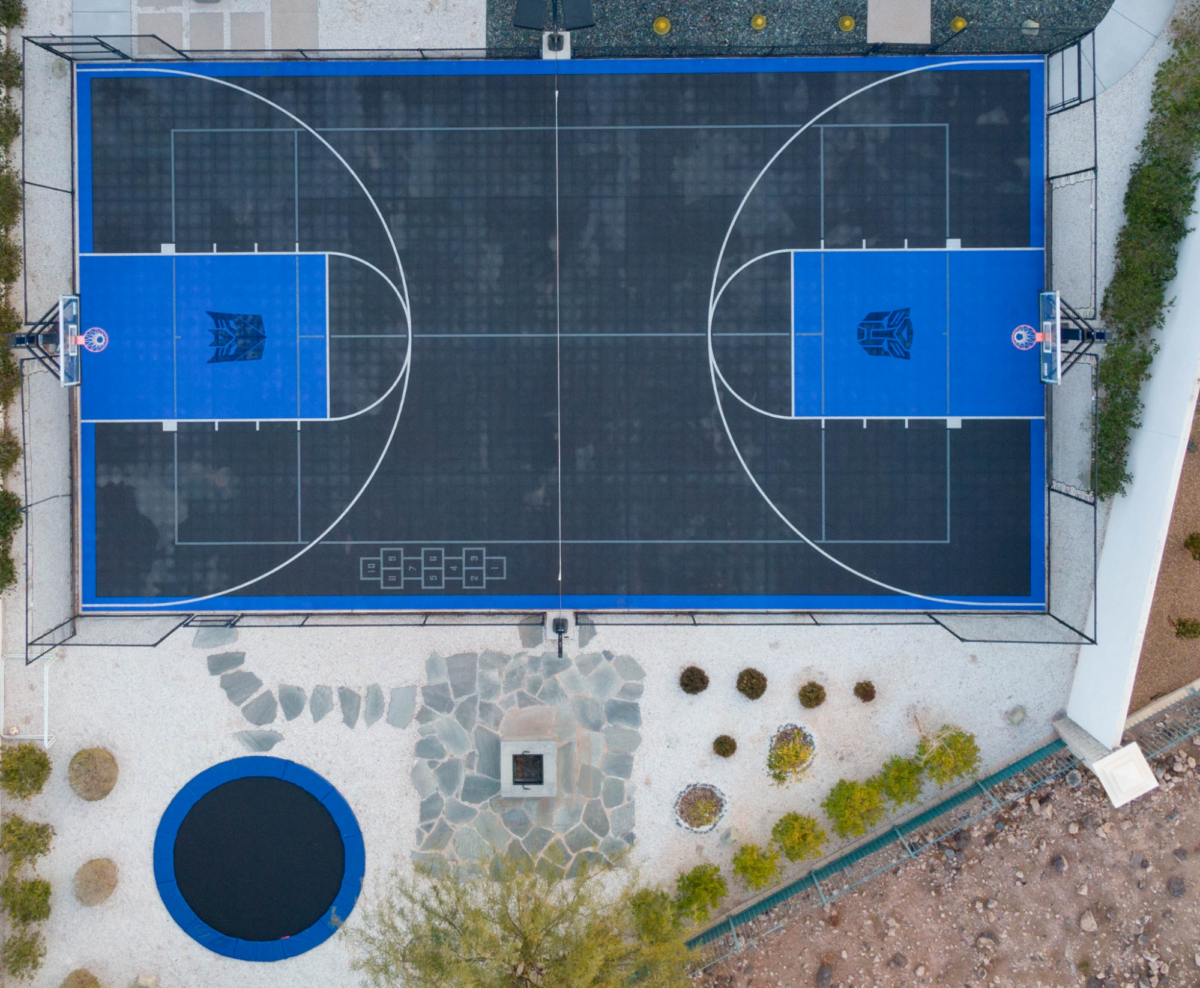
Phasing a Backyard Court Build: What to Do First When You Cannot Do It All at Once

Phased backyard court construction is a legitimate strategy, and most people do it wrong. The instinct is to build a reduced version of everything: a thinner slab, a smaller footprint, cheaper base, skip the drainage, and upgrade later. That is not phasing. That is building a court you will replace.

Real phasing follows one rule, and everything else in this article is a consequence of it.

The rule: never phase what gets buried

Anything under the concrete, inside the concrete, or under the ground next to it goes in phase one at full specification. Anything that sits on top of the finished court, or bolts to something already in place, can wait.

The logic is not about quality standards in the abstract. It is about what retrofitting costs. Adding a light pole to a finished court means excavating a footing next to a slab and trenching conduit across a surface you just paid to install. Adding a net post sleeve means core drilling. On a post-tension slab, every one of those operations requires tendon scanning first, and none of it is a small job. Adding a basketball goal to a court that already has an anchor in the concrete takes an afternoon.

That is the entire difference, and it is worth thousands of dollars of your future money.

Phase one, at full specification

These items are not candidates for deferral or reduction.

  • Site work and drainage. Grading, the slope plane, perimeter drainage and the discharge path. Water management is not upgradeable later without demolition.
  • Subgrade and base. Stripping, moisture conditioning, compaction, separation fabric and the full base thickness. Invisible forever after day one.
  • The slab at full size. Build the footprint you eventually want. Adding to a slab later creates a cold joint that will crack and will always be visible.
  • Slab thickness, reinforcement and joints. Structural, permanent, not improvable.
  • Conduit, sleeves and blockouts. Lighting conduit and junction boxes to every future pole location, net post sleeves, goal anchors, shade structure anchors or footings, drain lines, and a water line if you might ever want a hose bib or a mister at the court.

The conduit item is the one people skip and regret. Running empty conduit and capping it costs very little during construction. Trenching it later across a finished surface costs a great deal and leaves a repair line you can see. Cutting the base spec or the slab spec to save money in phase one is the classic version of the problem covered in cutting corners on a sport court.

What can genuinely wait

Plenty, as it turns out.

Surface upgrades. The slab needs a surface, but the surface is a wear layer that gets renewed on a cycle anyway. A straightforward acrylic system now and a more elaborate specification, custom colors or additional sport lines at the first resurfacing is a reasonable sequence. Modular tile can also be installed over a properly built slab later, which is covered under court flooring tiles.

Fencing. Fencing phases well by run. Build the tall run where balls actually escape, which is usually one end, and add the remaining runs later. The footings and layout should be planned for the full enclosure so the later work lines up.

Lighting fixtures and poles. If the conduit, junction boxes and pole base locations are in the ground, adding poles and fixtures later is a discrete project with no demolition.

Shade structures. Same principle. Footings and anchors in phase one, structure later.

Windscreen. Attaches to fence that already exists, assuming the fence was engineered for the added wind load.

Equipment. Goals, nets, posts, seating, storage and rebounders all install onto anchors and sleeves already in place.

Surrounding landscape and hardscape. Planting, seating areas, paths and lighting around the court are naturally separable, and doing them later lets you see how the court is actually used first.

Three sequences that work

Play sooner. Phase one is site work, slab, all conduit and sleeves, a basic surface system, and one goal or net. You are playing at the end of phase one. Phase two adds the fence. Phase three adds lighting. Phase four adds shade and the surrounding landscape. This is the right sequence when the household is impatient and the court sits well away from neighbors.

Neighbors first. Phase one is site work, slab, conduit, surface, and the full fence enclosure. Phase two is lighting done properly with shielding and controls. Phase three is shade and equipment upgrades. This sequence suits tight lots, HOA communities, and anyone who would rather not have a conversation about balls in the neighbor’s pool.

Whole yard integration. Phase one is the court and everything buried, including conduit stubs for future yard elements. Phase two is the larger landscape project the court sits inside. This works when the court is one part of a bigger plan and you would rather not tear up finished landscaping to build it.

All three share the same phase one. That is not a coincidence.

What phasing actually costs you

Phasing is a cash flow tool, not a savings tool. Doing a project in three trips costs more in total than doing it once, and it is worth understanding where that shows up.

Every phase carries its own mobilization: crews, equipment delivery, site protection and setup. Later phases mean working around a finished court that now has to be protected. Material and color matching gets harder as time passes, so a fence run added years later may not match exactly and a resurfacing will not match an older adjacent coat perfectly. Approvals can need re-engagement, since an HOA architectural committee and a building department may both need to review phase two separately.

The mitigation on that last point is straightforward: submit the whole plan for approval up front, including the future phases, even if you are only building part of it now. Approved and unbuilt is a much better position than unapproved and needed.

One more: keep the same builder across phases if you can. When two companies work on the same court, responsibility for anything that goes wrong becomes a conversation neither one wants to have with you, and warranty coverage gets complicated in exactly the way that benefits nobody.

How to approach the budget

Price the complete build first, even the parts you know you cannot fund yet. You need the total to make sensible decisions, and it tells you whether the full vision is realistic or whether the design should change now rather than later.

Then fund phase one at full specification rather than funding a percentage of everything. A correctly built slab with no fence is a court. A thin slab on a poor base with a beautiful fence around it is a problem with a fence around it.

Put your contingency in phase one, because that is where the unknowns live. Soil surprises, caliche, unmarked utilities and drainage complications all surface during excavation. Later phases are mostly known quantities.

Set a trigger for each subsequent phase rather than a vague intention. A date, a funding event, or a condition. Phases without triggers tend to become permanent.

We plan builds this way regularly on backyard courts and multi-game courts, and it is worth telling us up front that you intend to phase, because it changes what goes in the ground on day one. If you are earlier than that in the process, our guide to installing a backyard court covers the full sequence, and new court construction covers how we scope the work.

Frequently asked questions

Can I build a sport court in phases?

Yes, as long as everything buried goes in during phase one. Site work, drainage, subgrade, base, the full-size slab, reinforcement, joints, conduit, sleeves and anchors are all permanent decisions. Fencing, lighting fixtures, shade structures, equipment and surface upgrades can all be added later without demolition.

Should I build a smaller court now and expand it later?

No. Adding to an existing slab creates a cold joint between old and new concrete that becomes a visible crack line and a maintenance point. Pour the full footprint you want, and phase the things that sit on top of it instead.

Can I add lighting to a court later?

Easily, if the conduit, junction boxes and pole base locations were installed during construction. Without them, adding lighting means trenching across a finished surface and excavating footings beside the slab, and on a post-tension slab it means tendon scanning before anything is drilled. Install the conduit in phase one even if lights are years away.

Does phasing a court cost more overall?

Generally yes. Each phase carries its own mobilization and setup, later work has to be done around a finished court, and material or color matching becomes harder over time. Phasing manages cash flow rather than reducing total cost, and it is a reasonable tradeoff as long as you understand which one you are buying.

Do I need HOA and permit approval for each phase?

Possibly, since a later phase adding lighting, fencing or a structure may require its own review. The practical approach is to submit the complete plan including future phases for approval up front, so approvals are already in hand when you are ready to build. Confirm requirements with your building department and association.

If you know you will be phasing, tell us at the design stage and we will make sure phase one carries everything the later phases need. Call Nevada at (702) 883-8386 or Arizona at (480) 878-2292, or request a project quote.
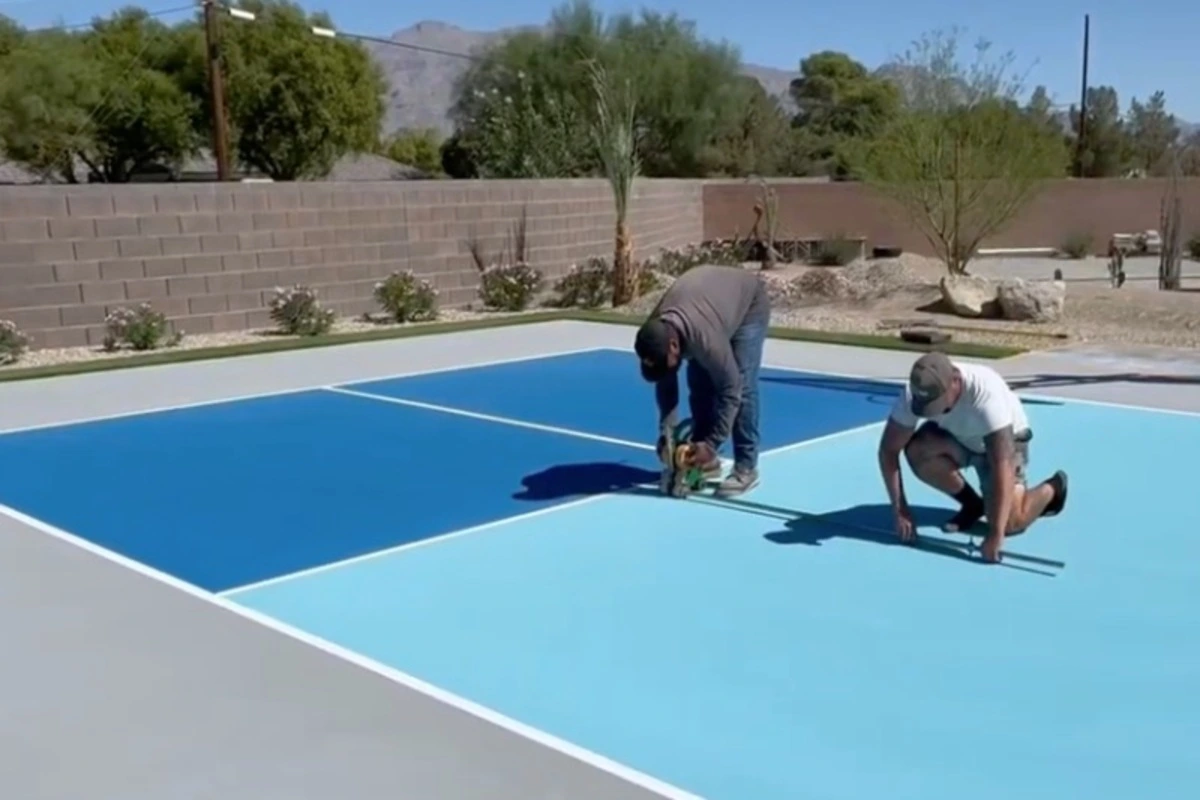
Desert Court Maintenance Calendar: Monthly, Annual and Five-Year

A sport court maintenance schedule written for Ohio does not work here, and one written for a basketball court does not cover the net posts on a pickleball court. This is a cross-sport calendar built for Nevada and Arizona conditions: ultraviolet exposure, extreme daily temperature swings, blowing grit and monsoon season.

If you want the service side of this, meaning what a professional visit includes, that lives on sport court resurfacing and maintenance. If your court is basketball only, basketball court maintenance covers that sport specifically. This piece is the calendar: what to do, when, and why the desert changes the answer.

What this climate actually does to a court

Five forces do most of the damage, and none of them are dramatic.

Ultraviolet exposure. Sunlight degrades the binders in acrylic coatings and fades line paint. Southern Nevada and central Arizona deliver more of it than almost anywhere in the country, which is why courts here reach the end of a color coat sooner than the same product in a milder climate.

Thermal cycling. A large daily swing between afternoon high and overnight low means the slab expands and contracts every single day of the year. That cycling works joints, works crack repairs, and eventually finds anything that was not bonded well.

Blowing grit. Fine sand lands on the surface and then gets ground into it by shoes. Grit left on a court is abrasive, and sweeping is not cosmetic maintenance here. It is wear prevention.

Monsoon. Short, violent storms deliver debris, silt and standing water all at once, and they are the annual stress test for your drainage.

Irrigation and hard water. Overspray leaves mineral deposits and staining, and it puts moisture at the slab edge where you least want it.

Weekly, or whenever you notice

Blow or sweep the surface. Grit and leaf litter both need to leave, and organic debris that sits on acrylic in the sun will stain it permanently within days.

Walk the court after any real rain and note where water sits. A puddle that dries in an hour is nothing. A puddle in the same place every time is information, and it is worth writing down with a date.

Lift equipment rather than dragging it. Goals, benches, ball hoppers and net posts all leave permanent scars when dragged across a coated surface.

Monthly

Wash the surface. Water and a soft-bristle push broom handles most of it. Where a cleaner is needed, use only what the surface manufacturer approves, since the wrong chemistry damages coatings and typically voids coverage.

Clear the drains and the perimeter. Trench drains, area drains and swales all collect grit in this climate, and a drain that is half full of silt is a drain that will fail on the day it matters.

Inspect the fence. Look at fabric tension, ties, the condition of the coating, and gate hardware and latches. Tighten what is loose before it works itself into damage.

Check anchors and hardware. Net post sleeves, goal mounts, backboard hardware and any bolted equipment. Thermal cycling loosens fasteners over time, and a loose backboard is both a play problem and a safety problem.

Check the lighting. Confirm fixtures still point where they were aimed, confirm the timer schedule is correct, and replace anything failed. Aim drifts more than people expect after a windy month.

Check the irrigation. Walk the perimeter with the system running and confirm nothing is spraying the court, the slab edge or the fence line.

Seasonal, four times a year

Late spring, before monsoon. This is the most important seasonal visit. Clear every drain and swale completely. Inspect shade structure and fence footings. Decide whether windscreen and shade fabric stay up or come down, and if they stay, verify the attachments. Trim vegetation that overhangs the court, because monsoon wind puts it on your surface.

Early fall, after monsoon. Remove accumulated silt from drains and the perimeter. Look for new low spots where water now sits and did not before, which is an early warning of base movement. Inspect for new cracking. Reinstall anything you took down.

Winter. The cool months are the right time to schedule repairs, crack treatment and resurfacing, because coatings cure properly at moderate temperatures and crews are not fighting heat. Winter is also when the schedule is less crowded. Inspect joint condition and any sealant.

Early spring. Deep clean before the heavy use season. Inspect line work for fading and wear. Plan and budget any work you identified over the winter.

Annual

Once a year, do a real inspection rather than a glance.

Survey the cracks. Photograph each one from the same position with something for scale, and compare against last year. A crack that has not changed is a maintenance item. A crack that is growing or opening seasonally is a structural conversation, and the reasons are laid out in why sport courts crack.

Check the surface plane. After rain, or by flooding the court with a hose, mark where water stands and how deep. Standing water is the single best indicator of a slab or base problem developing under a surface that still looks fine.

Assess coating wear and color. Look at the high-traffic zones: baselines, the key, service areas. Wear shows there first.

Service the systems. Fence hardware, gate operation, light fixtures and their aiming, and replacement of nets and worn equipment.

Update the log. Dated photos and a written record of what was done. Almost every warranty conditions coverage on performing maintenance and puts the burden of proving it on you, which we cover in more detail alongside the rest of the court maintenance services we provide.

Multi-year: the resurfacing cycle

Outdoor acrylic courts in this climate need resurfacing periodically. The interval depends on how heavily the court is used, how much direct sun it gets, the surface system installed and the color selected. Ask your manufacturer and your builder for the interval that applies to your court rather than assuming a number you read somewhere.

What a resurfacing involves: thorough cleaning, patching of cracks and damage, filling of low spots so the court drains and plays correctly, resurfacer coats, color coats and new line work. Done on schedule, it is routine. Deferred until the coating has worn through to the substrate, it becomes a bigger and more expensive job.

Roughly every five years, step back and ask structural questions rather than cosmetic ones. Is the court still draining the way it did when it was new? Are the low spots the same ones as last time, or are there new ones? Is any crack pattern spreading? Are the fence footings still plumb? That review is what tells you whether you are maintaining a sound court or maintaining the surface of a failing one, and the decision framework is in resurface versus replace.

Sport-specific additions

Tennis and pickleball courts add net and post hardware to the list: sleeve caps, ratchets, center straps and net condition, plus baseline wear where footwork concentrates. Line accuracy matters more here than on a basketball court, so fading lines get attention sooner.

Basketball courts add goal hardware, backboard mounting and rim condition, with the heaviest surface wear inside the key.

Volleyball courts add sleeve caps and corrosion checks at the post sleeves, which sit in the slab and collect water if left uncapped.

Modular tile surfaces have their own list: check for lifted or shifted tiles, keep debris from working underneath, and watch how the field behaves through the hottest part of the year. Tile detail is covered under court flooring tiles.

What to never do

No high-pressure washing. It strips coating and the damage is not always visible until later. No solvents, degreasers, bleach or acid. No wire brushes or stiff bristles. No sealers or paints that the surface manufacturer has not approved, including hardware store line paint. No vehicles, dumpsters or lifts on the surface. No dragging anything. No letting a third party patch or resurface without written approval, which commonly voids remaining coverage.

Frequently asked questions

How often should a sport court be cleaned in the desert?

Sweep or blow debris weekly, and wash the surface monthly with water and a soft-bristle push broom. Blowing grit is abrasive underfoot and organic debris stains acrylic quickly in direct sun, so both need to come off sooner than in a milder climate.

When is the best time of year to resurface a court in Nevada or Arizona?

The cooler months. Coatings cure properly at moderate temperatures, crews are not fighting extreme heat, and scheduling is easier outside the summer rush. Plan the work over the winter for the following season rather than trying to squeeze it in during peak heat.

How do I know if standing water on my court is a problem?

Water that clears within a short time after rain is normal. Water that pools in the same location every time, or in a location where it never used to pool, indicates a low spot from slab or base movement. Mark it, date it, photograph it, and compare against next year.

What should I do before monsoon season?

Clear every drain and swale completely, inspect fence and shade structure footings, verify or remove windscreen and shade fabric attachments, and trim any vegetation overhanging the court. Monsoon storms deliver debris, silt and water all at once, and clogged drainage is what turns a storm into damage.

How often does a court need resurfacing?

On a multi-year cycle that varies with use, sun exposure, the surface system and the color selected. There is no single interval that applies to every court. Ask your surface manufacturer and your builder for guidance specific to your installation, and resurface on schedule rather than waiting for the coating to wear through.

If you would rather have this handled on a schedule than remembered, call Nevada at (702) 883-8386 or Arizona at (480) 878-2292, or request a project quote.
Is a Backyard Sport Court Right for You? An Honest Look at Fit

Is a Backyard Sport Court Right for You? An Honest Look at Fit

Is a Backyard Sport Court Right for You? An Honest Look at Fit

Most people who ask us “is a backyard sport court a good idea?” already want one. What they’re really asking is quieter than that. Will our family actually use it? Does our yard fit? Are we the kind of household this makes sense for, or are we about to build something that sits empty by the second summer?
Fair questions. We’ve built courts across Las Vegas, Henderson, and out into the Phoenix and Scottsdale suburbs for over 20 years, and we’ve learned that the happiest court owners aren’t the ones with the biggest yards or the fanciest surface. They’re the ones who matched the court to how their family really lives. So instead of a sales pitch, here’s an honest look at fit.

The two questions that really decide it

Everything comes down to two things: how you’ll use it, and whether your space can hold it well.
Use is the one people skip. It’s easy to picture weekend games with the kids and harder to be honest about whether that picture lasts. A court that gets played on three or four times a week is a completely different decision than one built for a maybe. Neither is wrong. But knowing which one you are changes what you should build, and whether you should build at all.
Space is the more concrete question, and we’ll get into real numbers below. The short version: a court needs room not just for the lines, but for the run-off around them, the fence clearance, and the space behind the hoop where half the rebounds actually go.
Answer those two honestly and the rest of this article mostly sorts itself out.

Who a backyard court is genuinely right for

There’s a type of household that gets tremendous mileage out of a court, and after thousands of projects the pattern is pretty clear.
Multi-sport families. If your kids rotate through basketball, pickleball, and whatever their friends brought over that afternoon, a single well-designed surface gives all of it a home. A multi-sport game court can carry basketball keys, pickleball kitchen lines, and more inside the same footprint, which is why it’s our most-requested build for growing families.
Households with kids still at home. This is the big one. A court in the backyard is the difference between “go outside” being a suggestion and being the obvious thing to do. Our founder, Miles Reynolds, grew up playing on his driveway court every day with three brothers, and that’s genuinely the origin of this company. Courts are where athletes grow, families connect, and neighbors end up staying for dinner.
Entertainers. If your yard is already the gathering spot, a court extends it. Game nights, birthday parties, the neighborhood kids who somehow always know where the good hoop is.
Pickleball converts. We’ve watched this one accelerate. People pick it up at a rec center, get hooked, and want a court steps from the kitchen. Pickleball’s low barrier and cross-generational appeal (grandparents and grandkids on the same court, genuinely) make it one of the strongest fits we see.

Who should think twice

We’d rather tell you now than have you regret it later, so here’s the honest counterpoint.
If your available space is genuinely tight, forcing a court into it usually means cramped run-off and a surface that never feels quite right to play on. Sometimes the better call is to wait until you can do it properly, or to choose a smaller single-sport layout instead of squeezing a full multi-sport court where it doesn’t belong.
If the use is rare (a court you’ll touch a handful of times a year), be honest about that before you build. And if nobody in the household is willing to give it the light upkeep it needs, that’s worth naming too. A court isn’t demanding, but it isn’t zero. We’d rather you know that going in.
None of these are permanent no’s. They’re “not yet,” or “not this version.” That distinction matters.

How much space do you actually need?

Here are the numbers people ask us for most, in real feet, so you can walk your yard this weekend.
  • Pickleball: the playing area is 20 by 44 feet, but you want closer to 30 by 60 feet once you add safe run-off on the sides and behind each baseline. Players chase lobs well past the line, so that buffer isn’t optional if you actually want to play.
  • Half-court basketball: plan for roughly 2,350 square feet to have comfortable room around the key and behind the hoop.
  • Multi-sport: a 30 by 60 foot area is the sweet spot, and it’s enough to combine a half-court with pickleball on one surface.
If your yard clears those comfortably, you’re in great shape. If it’s close, that’s exactly the kind of thing we sort out on a site visit before anyone commits to a layout. For more layout inspiration once you know your dimensions, our backyard sport court ideas gallery is a good next stop.

Matching the court to how you actually play

The right court is the one built around your real weekends, not a spec sheet.
A family that lives and breathes basketball might want a proper half-court with a regulation-height, breakaway rim and room to run a real game. A pickleball-first household wants accurate kitchen lines and a surface that plays true. Most people, though, land somewhere in the middle and are best served by a multi-sport layout that does several things well rather than one thing perfectly. Surface choice follows the same logic: cushioned acrylic feels different underfoot than a modular tile system, and what’s right depends on who’s playing and how hard.
There’s no single best answer here, and anyone who gives you one without seeing your yard is guessing.

Desert considerations before you build

Building here isn’t like building in a mild climate, and a few things deserve a look before you fall in love with a layout.
Space and run-off we’ve covered. Beyond that, sun and shade matter more than people expect, because a west-facing court with zero shade turns into an oven by mid-afternoon in a Vegas or Scottsdale summer. Orientation, and sometimes a shade structure, can change how many months a year the court actually gets used. Then there’s HOA design review, which is a real step across much of Southern Nevada and Arizona and worth starting early. And drainage: our monsoon bursts are short but serious, so slope and water handling get engineered in from the start, not patched on later.

Why quality decides whether you love it in ten years

Here’s the part that separates a court you’re glad you built from one you quietly wish you hadn’t.
You can’t see the base once the court is finished, which is exactly why it’s the thing that decides everything. We engineer the base first, on properly compacted sub-base with correct slope, then surface it with UV-stable acrylic that won’t chalk out after one desert summer. That’s the difference between a court that looks great on day one and one that’s still going strong decades later. We have courts in Vegas that families have played on for over 30 years. The reason isn’t the color they picked. It’s what went in underneath. If you want to understand what goes wrong when that base gets rushed, why cutting corners on a sport court backfires walks through it.
Follow our Design, Build, Play, Maintain process and the court earns its keep in family time, not regret.

Keeping it great for the life of your court

Upkeep is lighter than most people fear. Sweep it, rinse it, keep an eye on the surface, and plan on a periodic resurface down the road to refresh the color and the lines. That’s most of it. The specifics live in our guide to keeping it in shape, and we stay in the picture for the life of your court, not just the day we hand you the keys. Want to see how these hold up over the years? Take a look at real courts we’ve built.

FAQ

What’s the best court type for my family? It depends on how you play. Basketball-first households lean toward a half-court, pickleball converts want accurate lines and a true surface, and most families are happiest on a multi-sport layout that handles several games well. A quick look at your yard and your weekends usually makes the answer obvious.
How much space do I really need? Plan for about 30 by 60 feet for pickleball with proper run-off, roughly 2,350 square feet for a comfortable half-court, and 30 by 60 feet for a multi-sport court. If your yard is close but not certain, that’s what a site visit is for.
Does a backyard court need maintenance to stay good? Yes, but not much. Regular cleaning, keeping the surface clear, and a periodic resurface down the line keep it playing and looking right. A well-built court asks very little to stay great for decades.
Still weighing it? The honest way to know if a court fits your family and your yard is to have someone stand in the space with you. Book a site visit and we’ll walk it together, no pressure to build.

Acrylic Sports Court Surfaces: Why Acrylic, Maintenance & UV Durability

Acrylic Sports Court Surfaces: Why Acrylic, Maintenance & UV Durability

Acrylic Sports Court Surfaces: Why Acrylic, Maintenance & UV Durability

Acrylic is the most widely used surfacing system for outdoor sports courts, and understanding why it’s the standard, and how to maintain it, helps you get the most life and performance out of your investment.
 

Why Acrylic Is the Standard Court Surface

 
Consistent playing performance. Acrylic systems are engineered to provide a specific surface texture that delivers reliable ball bounce and player traction across the entire court, unlike raw concrete or asphalt, which can have inconsistent texture from panel to panel.
 
Design flexibility. Acrylic coatings come in virtually any color, allowing custom court designs, team colors, two-tone key areas, and multi-sport line overlays that would be difficult or impossible with other surface types.
 
Cost-effectiveness. Compared to specialty synthetic systems or premium modular tiles, acrylic surfacing delivers a professional-grade playing surface at a lower overall cost, especially when factoring in application over an existing, well-prepared concrete or asphalt base.
 
Reparability. Acrylic systems can be recoated rather than fully replaced, extending the usable life of a court for decades with periodic maintenance instead of expensive rebuilds.
 

How Acrylic Surfacing Is Applied

 
A proper acrylic system is built in layers:
 
  1. Crack repair and patching of the underlying base, if needed.
  2. Resurfacer coat, a textured layer that smooths minor surface imperfections and creates the base texture for ball bounce.
  3. Color coats, typically two or more coats applied for even color and durability.
  4. Line striping, using durable, UV-resistant paint for precise regulation markings.
 
Each layer needs proper cure time before the next is applied. Rushing this process is one of the most common reasons budget installations fail early, coats that haven’t cured properly don’t bond or wear correctly.
 

UV Durability: Why It Matters in Las Vegas and Phoenix

 
Not all acrylic coatings are created equal, and this matters enormously in a climate as demanding as ours. Generic or interior-grade coatings break down under sustained UV exposure and high surface temperatures, leading to:
 
  • Chalking, a powdery residue that forms as the coating’s binder degrades under UV exposure.
  • Fading, especially in darker colors that absorb more heat and UV energy.
  • Premature cracking, as the coating loses flexibility and can no longer move with the base beneath it.
 
We use acrylic systems specifically formulated for high-heat, high-UV climates. These systems hold color and texture significantly longer under desert sun than generic products, which is the difference between a court that looks great for two seasons and one that looks great for years.
 

Maintaining an Acrylic Court

 
Routine cleaning. Sweeping debris and rinsing the surface periodically prevents dirt and organic buildup from degrading the coating prematurely.
 
Prompt crack attention. Small cracks should be addressed quickly with flexible fillers before they widen and allow water intrusion, which can undermine the base beneath the coating.
 
Periodic recoating. Most acrylic courts benefit from a full recoat every four to seven years, depending on usage intensity and sun exposure. Recoating restores color, texture, and surface protection at a fraction of the cost of a full rebuild.
 
Avoiding harsh chemicals. Certain cleaning products and de-icers (in colder climates) can degrade acrylic coatings faster than normal wear. We can advise on safe maintenance practices specific to your court.
 

FAQ

 
Why is acrylic the most common surface for outdoor sports courts?
Acrylic offers a strong combination of performance, design flexibility, and cost-effectiveness, while also being straightforward to recoat and maintain over the court’s life.
 
How long does an acrylic court surface last?
With proper installation and periodic recoating every four to seven years, an acrylic surface system can support a court for well over a decade before major structural work is needed.
 
Does acrylic surfacing fade in Las Vegas or Phoenix heat?
Standard or generic coatings can fade and chalk under intense desert sun. UV-stable acrylic systems formulated specifically for high-heat climates resist this significantly better.
 
How often should an acrylic court be recoated?
Typically every four to seven years, depending on usage and sun exposure, though heavily used courts may need it sooner.
 
Can acrylic surfacing be applied over an existing asphalt or concrete pad?
Yes, as long as the existing base is structurally sound and properly sloped. We assess the base before recommending a resurfacing plan.
 
Is acrylic surfacing slippery when wet?
Properly textured acrylic coatings maintain reasonable traction even when damp, though like most outdoor court surfaces, play should generally pause during active rain.
 
This page connects to our surface options guide and our resurfacing and maintenance page. Ready to discuss your court’s surface system? Get a quote from Legendary Sport Construction today.

GET A QUOTE

Please Provide Your Contact Information and Project Details